Website Buyer Context: The New AI Advantage for GTM Agents and Teams
Key Takeaways
- Agentic GTM systems make thousands of automated decisions about who to prioritize, how to treat each prospect and where to allocate sales and marketing resources.
- The quality of those decisions depends on the quality of the Buyer Context AI is given.
- There are 4 types of GTM Context, but only Website Buyer Context predicts the buying probability of each individual website visitor, known or anonymous, because it’s derived from their real-time behavior.
- Lift AI's unique model turns hundreds of micro-behaviors and patterns from each website visitor into actionable Buyer Probability Scores and Context Briefs, with an accountable Revenue Loop.
- Today’s AI advantage belongs to enterprises with the highest quality GTM Context.
Every day, GTM systems make thousands of decisions. Which prospects should be prioritized for sales? Who should be nurtured or accelerated? Which website visitors should be prompted for live chat? How should conversational AI personalize engagement? Which product, service or benefit should be emphasized? Who deserves the most retargeting budget? And much more.
The ability of any GTM agentic system to make good decisions depends on the quality of the intelligence (context) you give it. Agents have no inherent understanding of where a prospect is in their buying journey or which prospects are sales-ready right now. They must make every decision based on the GTM Context they’re given about every prospect.
GTM Leaders Are All Betting The Future on Context
Some of the most influential leaders in GTM technology have reached the same conclusion. Today’s AI advantage for Agentic Enterprises is based on the GTM Context that drives GTM decisions. HubSpot’s Co-Founder and CTO, Dharmesh Shah, wrote, “The missing piece isn't a smarter model. It's context. Context is not a feature. Context is the whole game.”
Salesforce President and GM, Rahul Auradkar, said “More data won't save you. A smarter model will not either. For AI to be converted to business outcomes, what you need is context. Trusted enterprise context. That is your AI advantage.” ZoomInfo CEO Henry Schuck said, “Context is the bottleneck, the models are plenty good.” And Scott Brinker, editor of Chiefmartec, wrote, “The buyer’s context isn’t a strategic aspiration. It’s the playing field.”
The Four Domains of GTM Context
Context is all the information available about a prospect that helps agents and humans determine how to prioritize, treat and engage them. Each domain contributes different intelligence to GTM decisions. What makes Website Buyer Context uniquely valuable is its ability to accurately predict the buying probability of every website visitor.
Identity Context tells you who the prospect is — their company, industry, role, demographics, technology stack and other known attributes. Identity is essential for understanding fit, but knowing who someone is doesn't tell you how likely they are to buy.
Signal Context tells you what a prospect is doing or researching through activities such as pricing page visits, form fills, content downloads, email engagement, searches and third-party intent data. These signals can indicate interest and buying intent, but isolated activities don't reliably reveal buyer journey status or accurately predict each prospect’s buying probability.
Relationship Context tells you what has already happened between the prospect and your organization. CRM history, sales conversations, previous engagement, opportunities and existing customer relationships provide important context about the history of that relationship. History explains where a relationship has been, but not how likely the prospect is to buy right now.
Website Buyer Context tells you how likely a prospect is to buy based on their actual website behavior. It is derived from continuous behavioral patterns generated as prospects research, compare and evaluate your offering throughout their website buying journey, interpreted against behavioral patterns proven to lead to revenue.
Enterprise Websites Are The Richest Source of Buyer Context
The enterprise website is typically the most valuable GTM asset, with years of investment in development, demand generation, content, conversion optimization and more - all for the purpose of generating website traffic that builds quality pipeline and drives revenue growth.
“Every company with a website already has rich buying behavior,” said Lift AI Founder and CEO Don Simpson. “The challenge has always been accessing it and understanding what it means. We built Lift AI to turn that behavior into accurate Website Buyer Context, giving GTM agents and teams the intelligence they need to make better decisions and drive better revenue outcomes.”
Website visitors continuously generate Buyer Context through their behavior while they research, compare and evaluate. Unlike isolated signals collected across multiple systems and domains, website interactions contribute to a continuous first-party behavioral story within one consistent environment throughout the buying journey.
Every visitor generates hundreds of micro-behaviors and behavioral patterns as they navigate a website, including browsing patterns, engagement, timing, progression and many other interactions that can reveal a visitor’s readiness to buy or journey status. This depth of potential buying behavior from an enterprise's target market simply doesn't exist anywhere else in the GTM ecosystem.
The problem has always been - how do you interpret those complex behavioral patterns to accurately predict the buying probability of every website visitor, in real time and at scale? That is a different problem from assembling reference data. It requires a behavioral model trained and graded against revenue outcomes.
Turning Website Buyer Context Into Buyer Probability
Lift AI was built specifically to solve this problem. Developed from more than 15 years of enterprise website buyer data, Lift AI is a pre-trained intelligence layer, powered by a machine-learning model trained on billions of website visits and millions of commission-audited sales outcomes. The model reads and analyzes the complex behavioral patterns that determine which visitors have the highest probability of becoming buyers, in real time, at scale and with 85%+ audited accuracy.
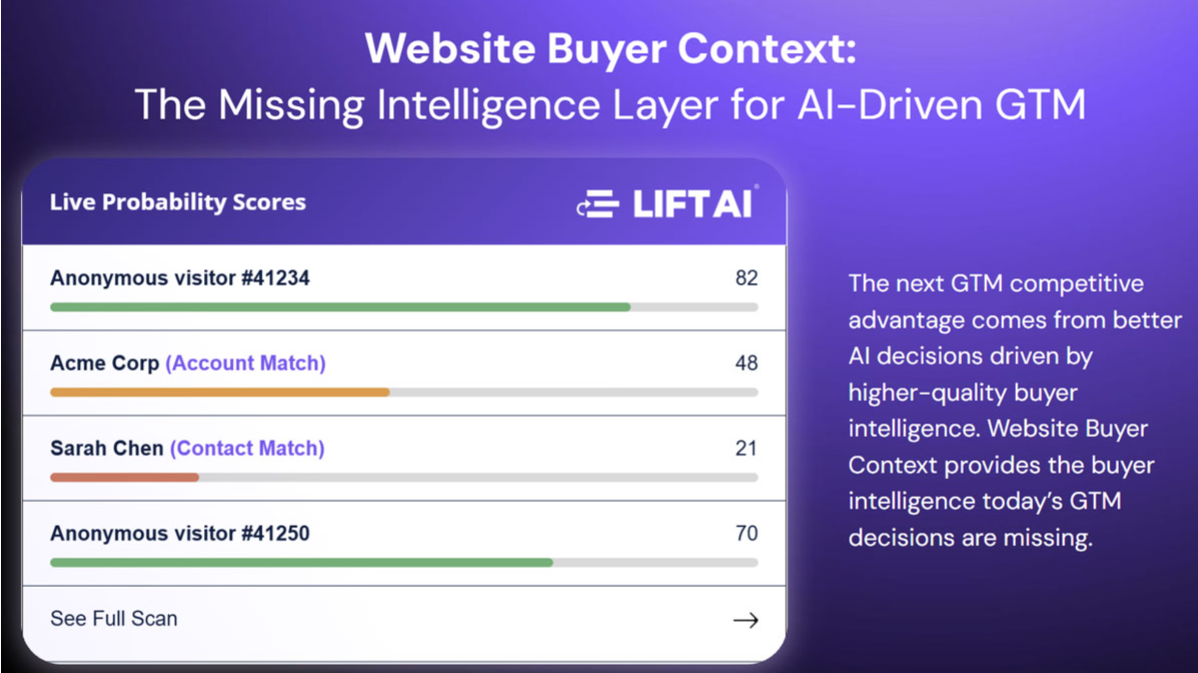
The result is a Buyer Probability Score from 0 to 100 that predicts how likely each website visitor is to become a buyer, based on Lift AI's analysis of all their website behavior. The Score also segments all website visitors into low, mid or high-probability buyer audiences. Every prospect on the website gets a Score, including all anonymous visitors, because identity resolution isn’t needed.
Better GTM Decisions Grow Revenue in Three Ways
Instead of treating every website visitor, lead or prospect the same way, Buyer Probability Scores provide a new high-quality input for determining who to prioritize, how to treat them and where to allocate sales and marketing resources. This gives GTM agents and humans the actionable intelligence they need to prioritize and personalize all downstream sales and marketing motions.
Website Conversions: Using Buyer Probability Scores, AI agents prioritize high-probability buyers for proactive live chat prompts and stronger calls to action. Every website visitor, whether low, mid or high-probability, receives personalized website experiences and messaging based on their Score.
Sales Prioritization: Agents and teams use Buyer Probability Scores to prioritize high-probability prospects for immediate follow-up while directing others into appropriate nurture motions. For example, when high-probability buyers are identified through CRM matching or identity resolution, they can be routed directly to sales reps for personal follow up.
Advertising Optimization: Retargeting ads can be optimized to generate more sales leads by allocating the majority of retargeting budgets to target mid- and high-probability buyers using more channels, more saturation and higher bids. Low-probability visitors still receive ads, but much fewer.
Surfacing Buyers Before They Raise Their Hands
One of the biggest challenges in GTM is that the vast majority of website visitors are completely anonymous, including plenty of sales-ready prospects. As a result, organizations spend enormous resources competing for the small fraction of prospects who raise their hands, while a huge amount of sales-ready pipeline remains hidden within existing website traffic.
Buyer Probability Scores allow GTM agents and humans to identify high-probability visitors before they identify themselves and immediately take action based on their buying probability. This makes it possible to engage sales-ready prospects who are otherwise invisible to traditional GTM systems.
Another major advantage is that GTM teams no longer have to wait for sales-ready prospects to raise their hands. For visitors whose identities are known or resolved (about 30% on average) and who are high-probability buyers, teams can take action to engage them earlier in their evaluation process, creating new pipeline opportunities before they talk to competitors.
Lift AI customer results demonstrate the impact. Boomi used Buyer Probability Scores to prioritize live chat prompts to high-probability anonymous website visitors and generated 23.4x more chat revenue. RealVNC got a 200% increase in sales leads from retargeting ads, without increasing its ad budget, lowering its CPL by 67%.
Known Prospects: Prioritize Who Will Buy, Not Just Who You Know
The problem with website visitors you can identify is you still don’t know how likely they are to buy. Whether prospects fill out a form, are revealed through identity resolution, matched to your CRM or ABM lists, or otherwise raise their hands, known website visitors represent about 30% of most enterprise website traffic. But knowing their identity doesn't tell your agents and sales teams which prospects are most likely to buy.
When you connect Buyer Probability Scores to known prospects, you fundamentally improve sales prioritization and efficiency. Instead of treating every known website visitor the same and guessing which ones are most likely sales-ready, sales teams can now prioritize high-probability buyers for follow-up and focus their time on the prospects most likely to generate pipeline and revenue.
At Payscale, Lift AI added Buyer Probability to every prospect already classified as "Purchase Stage" by their ABM platform. By isolating the smaller group of actual high-probability buyers, they converted prospects in that group into high-quality pipeline at 19x the rate of the original Purchase Stage segment.
At RealVNC, 60% of form fills scored low probability and produced just 8% of form revenue. But the bigger surprise was in their CRM. A total of 1,476 returning contacts who never filled out a form, but scored as high or mid probability, generated 2.3x the revenue of all 9,148 low-probability form fills combined. Justin Wagg, VP of Marketing for RealVNC, said, "Our reps don't need to get faster — they can just stop chasing the wrong people and focus on the right ones."
The end result of using Website Buyer Context is more efficient sales prioritization. By combining prospect identity with Buyer Probability Scores, sales teams can focus their time and personalized follow-up on the prospects most likely to generate pipeline and revenue.
The Three Components of Website Buyer Context
Buyer Probability provides a powerful new input for GTM decision-making, but AI agents and humans also need additional Context to guide how each prospect is treated and engaged. GTM systems also need feedback loops that connect their inputs to revenue outcomes to track, validate and report current performance, and improve future results.
Lift AI provides the Website Buyer Context for this through three integrated components:
- Website Buyer Probability Score™ — Predict. The Score predicts how likely every website visitor is to become a buyer, providing agents and humans with a simple 0-100 input for determining who to prioritize and where to allocate resources.
- Buyer Context Brief — Guide. The Brief adds behavioral Context about each visitor's buying journey to help determine how to treat them. It includes a Buyer Profile, Areas of Focus, Behavioral Trace and Recommended Action.
- Revenue Loop — Prove. Where outcome data is connected, the Revenue Loop grades Buyer Probability against downstream pipeline and revenue outcomes, making Website Buyer Context accountable to actual business performance.
Working together, the Score predicts, the Brief guides and the Revenue Loop proves.
Making GTM Decisions Accountable to Revenue
The most important GTM question - “Did it drive more revenue?” - is also the hardest to answer. Most GTM systems measure and optimize performance using activity-based metrics such as clicks, opens, form fills and MQLs. These metrics are useful, but they don't reliably tell you whether the Context used to make GTM decisions actually contributed to pipeline and revenue.
The Revenue Loop was designed to close that gap by making Website Buyer Context accountable to revenue. Lift AI itself was built on this loop. Its machine learning model was trained by correlating billions of website visits and behavioral patterns with millions of actual sales outcomes, learning which website behaviors predict buyers and revenue.
Every website visitor receives a Buyer Probability Score that helps drive GTM decisions and actions. Where outcome data is connected, the Revenue Loop preserves each visitor's Score at the time a decision is made and grades that prediction against the pipeline and closed revenue that follows.
The Revenue Loop closes the cycle: Probability Scores predict, agents and humans decide and act, and revenue outcomes validate the prediction. That revenue-grounded feedback is the key to improving future GTM decisions and outcomes.
Website Buyer Context: The New AI Advantage
AI has already changed the scale and speed of GTM decision-making. Now, the new competitive question is: How can organizations provide GTM agents and teams with the highest-quality Context to make better decisions at scale?
Identity, Signal and Relationship Context each provide valuable intelligence for GTM decision-making. Bringing these domains together to create a more complete picture of prospects and accounts adds more value. However, none of these domains can reliably, and at scale, predict how likely every website visitor is to become a buyer.
Website Buyer Context adds a unique dimension: the behavioral context needed to determine how likely every website visitor is to buy. That Context has always existed within the website. The challenge has been accessing it, interpreting hundreds of behavioral patterns at scale and turning them into a prediction that GTM systems and teams can actually use.
Lift AI does that with a Website Buyer Probability Score that predicts who is most likely to buy, a Buyer Context Brief that guides how to treat them, and a Revenue Loop that grades that prediction against pipeline and revenue outcomes when outcome data is connected.
Advantages for GTM enterprises don't come from smarter models or more data. They come from higher-quality Context that drives better AI agent and human decisions, more effective actions and better revenue outcomes. The richest source of Buyer Context is on your website, which is why Website Buyer Context is the new AI Advantage for the Agentic Enterprise.
About Lift AI
Lift AI is the Website Buyer Context layer for the GTM stack. Trained on billions of website visits and millions of commission-audited sales outcomes, its machine-learning model predicts how likely every website visitor — known or anonymous — is to buy, with 85%+ proven accuracy. Lift AI delivers that intelligence through the Buyer Probability Score, the Buyer Context Brief and the Revenue Loop directly into the GTM platforms and AI agents companies already use. Customers include Boomi, RealVNC, Okta, Fluke and Intelex. Learn more at https://lift-ai.com
Lift AI
City: San Francisco
Address: One Sansome Street
Website: https://lift-ai.com
Email: dsimpson@lift-ai.com


Comments
Post a Comment