Half Rack vs Full Rack for Home Gyms: How to Choose Strength Training Options
Key Takeaways
- A full rack uses four steel uprights for maximum stability and safety, while a half rack uses two uprights and takes up far less floor space
- Half racks typically cost 25-40% less than comparable full racks, making them a budget-friendly pick for home gym owners
- Full racks allow lifting inside a protective cage with safety bars on all sides, a feature most half racks cannot fully match
- Anchoring any squat rack to the floor is recommended for safety, even for lighter lifters who are not pushing heavy weight
- SOLE Fitness argues that the right choice comes down to available space, lifting goals, and budget rather than one rack being universally better
Choosing the centerpiece of a home gym often comes down to one big decision: half rack or full rack. Both styles let lifters perform squats, bench presses, pull-ups, and a long list of barbell movements, but they differ enough in size, safety features, and price that the choice deserves real thought.
Full Rack or Half Rack: What's the Difference?
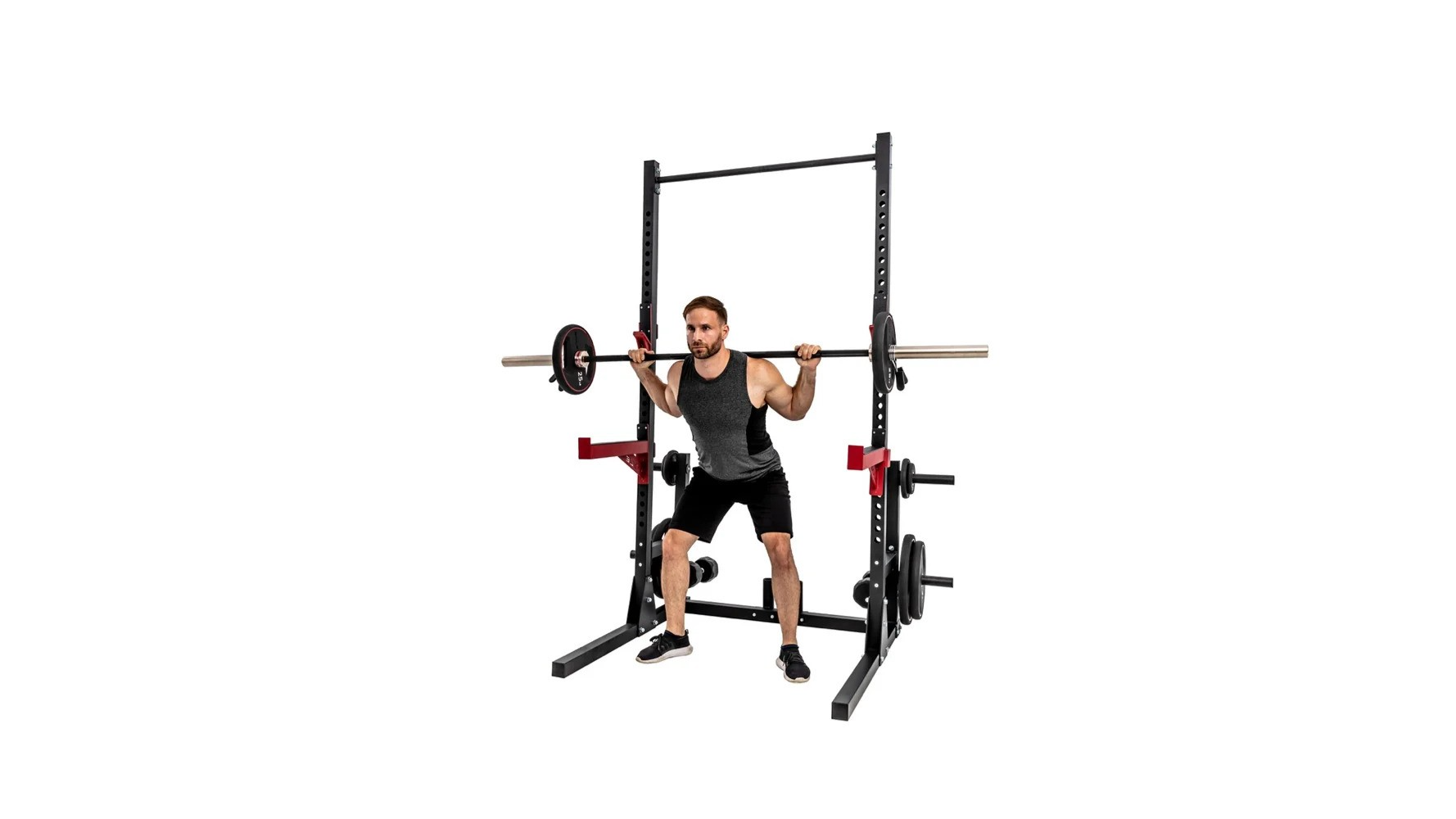
A full rack, sometimes called a power rack or power cage, is built from four heavy-gauge steel upright posts connected at the base, along the midsection, and again at the top. That cage-like frame surrounds the lifter on all sides, which is why full racks are often considered the gold standard for heavy, solo strength training. A half rack trims that design down to two uprights, sometimes with a short second pair of posts behind the main frame for extra support, creating a more open structure that still includes a bar and j-hooks for catching weight.
The core difference shows up in how each rack handles space and protection. A full rack encloses the lifting zone with front and rear posts joined across the top and base, while a half rack typically places the bar supports and safety features on the front of a single upright structure. Both qualify as squat racks capable of handling a wide range of barbell exercises, but the amount of steel, floor space, and built-in safety separates them in meaningful ways.
What a Full Rack Delivers
Strength Advantages: Stability, Safety, and Add-Ons
Full racks earn their reputation through sheer durability. The four-post, cage-style construction accommodates heavier weight capacities and keeps the frame steady even under a loaded barbell, which matters when someone is chasing a personal best and cannot afford a wobbly setup to break concentration. That stability also opens the door to serious add-ons: full racks commonly support plate storage pegs, rack pull bars, pulley systems for lat pulldowns, and other attachments that turn a single station into a nearly complete strength gym.
Safety is where the full rack truly shines. Because safety bars run across the inside of the cage, a lifter can fail a rep and drop the bar forward or backward with a built-in catch system standing by. Even outside the cage, attachable safety arms extend that protection further. For anyone training without a spotter, that 360-degree coverage is a major selling point, especially during heavy compound lifts like squats and bench presses.
Trade-Offs: Bulk, Restriction, and Expense
That same four-post frame that makes a full rack so sturdy also makes it a space hog. A standard power rack needs roughly an 8-by-8-foot footprint, which can be a dealbreaker in a garage or spare room already packed with other equipment. Taller lifters may also find the overhead bars restrictive during presses, and Olympic lifts like the clean, jerk, or snatch that require unobstructed vertical clearance can be awkward or impossible to perform from inside the cage.
Cost is the other major trade-off. Building a four-post frame simply requires more steel than a two-post design, and that material cost gets passed along in the price tag. Heavier packaging also tends to push shipping costs higher, so a full rack of comparable quality to a half rack will almost always cost more to buy and deliver.
What a Half Rack Delivers
Strength Advantages: Space, Freedom, and Price
A half rack's biggest selling point is how little room it demands. With two main uprights instead of four, it occupies a fraction of the floor space a full power rack needs, which makes it a natural fit for garages, basements, or multipurpose rooms where square footage is tight. The open design also allows more freedom of movement. Lifters are not boxed in by horizontal bars overhead, so transitioning from squats to overhead presses or stepping out for lunges happens without ducking around a cage frame, a detail that matters during fast-paced circuit-style training.
Price seals the deal for many home gym owners. Half racks typically cost 25-40% less than comparable full racks, largely because they require less steel and cost less to ship. Many half racks also include a built-in pull-up bar, which adds exercise variety without adding bulk, and some higher-end PRO-style half racks feature thicker steel tubing, extended base supports, and precision-spaced holes for safer progression as strength increases.
Trade-Offs: Lighter Build, Fewer Safety Features
The lighter build that makes a half rack easy to fit into a small room can become a liability under heavy loads. As plates stack up on the bar, a half rack is more prone to wobbling, and in some cases tipping, if it is not secured to the floor. That instability can also creep into a lifter's mindset, since a shaky rack is a distraction nobody wants mid-lift.
Safety coverage is the other area where half racks fall short of their four-post counterparts. Entry-level half racks often skip spotter arms entirely, meaning a failed lift has nowhere to go but the floor. Some models offer attachable safety arms or a secondary set of shorter rear uprights to catch a bar, which helps close the gap, but even then, most half racks provide less complete protection than a full cage. Some experienced lifters actually prefer this open setup, arguing that getting trapped inside a full rack during a failed lift carries its own risk, and that a half rack lets a lifter step back and let the bar drop clear.
Comparing Size, Weight, and Cost
Laid side by side, the practical differences between these two rack styles become easy to outline.
- Full racks typically need around 8 by 8 feet of floor space, use four full-length uprights, weigh more due to the extra steel, and cost more both to purchase and ship.
- Half racks stand about 7 to 8 feet tall but occupy a much smaller footprint, use two uprights (sometimes with a shorter secondary pair), weigh less, and typically run 25 to 40 percent cheaper than a comparable full rack.
Weight capacity tracks closely with these size differences. The added steel in a full rack's four-post frame generally supports heavier loads with more confidence, while a half rack's lighter frame is better suited to moderate loads unless it has been reinforced or anchored down.
Matching a Rack to Your Space, Goals, and Budget
Deciding between these two rack styles really comes down to answering three honest questions: how much floor space is available, how heavy the lifting will get, and what the budget allows. A full rack makes the most sense for lifters with room to spare who are chasing serious strength gains and want the option to add plate storage, pulley attachments, or rack pull bars down the line. It is also the better pick for anyone training alone who wants maximum safety coverage during heavy squats or bench presses.
A half rack tends to be the smarter choice for home gym owners working with a smaller space, a tighter budget, or a training style built around moderate weights and varied movement. New lifters in particular benefit from a half rack's open, predictable layout while they build confidence and technique before progressing to heavier loads.
Anchoring Your Rack for Safety
Regardless of which rack style ends up in the home gym, anchoring it to the floor is a smart safety habit. Even at lighter weights, an unanchored rack carries some risk of tipping or shifting during a lift, and that risk only grows as the plates add up. Bolting a half rack down is especially worthwhile given its lighter frame, but full racks benefit from the same precaution since stability under heavy loads is never guaranteed by weight alone. A few bolts and a stable floor surface go a long way toward making every lift feel secure.
The Right Rack Depends on Your Lifting Goals
Both full racks and half racks earn their place in a well-equipped home gym, and neither is a wrong choice. The decision ultimately hinges on the specific mix of available space, lifting ambitions, and budget that makes sense for a particular household. Lifters with room to spare and a focus on heavy, serious strength work tend to get the most value from a full rack's stability and expandability. Those working with a smaller footprint, a leaner budget, or a moderate lifting routine often find that a half rack covers everything they need without compromise.
Still deciding which option fits best? SOLE Fitness explains that pairing a rack with a few other versatile home gym equipment models like rowers or bikes creates a well-rounded strength and cardio routine that supports long-term fitness goals.
SOLE Fitness
City: Salt Lake City
Address: 56 Exchange Pl.
Website: https://www.soletreadmills.com/


Comments
Post a Comment