What Makes an Underride Truck Crash So Deadly, and Who Pays for It
Key Takeaways
- The danger in an underride crash isn't the impact speed. It's that a passenger car's airbags and crumple zone never get the chance to work, because the trailer strikes the windshield instead of the bumper.
- Federal rules require a guard on the back of most trailers. Nothing similar exists for the sides, and that gap has been under federal review since 2023, with no final rule.
- More than one party can be named in an underride lawsuit, and most interstate carriers must carry at least $750,000 in liability coverage, which is often why identifying every defendant matters.
- A truck's electronic logging data only has to be kept for six months, and guard damage gets repaired even sooner, so evidence has to be locked down almost immediately.
- A Texas jury can wipe out a recovery entirely if it finds the injured driver more than half at fault.
Picture a sedan approaching a stopped tractor-trailer at night on a two-lane Texas highway. The trailer's taillights are dim, maybe half-covered in road grime, and by the time the driver reacts, the car is already sliding beneath the trailer's rear end rather than crashing into it. That's an underride accident, and the size mismatch alone explains a lot: a fully loaded 18-wheeler can weigh up to 80,000 pounds under federal limits, while the sedan weighs roughly 3,500 to 4,500 pounds.
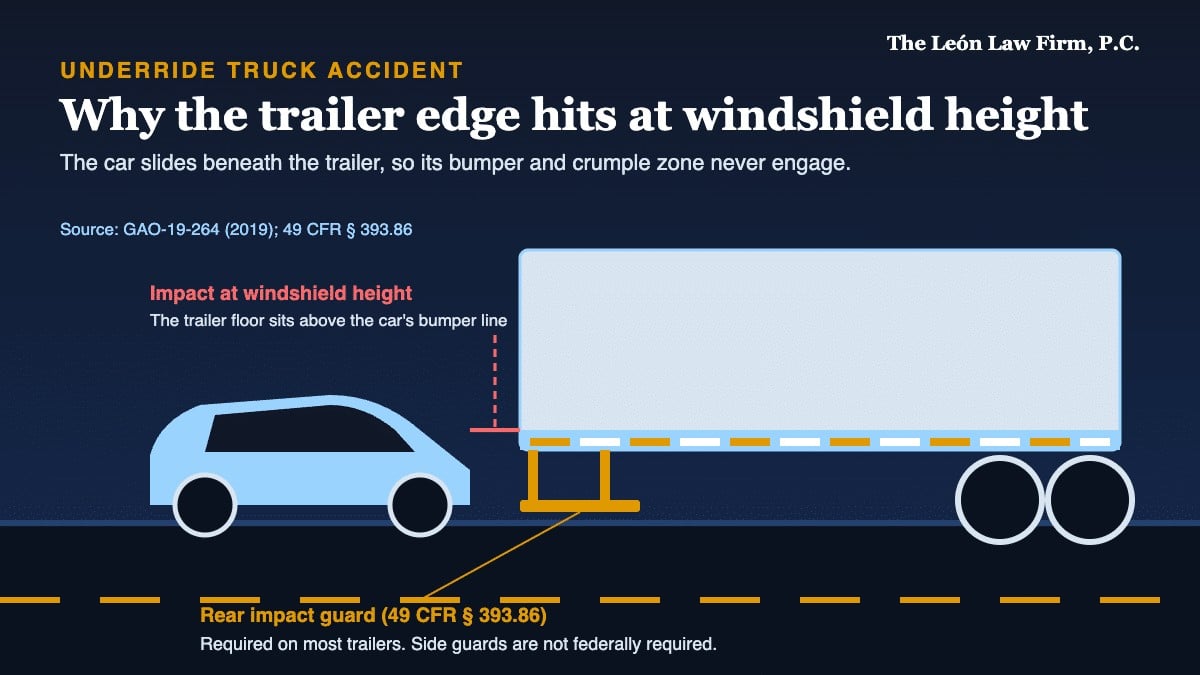
The physics make it worse than a simple size gap would suggest. A trailer's underside sits at roughly windshield height on a passenger car, not bumper height. The car's whole safety system, the crumple zone in front, the airbags, the frame built to fold predictably, is designed around an impact at bumper level. None of it engages when the car goes underneath instead. What hits first is the windshield and the roof, the weakest part of the cabin, at a spot none of the car's crash engineering was built to protect.
The government's own numbers on how often this happens are shaky. A 2019 report from the Government Accountability Office (GAO-19-264) found that standard police crash forms have no box to check for "underride," so a crash gets logged as a generic collision even when the mechanism was entirely different. Nobody knows exactly how many underride crashes that miscounts.
There are really three versions of this crash, and only one of them is fully covered by federal regulation. Rear underride, a car hitting the back of a trailer, is the one federal law addresses directly: 49 CFR Section 393.86 requires a rear impact guard on most trailers operating across state lines. Side underride is different. A car can cross into the gap along a trailer's side during a turn or a lane change and slide under just as completely as it would hitting the rear. No federal safety standard currently requires a guard. NHTSA opened a formal review of a side-guard mandate in 2023. As of early 2026, that review is still working through public comments, which include the trucking industry's own estimate: side guards would add $3,740 or more per trailer, plus a few hundred pounds of extra weight. Front underride, where a car ends up beneath the tractor rather than the trailer, mostly happens as a secondary event in a rear-end pileup.
Figuring out who answers for one of these crashes rarely stops with the driver's insurance card, and in most commercial-truck cases the motor carrier becomes the primary target rather than the driver alone. Texas's respondeat superior doctrine holds an employer responsible for an employee's negligence committed in the course of the job, which is why a carrier's hiring file, training records, and dispatch pressure become fair game once a lawsuit is filed. Beyond that, a carrier can be independently negligent through negligent hiring, negligent training or supervision, or dispatch pressure that pushes a driver to skip required rest. A trailer is sometimes owned by a leasing company separate from whoever was pulling it that day, adding a second defendant with its own insurance policy. If a repair shop patched a bent guard instead of replacing it, that shop can also be named, and in rarer cases, a guard manufacturer answers for one that failed despite passing inspection. More defendants usually means more coverage on the table, since most interstate carriers must carry at least $750,000 in liability insurance under 49 CFR Section 387.9, and a separate truck owner or maintenance contractor typically carries a separate policy on top of that. The León Law Firm's breakdown of who can be held liable after a truck accident walks through how each party is identified in practice, not just in theory.
What usually sits behind these crashes isn't a single dramatic mistake. It's a trailer with a burned-out marker light nobody replaced. A truck stopped on the shoulder with no warning triangle out. A turn made across a highway without quite enough gap in traffic. Driver fatigue tends to be the thread running through several of those at once, and it isn't always a vague accusation: federal hours-of-service rules cap driving at 11 hours after 10 consecutive hours off duty, limit the on-duty window to 14 hours, and require a 30-minute break after 8 cumulative hours behind the wheel. A driver who blew through those limits to meet a delivery window leaves a paper trail that can become direct evidence of negligence. On Texas interstates specifically, there's an added wrinkle. Big rigs often run noticeably slower than the traffic around them at night, and a closing speed that looks manageable from two hundred yards away can close faster than expected.
Texas's fault-splitting rule raises the stakes. A jury divides responsibility by percentage among everyone involved in the crash, including the injured driver, and if that share crosses 50%, the recovery disappears entirely. Take a $500,000 case: a jury assigning the injured driver 20% fault trims it to $400,000. Push that number to 51%, and there's nothing left. That single rule is why a carrier's insurer will fight hard to pin some percentage of blame on the injured person. It's also why proving the trailer's own condition, its lighting, its guard, matters as much as proving what the other driver did.
None of that evidence sits around waiting to be collected. A bent guard gets straightened out at the next scheduled maintenance stop. A burned-out light gets swapped the same week. Federal rules only require carriers to keep electronic logging device records for six months, and a truck's event data recorder, the vehicle's own black box, can be overwritten once it goes back into service. That's the reason The León Law Firm sends a preservation letter to the carrier and its insurer almost immediately in these cases. The goal is simple: get there before the trailer goes back on the road looking like nothing ever happened, and before the six-month clock on the electronic records runs out.
An underride case is expensive to build correctly. Someone has to physically inspect the trailer, pull the electronic data, and often bring in an accident reconstruction expert before the claim even goes anywhere. The León Law Firm has handled cases like these from its Sugar Land office since 1995, on contingency, in English and Spanish. A family can find out whether the case is worth pursuing before spending a dollar.
The León Law Firm, P.C.
City: Sugar Land
Address: 1 Sugar Creek Center Boulevard
Website: https://theleonlawfirm.com


Comments
Post a Comment