The Messed-Up History of 'Left' vs. 'Right', And Who Benefits From the Confusion
Make Sense of Any Political Debate With One Question
Key Takeaways
- "Left" and "right" started as a seating arrangement in 1789 France. The words have been twisted so many times since then that they mean different things to different people.
- Political scientists mostly agree: putting everything on one line from left to right is too simple. It can't explain why fascism and communism both ended up with secret police and prison camps.
- Voter confusion is real and costly. Studies on State ballot measures found that confusing language likely flipped the results of actual elections.
- The confusion isn't always an accident. Some political players benefit when you can't pin down what words actually mean.
- A better test exists: does a system move people toward freedom or toward control? That question works better than any left-right label. Learn more at https://freedomseries.one
---
You've heard it a hundred times. Left means liberal. Right means conservative. Go too far either way and bad things happen.
Simple enough - until you ask a basic question: if fascism and communism are supposed to be opposites, why did both end up with dictators, secret police, and millions of dead citizens?
That question breaks the whole model. And once it breaks, you start to see how much of what passes for political conversation is built on words nobody agrees on.
"Left" and "Right" Started as a Seating Chart
During the French Revolution in 1789, members of the National Assembly sat on the right if they supported the king. They sat on the left if they wanted power in the hands of the people.
That's it. A seating chart became political shorthand. We've been stuck with it for over 230 years.
The problem? Those words now mean completely different things depending on who's talking.
In America, "right-wing" usually means small government and free markets. In parts of Europe, "right-wing" has historically meant nationalist movements that want a *stronger* state. Media, professors, and politicians all use these terms differently.
It's like everyone ordering "coffee," but some people mean espresso, some mean a latte, and some mean hot chocolate. The word sounds the same. The meaning isn't even close.
One Line Can't Hold All of Politics
Most political scientists have said the same thing for decades: a single line from left to right is too simple.
Think of it like rating every movie ever made on one scale: "funny to serious." Where does a funny horror movie go? Where does a serious comedy go? The scale can't handle it.
The political spectrum has the same problem. Libertarians want small government and personal freedom. Authoritarians want big government and tight control. The left-right line forces both into the same row. Wildly different ideas end up side by side just because they share one trait.
Some thinkers tried to fix this by bending the line into a circle, where the far left and far right curve around and meet at the bottom: authoritarianism. Both fascism and communism land in the same spot. Because in practice, that's exactly where they both end up.
Confused Voters Cast Wrong Votes
This goes way beyond college classrooms. It hits the ballot box.
Studies on state ballot measures found something alarming: when proposals are written in confusing, legalistic language, voters frequently vote the opposite of what they actually want. People who strongly opposed a measure accidentally voted "Yes" because the wording was designed to mislead.
Their votes directly contradicted their own values. A complete failure of the system.
There's a deeper problem, too. Research in political psychology shows most people don't pick their beliefs first and then join a team. They join a team first, based on family, friends, or one hot-button issue, and then absorb that team's entire platform.
Political labels work more like sports jerseys than mission statements. Many voters can't fully explain what their "side" actually stands for.
Someone Profits from Your Confusion
If the definitions are this broken, why hasn't anyone fixed them?
Partly because language shifts on its own. Nobody controls it.
But partly because the confusion is useful.
When "socialism" means five different things to five different people, an honest public conversation about it becomes impossible. When "fascism" gets thrown at anyone the speaker dislikes, the word loses all meaning - and with it, the ability to spot real authoritarian behavior.
Fuzzy definitions also make it easy to move the goalposts. A policy can be called "moderate" or "extreme" depending on which version of left and right someone is using that week. Without a stable measuring stick, you can't track these shifts.
Those with the loudest megaphones and the sharpest messaging hold a built-in advantage over people trying to reason through contradictory labels. The confusion doesn't help ordinary citizens. It helps those best positioned to fill the gap with their own story.
A Better Measuring Stick: Freedom vs. Control
Forget about picking a better spot on the left-right line. The line itself is the problem.
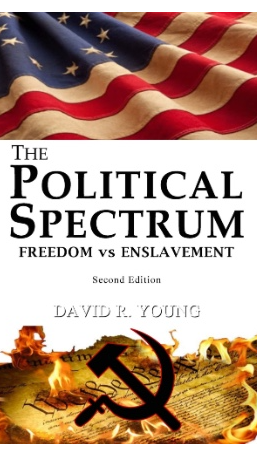
David R. Young ran into this wall while researching how political systems actually work. What he found was a field full of contradictory, incomplete, and often partisan explanations. That research led to the award-winning book *The Political Spectrum: Freedom vs. Enslavement*, the first volume in the Freedom vs. Enslavement series.
The framework is straightforward. Instead of asking "is this left or right?" - a question with no stable answer - ask: does this system give people more freedom and responsibility, or push them toward dependence and control?
That question works on any policy, any party, any system. And it gives you a consistent result every time.
What This Looks Like in Practice
Line up major systems on a freedom-to-control axis and the picture gets much clearer:
- Constitutional republics sit near the freedom end, built to protect individual rights from government overreach.
- Social democracies sit in the middle, expanding government services while keeping civil liberties, but shifting responsibility from the person to the institution.
- Socialism moves further toward collective control, with economic decisions made centrally and individual economic freedom shrinking.
- Fascism and communism both sit at the control end. Despite being called "opposites" on the old spectrum, both crush individual freedom in practice. They differ mainly in rhetoric and who holds the reins.
This map shows what the traditional spectrum hides. Societies under extreme pressure don't always swing neatly from one end to the other. They slide toward control, regardless of which flag that control waves.
You Get to Decide - But Only If You Can See Clearly
Political labels will keep shifting. Parties will keep rebranding. Media framing will keep changing.
None of that has to throw you off, if you have a stable standard to measure against.
The freedom axis gives you that standard. It doesn't require loyalty to any party. It asks one question, applied consistently: is this moving toward freedom and personal responsibility, or toward dependence and control?
When you can't define the terms being used to persuade you, you're easy to lead. When you can define them clearly, without leaning on tribal shortcuts, you become much harder to manipulate.
That outcome belongs to no party. It belongs to free people.
For a closer look at how political systems map to freedom and control - and what that means for your everyday life - visit the Freedome Series website (https://freedomseries.one) home of David R. Young's Freedom vs. Enslavement series.
David R Young
City: Clearwater
Address: Clearwater
Website: https://freedomseries.one
Phone: +1 727 215 0628


Comments
Post a Comment