RS1 Putter's Forward Axis Weighting: Plain Physics vs LAB Zero Torque
Key Takeaways
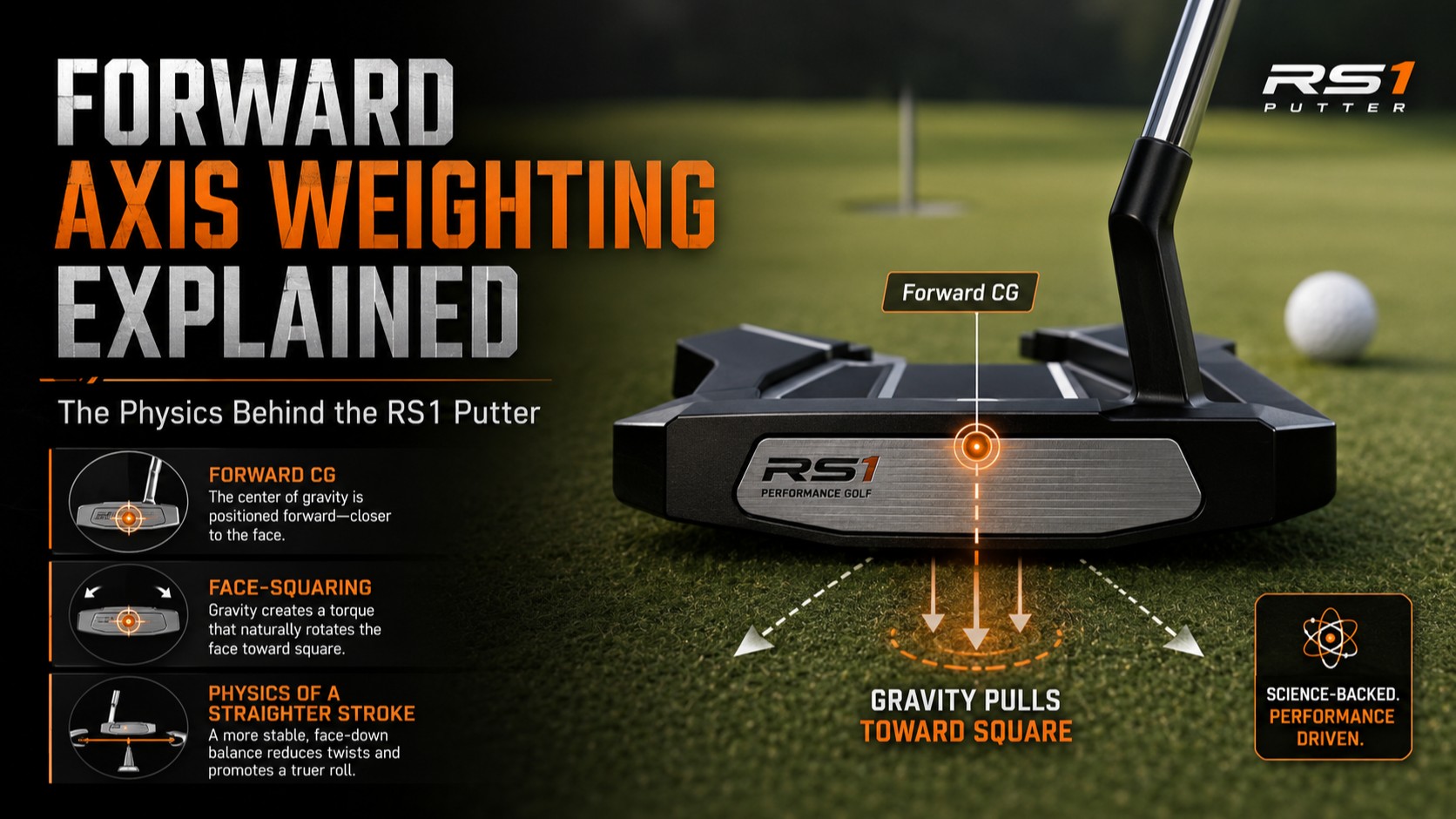
- Forward Axis Weighting in the Performance Golf RS1 concentrates over 75% of its 360-gram head weight in the front 25% of the clubhead, pulling the center of gravity forward of the shaft to actively pull the face toward square
- LAB Golf's Zero Torque putters, including the DF3, place the center of gravity directly on the shaft axis so the face has no gravitational pull in either direction, offering passive neutrality instead of active correction
- The RS1's active correction tends to show up most on short putts inside 10 feet, where face angle mistakes turn into missed cups fastest
- Choosing between active correction and passive neutrality comes down to whether a golfer's stroke has a directional tendency or is already technically sound
- Independent testers have reported measurable gains in face angle consistency with the RS1, though matching the technology to stroke type still matters more than marketing claims
Two putters, two different theories about what causes missed putts. The Performance Golf RS1 and LAB Golf's Zero Torque putters, like the DF3, both aim for a squarer face at impact, but they arrive there through opposite physical approaches. One actively pulls the face back to square using gravity. The other simply refuses to let the face rotate at all. Understanding the difference matters more than picking a side, since the right choice depends entirely on what a golfer's stroke already does.
Two Ways to Fix Your Face Angle
Every putter design answers the same underlying question: what happens to the face when the hands introduce a little rotation mid-stroke? Conventional putters simply pass along whatever the hands do, neither helping nor hurting. Forward Axis Weighting and Zero Torque both aim to improve on that baseline, but they take opposite paths. One creates an active correction that works against face rotation. The other removes rotational tendency altogether, leaving the face passively neutral. Fairway Tips and News has broken down the physics behind Forward Axis Weighting in detail, and that groundwork is worth reading before comparing it to LAB Golf's approach.
Why Face Angle Wins or Loses Putts
Face angle at impact is the single biggest factor in where a putt starts. Independent putting-analysis research indicates that a putter face landing just two degrees open at impact on a ten-foot putt can miss by roughly four inches to the side - nearly the width of the cup itself. That is why so much putter engineering over the last decade has focused on controlling face angle rather than chasing distance control or feel. Small, invisible rotation errors during the stroke carry outsized consequences on the green, and both Forward Axis Weighting and Zero Torque exist specifically to shrink that error.
How Forward Axis Weighting Squares the Face
Concentrated Mass Pulls the Face Toward Square
The RS1 places over 75% of its 360-gram head weight in the front 25% of the clubhead, pushing the center of gravity well forward of the shaft axis. Soled on the ground, that heavy front section wants to rotate downward toward its lowest, most stable position, similar to how a hammer falls head-first when dropped. That lowest position lines up with the face being square. During the stroke, this creates a constant, gentle pull back toward square whenever the hands introduce rotation, working like a small pendulum correcting itself mid-swing.
Why Short Putts Benefit Most
Short putts have compact stroke arcs, giving the corrective pull more relative influence over the whole motion. On putts inside 10 feet, the face angle at impact ends up shaped largely by the head's natural gravitational position rather than by small technical flaws in the stroke. This is why golfers trying the RS1 often notice the biggest difference in that short range, where face angle errors matter most and where a few saved strokes per round add up quickly.
How Zero Torque Removes Rotation Entirely
CG on the Shaft Axis Eliminates Torque
LAB Golf's Lie Angle Balancing, used in putters like the DF3, takes the opposite approach. Instead of shifting weight forward, it positions the center of gravity directly on the shaft axis. With no offset mass pulling in any direction, no torque is generated during the stroke at all. The face has no tendency to open or close on its own.
Passive Neutrality vs Active Correction
This creates what is best described as passive neutrality. The putter does not fight rotation, and it does not correct it either. Whatever the stroke produces, the face faithfully reflects it. This stands in clear contrast to the RS1's active correction, where gravity constantly nudges the face back toward square. Neither approach works better for every golfer; each simply solves a different problem for a different stroke.
Matching the Technology to Your Stroke
Golfers Suited to Active Correction
Golfers with a known directional tendency, such as consistently leaving putts open to the right, tend to benefit most from active correction. The RS1's forward-weighted design works directly against that kind of systematic bias, offering a built-in counterbalance that does not rely on conscious hand adjustments during the stroke.
Golfers Suited to Passive Neutrality
Golfers with a technically sound, well-grooved stroke who deliver the face square on their own often prefer passive neutrality. For these players, an actively corrective putter can feel like it is working against a stroke that does not need help. LAB Golf's Zero Torque design lets that kind of stroke play out without outside influence, which some low-handicap players value more than a correction they do not need.
What Independent Testing Reveals
Independent equipment reviews from outlets such as Plugged In Golf and Breaking Eighty have reported measurable improvement in face angle consistency among testers using the RS1, supporting the idea that concentrated forward mass does meaningfully influence face control during the stroke. Formal academic research directly comparing Forward Axis Weighting to Zero Torque remains limited, but the physics behind both designs are straightforward and can be verified independently rather than taken purely on faith. Some LAB Golf testers have also noted a short adjustment period getting used to a completely neutral face, which is worth factoring in before switching putter philosophies entirely.
Face Control Comes Down to Physics, Not Marketing
Both technologies are legitimate answers to the same core problem, built on opposite assumptions about what a putting stroke needs. Fairway Tips and News reports that the RS1 is fully USGA conforming and comes in Standard ($399), Plus ($429), and Founder's Edition ($449) configurations, backed by a 365-day money-back guarantee that makes testing the technology relatively low-risk. Whether active correction or passive neutrality fits better ultimately depends on an honest look at what a stroke already does under pressure, not on which marketing story sounds more convincing.
For golfers unsure which camp they fall into, spending time comparing forward axis weighting putters against a stroke's actual tendencies is a smarter first step than guessing based on price or looks alone.
Fairway Tips and News
City: Pleasant Prairie
Address: 8767 3rd Avenue
Website: https://www.golfersparidise.com/


Comments
Post a Comment