Near Infrared Sauna Studios for In-Home Hot Exercise Training
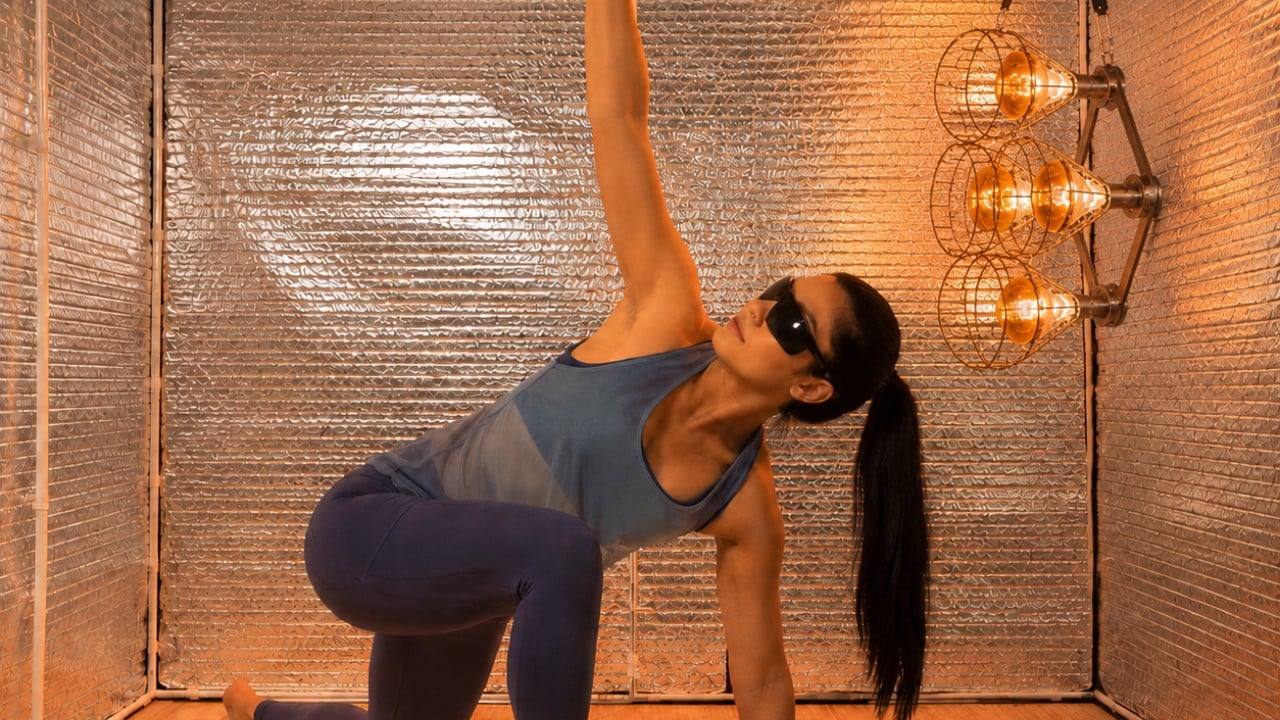
When heat meets movement
Hot yoga studios have combined movement and elevated temperatures for decades. A near infrared sauna studio built for exercise applies the same broad idea, moving in a heated environment, but creates that environment differently. A hot yoga room heats the surrounding air, often to about 105°F, and your body warms by contact with that air and by the heat exercise generates. An infrared exercise space adds radiant energy: incandescent lamps emit light and infrared that the body and the surfaces around it absorb and convert to heat, while the insulated enclosure warms as the session goes on. Distance from the lamps, enclosure size, insulation, exercise intensity and session length all shape the experience.
What a home near infrared sauna studio is
A studio for exercise needs more usable space than a seated sauna. The Sauna Fix® Home Near Infrared Hot Exercise Studio pairs one four-bulb incandescent lamp with the long Hot Exercise Radiant Sauna Tent. The full enclosure measures about 94.5 inches long, 78 inches high and 35.43 inches wide, which is room to stand, kneel, sit or lie down rather than hold one seated position. The tent uses R-15 insulated panels to hold heat, and its interior reconfigures: a middle partition makes a smaller standing chamber when the full length is not needed, and a ceiling partition lowers the chamber to about 60 inches for seated sessions. One four-bulb lamp is the base configuration; an optional second lamp adds radiant coverage and higher heat when more of the enclosure is in use.
How the incandescent system works
The lamp uses incandescent bulbs rather than narrow-band LEDs. The bulbs produce a continuous spectrum from about 550 to 3,000 nanometers, beginning in visible red and running through near infrared into mid infrared, together with substantial radiant heat. That is a different device from an LED red-light panel, which concentrates its output in a few selected bands and gives off very little heat. The fixture is simple electrically: no LED drivers, no Bluetooth controls and no app electronics at the light, just incandescent lamps on grounded, shielded wiring. For someone comparing heated-training options at home, this is a heated movement enclosure built around broad-spectrum radiant lamps, not a light panel placed in an ordinary exercise room.
Which exercises fit a heated studio
Heat already raises the challenge of any activity, so a sauna session does not need to duplicate a hard gym workout. The better fit is deliberate, technically controlled movement that can stop the instant the heat becomes uncomfortable: hot yoga and gentle flows, stretching, mobility drills, spinal fitness floor exercises, walking or marching in place, breathwork and easy recovery movement. Light resistance bands work when they are attached to secure anchors and used from a stable position. What does not fit matters just as much: maximal intervals, sprint-style conditioning, heavy lifting, explosive movements and exercises that need difficult balance corrections. The sauna exercise menu lists movements that suit the space.
Why exercise feels harder in heat
Working muscles generate heat, and the body has to move it to the skin and shed it into the environment. Inside a heated enclosure that job gets harder. Sweating increases, heart rate rises faster for the same workload, and a familiar exercise feels more demanding than it would in a cool room. That does not automatically mean the exercise has become a better strength or cardiovascular stimulus; part of the added difficulty is thermoregulation. A slow sequence of squats, mobility work or marching in place may already be plenty once radiant heat and a warm enclosure are added, so there is little reason to compensate by going faster or heavier. Sweating should also be read for what it is: a cooling mechanism that costs fluid. A lower number on the scale right after a hot session reflects water loss, not body-fat loss.
How to exercise safely in the heat
Heated exercise stays conservative, stable and symptom-limited. Begin with movements you already perform correctly rather than learning new ones in a hot space. Stop and begin cooling down at dizziness, nausea, unusual weakness, confusion, difficulty breathing, a racing or irregular heartbeat, loss of coordination or anything else that feels abnormal. Hydrate before the session, keep fluids within reach and replace what you lose; heavy sweating is not the objective. Anyone who is pregnant, has a heart, kidney or blood-pressure condition, has a history of fainting or poor heat tolerance, or takes medication that affects hydration, circulation or temperature regulation should talk with a healthcare professional before starting heated exercise. Keep the enclosure easy to exit, and never set it up so that moving away from the lamp is awkward.
Building a sustainable hot exercise routine
A useful home practice does not require making every session longer, hotter or harder. Start with a moderate temperature, a short exposure and familiar low-intensity movements, and change one variable at a time as you learn how you respond. The adjustable enclosure makes different session styles possible: the full tent when floor space matters, the middle partition for a compact standing area, the lowered ceiling for a seated sauna. Some sessions are gentle yoga or spinal fitness work; others are mobility, stretching, marching or breathwork; on another day the studio is simply a seated sauna. The principle is the same throughout: heat is one more training variable, to be controlled deliberately rather than maximized.
Creatrix Solutions designs and sells the Sauna Fix® near infrared sauna and the Home Near Infrared Hot Exercise Studio bundle. This article is educational and is not medical advice.
Creatrix Solutions
City: Kennewick
Address: 214 E Albany Avenue
Website: https://creatrixsolutions.com
Phone: +1-866-686-5605
Email: contact@creatrixsolutions.com


Comments
Post a Comment