Local Search's Future: Google, Maps, Social & AI Naming Businesses
Key Takeaways
- Local search is shifting from ranking in a list to being named directly by AI Overviews, Google Maps' Ask Maps, voice assistants, and social platforms
- Google still matters most, with 52% of consumers starting local searches there and 71% touching Google at some point in their search process, per BrightLocal's research
- Three-quarters of consumers use more than one platform during a single local search, so single-channel optimization leaves businesses invisible on the other stops
- Five specific signals, from matching business information everywhere to website content that confirms profile claims, determine whether AI tools name a business
- The article breaks down exactly what Google Business Profile categories, reviews, and photos need to look like to get chosen instead of skipped
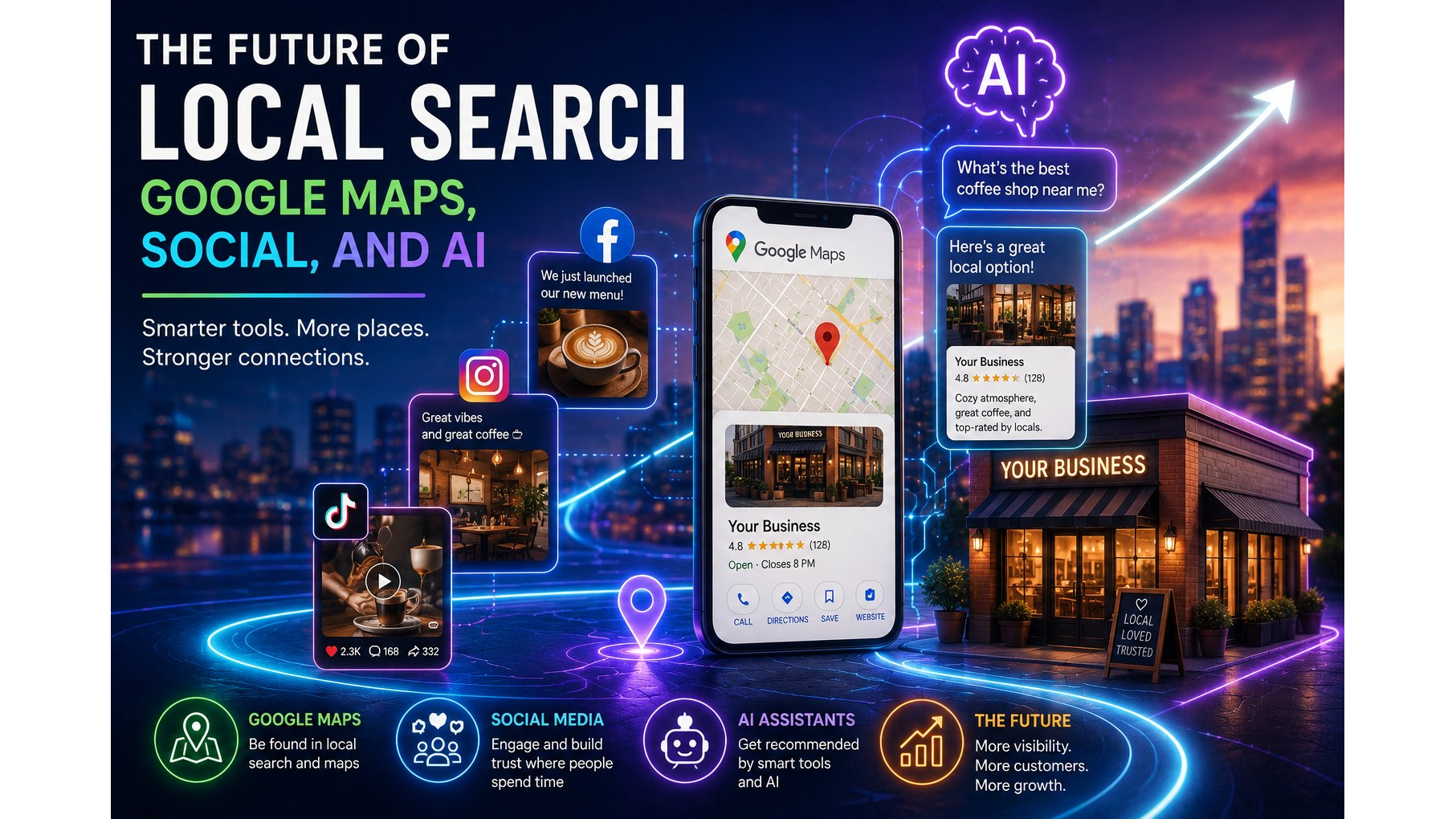
Local search used to be a simple game: rank higher, get more clicks. That game is ending. AI Overviews, Google Maps, social platforms, and voice assistants are now naming a small handful of businesses directly, and everyone left off that short list disappears from the conversation entirely.
71% Still Touch Google, BrightLocal Study Finds
BrightLocal's consumer search behavior study found that 52% of consumers started their local search on Google Search in 2026. Google Maps and social media each captured 9% of first touches, and AI tools accounted for 8%, a share that barely existed two years earlier.
The more telling number is what happens after that first tap. BrightLocal's Local Consumer Review Survey 2026 found that regardless of where a search begins, 71% of consumers touched Google at some point before making a decision. Google has become a verification layer as much as a discovery tool. Someone finds a business name on Instagram or through a friend's recommendation, then searches Google to confirm hours, read reviews, and check photos before calling. Profit Acuity has been tracking this shift closely, noting that an incomplete or outdated Google Business Profile can quietly cost customers who already found a business somewhere else.
This is the piece most business owners miss. Winning the first click matters less than surviving the verification step that almost always follows.
Google's AI Overviews Are Naming Businesses, Not Ranking Them
AI Overviews, the AI-generated summaries appearing above traditional search results, are showing up for local service searches and "best near me" queries with increasing frequency. Instead of a ranked list of ten links, these summaries generate an answer that names two or three businesses specifically.
Being the fourth-best option no longer earns a consolation mention. The AI reads Google Business Profile completeness, review volume and recency, website content that confirms profile claims, photo activity, and third-party mentions across directories and news sites, then synthesizes all of it into a short, specific answer. Relevance now depends on how clearly a business communicates what it does and how consistently that story is confirmed across multiple sources, rather than on backlink count or domain authority alone. That is good news for smaller businesses willing to put in the work.
Social Media Now Functions as a Discovery Engine
Facebook, Instagram, and TikTok have converged into discovery engines with a social layer built on top. Facebook's local search pulls from business page information and on-page reviews. Instagram surfaces location-tagged posts when someone searches a neighborhood. TikTok search, especially among younger users, now rivals Google for restaurant and entertainment discovery.
Google has stayed vague about exactly how social activity influences its rankings, but the pattern is consistent: businesses posting regularly and tagging locations tend to appear more reliably in local results than identical businesses with no social presence. Follower count matters far less than consistency. A page with a few hundred followers posting several times a week regularly outperforms a page with ten times the following that has gone quiet.
AI Assistants and Voice Search Pick One Winner
Asking Siri, ChatGPT, or Perplexity to find a local business triggers a completely different process than a Google search. These assistants do not crawl and rank in real time; they synthesize information from web content, directories, review platforms, and structured data to generate a single confident answer.
Siri routes most local queries to Apple Maps, which pulls from Yelp and Foursquare rather than Google, so a business optimized only for Google can be invisible to Siri entirely. Local AI Registry's scoring data shows that 73% of local businesses are never recommended by AI assistants. Voice search makes this even starker: a smart speaker asked to find a same-day HVAC repair company gives back one name, not three. Coming in second in a voice query means not appearing in it.
The pattern across every AI platform is agreement. When a business name, address, phone number, and category match consistently across a website, Google Business Profile, Yelp, Apple Maps, and directories, AI systems gain confidence and surface that business. Conflicting details push the AI toward a competitor it can verify more easily.
The Five Signals That Get You Named
1. Match Your Name, Address and Phone Everywhere
Start with an audit. Search the business name and check every result: Yelp, Apple Maps, Bing Places, the Facebook business page, Foursquare, and any industry directories. A mismatched suite number or an old phone number on just one of these sites creates ambiguity that AI systems read as a reason to look elsewhere.
2. Choose Specific Categories and List Every Service
Google offers thousands of business categories, yet most businesses settle for one generic option. A general contractor who adds "Kitchen Remodeler" and "Bathroom Remodeler" as secondary categories becomes matchable to far more specific AI queries. The Services section deserves the same attention, filled out in the plain language customers actually use, since that text gets pulled directly into AI-generated summaries and Ask Maps responses.
3. Win With Recent, Detailed Reviews
AI systems read the words inside a review, not just the star rating. A business with 15 reviews from the last 90 days can outperform one with 300 older reviews, because recency signals that the business is still active and worth recommending. Reviews mentioning specific services, situations, and outcomes give AI concrete details it can match against precise search questions.
4. Keep Photos and Posts Fresh
Consistent new photos and weekly posts on a Google Business Profile signal an active business. Photos showing completed work, real locations, and real team members carry more weight than stock images, and customer-uploaded photos tend to matter more than owner-uploaded ones.
5. Make Your Website Confirm Your Profile
When a Google Business Profile lists a service the website never mentions, AI sees a conflict it cannot resolve confidently. Every service listed on a profile should have a matching page or section on the website, along with the business name, address, and phone number in plain text rather than buried inside an image.
Why Multi-Channel Search Changes Everything, Per BrightLocal
The most disruptive finding from the BrightLocal study is that 75% of consumers used more than one platform during a single search for a local business. The process now loops between platforms: starting on Google, checking Maps for distance, reading reviews for specific mentions, then verifying legitimacy on Facebook before finally calling.
A business ranked second on Google but backed by an active, recently updated Facebook page often wins the call over a business ranked first with a stagnant social presence. The practical response is not managing six platforms constantly. Staying accurately represented everywhere matters more: a Google Business Profile updated weekly, a Facebook page updated at least monthly, and quarterly audits of Yelp and Apple Maps listings.
Getting Named Beats Getting Ranked
Ranking measures position. Getting named measures selection, and AI systems make choices rather than assign spots on a list. The businesses that show up in AI Overviews, Ask Maps answers, and voice search results share the same traits: consistent information across every platform, specific categories, fresh reviews and photos, and a website that backs up every claim made elsewhere.
None of this requires a massive budget or a specialized team, just consistent attention to the details that AI systems use to decide who deserves the confidence of a direct recommendation. For a practical starting point, reviewing an authority content system built for local visibility can help clarify which signals to fix first.
Profit Acuity
City: Center Valley
Address: Concord Drive
Website: https://profitacuity.com/authority-content-system/
Phone: +1 877 624 1229


Comments
Post a Comment