How to Get My Business Cited by ChatGPT and AI Search Tools
Key Takeaways
- Getting noticed by AI search tools such as ChatGPT, Google AI Overviews, and Microsoft Copilot depends on being retrievable, cited, and recommended, not just ranked in traditional search results
- AI tools rely on live-web retrieval, meaning a page must first be crawlable and indexed before it can ever be chosen as evidence for an answer
- Original, first-hand evidence and recently updated content are far more likely to earn a citation than generic, recycled copy, though the exact freshness advantage varies by platform
- Consistent business details across a website, Google Business Profile, and third-party listings help AI systems recommend a brand with confidence
- Measuring AI visibility now means tracking citations and mentions alongside traditional clicks and rankings
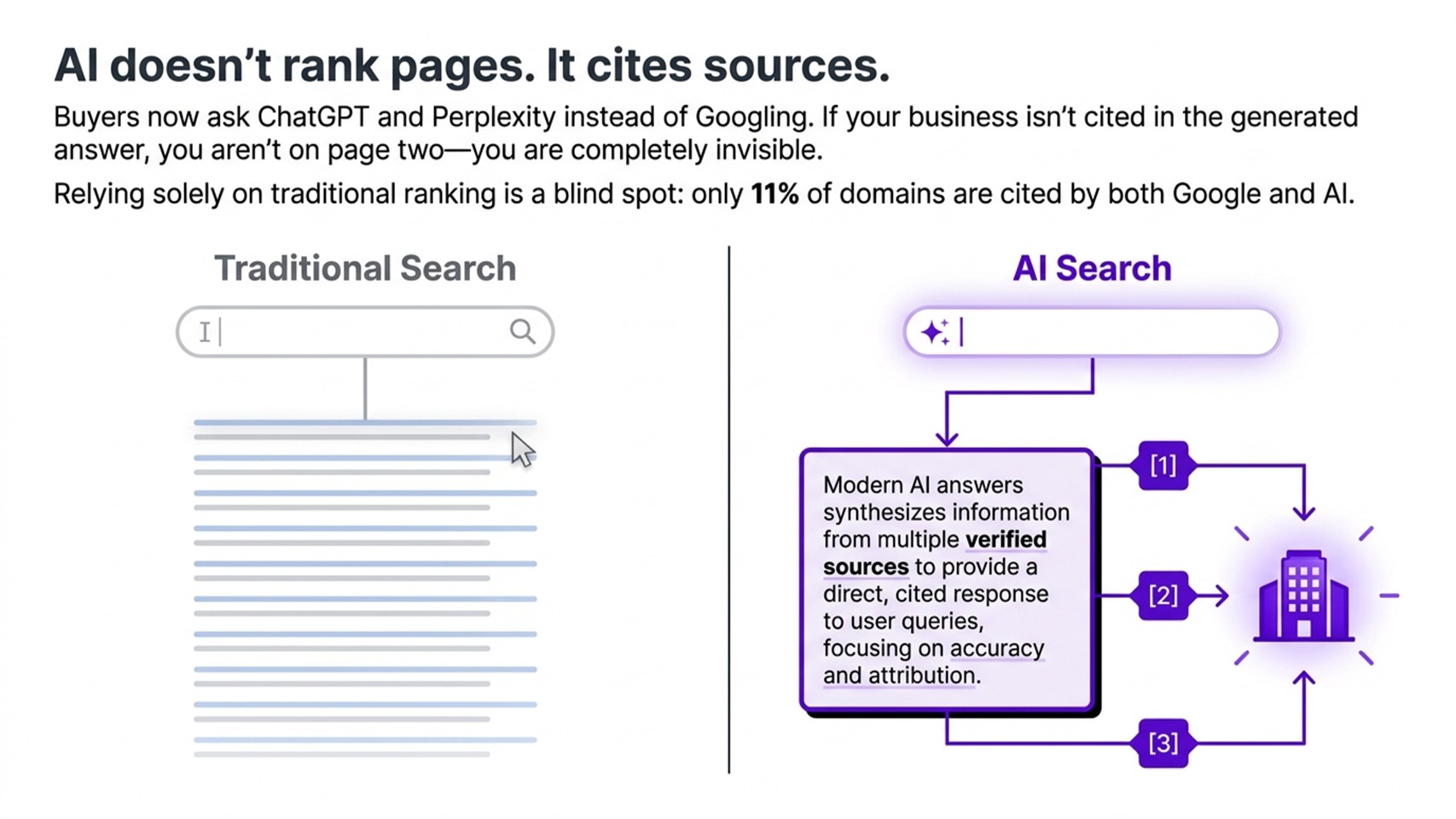
Search has quietly split into two systems. One still sends a list of blue links; the other reads the web, picks out the best evidence, and writes an answer on the spot. For any business owner watching customer enquiries shift to chatbots and AI-powered search boxes, understanding that second system has become essential.
Why AI Search Changes Everything
Traditional search engines rank pages and let a person choose which one to click. AI search tools such as ChatGPT, Google's AI Overviews, and Microsoft Copilot behave differently: they read across many sources, pull out useful facts, and generate a single answer, sometimes with links attached and sometimes without. This is often called retrieval-augmented generation, and it means a business no longer needs to win the top spot on a results page. It needs to be one of the sources an AI system trusts enough to use.
That shift matters because ranking well in Google does not guarantee a mention in an AI-generated answer. ChatGPT has also become the third most popular source of local business recommendations, following Google and Facebook. West Pro Media Services works with business owners adapting to this change, helping them build a digital presence that AI search systems can find, trust, and recommend.
The practical challenge is that AI search does not reward the same things traditional SEO always has. A page can rank well in Google and still be ignored by an AI system if it lacks originality, freshness, or clear evidence. This is why business owners need to think about three separate outcomes rather than one single ranking goal.
Three Outcomes: Retrieved, Cited, Recommended
Being noticed by AI search happens in stages, and a business can succeed at one stage while stalling at another. Understanding the difference explains why some websites appear constantly in AI answers while others, even well-established ones, seem invisible.
Retrievable: Can AI Even Find You?
Retrievability is the foundation. It simply means an AI system or search platform can crawl, index, and read a page in the first place. Without this, nothing else matters, because a page that cannot be accessed cannot be evidence for anything.
Technical SEO sits at the heart of this stage. If a website blocks the wrong bots, hides content behind heavy scripts, or buries key pages where no internal links lead, it may be entirely excluded from AI-generated responses, regardless of how good the content actually is.
Cited: Chosen as Evidence
Once a page is retrievable, the next hurdle is being selected as supporting evidence within an AI-generated answer. This depends on relevance to the question asked, the quality and specificity of the source, how recently it was updated, and whether it says something genuinely original rather than repeating what dozens of other pages already say.
Content that leads with a clear answer, backs it up with real expertise, and uses sensible structure such as headings and question-and-answer formats shows a strong link with being cited more often. Product-related material, including specifications, comparisons, and "best of" style guides, makes up a large share of the sources AI search engines actually reference.
Recommended: Named as a Trusted Option
The final and most valuable outcome is being named directly as a trustworthy option, not merely cited as a footnote. This is where a business moves from being a source of information to being an actual recommendation.
Recommendation relies far less on website content and far more on entity strength: how well-known and verifiable the business is across the wider web. Reviews, consistent local listings, independent mentions, and real-world reputation all feed into whether an AI system feels confident enough to say "this business is a good choice."
Building Technical Eligibility First
None of the later stages matter if the technical basics are missing. Google has stated that, for a page to appear as a supporting link in AI Overviews or AI Mode, it must already be indexed and eligible to appear in standard Google Search with a snippet. There is no separate, secret technical requirement for AI visibility.
Crawlability, Indexation and Robots Rules
Getting the basics right starts with a straightforward audit. Business owners, or whoever manages their website, should check that important pages are not accidentally blocked by robots.txt rules, "noindex" tags, login walls, or overly aggressive security settings. Content also needs to exist as readable text rather than locked inside images, PDFs, or scripts that never fully load for a crawler.
- Confirm key service and information pages are indexable and free from accidental blocks
- Make sure important content appears as crawlable text, not just images or sliders
- Check canonical URLs, sitemaps, and internal links so pages connect logically
- Use clear page titles and headings so the subject of each page is obvious
- Allow relevant search and AI bots where this suits the business's data policy
Keeping Business Profiles Accurate
Beyond the website itself, Google Business Profile and, where relevant, Merchant Center listings play a direct role in AI-enabled search experiences. These profiles need current, accurate information: correct opening hours, services offered, address, and contact details. An out-of-date profile can quietly undo months of good content work, because AI systems checking for a reliable local answer will simply move on to a competitor whose details are current.
Content That Earns a Citation
Technical eligibility opens the door. Content quality decides whether a business walks through it. AI systems are designed to prioritise authoritative material that directly answers a specific, valuable question, rather than material that vaguely circles a topic.
Original Evidence Over Generic Copy
Generic, recycled content rarely earns a citation, because AI systems have no shortage of similar pages to choose from already. What stands out is content built on genuine, first-hand evidence: case studies with real detail, original data, proprietary methods, or honest comparisons that explain where a business is, and is not, the right fit.
A short generic post explaining "what is a loft conversion" will struggle to compete, but a detailed account of how a specific planning approval was secured in a particular local conservation area, complete with real constraints and lessons learned, gives an AI system something worth citing. This kind of specific, people-first content is exactly what current guidance from Google points to, favouring genuinely helpful material over content that could have been written by anyone, anywhere.
Freshness and Fast-Ageing Answers
AI systems are built to retrieve current, reliable information, which makes freshness a real advantage, though the size of that advantage varies by study and by platform. Ahrefs found that content under 30 days old earned around 3.2 times more AI citations than older pages. ChatGPT in particular tends to favour newer pages, while Google's AI Overviews are more willing to cite older material.
This does not mean rewriting everything every few weeks. It means identifying time-sensitive pages, such as pricing, regulations, or service details, and reviewing them regularly so an AI system is not citing outdated information that could embarrass the business or mislead a customer.
Entity Strength and Local Trust Signals
Recommendation, the most valuable of the three outcomes, depends heavily on how clearly an AI system can identify a business as a real, consistent, trustworthy entity. This goes well beyond anything written on the company's own website.
Consistent Brand Data Across the Web
AI tools need to resolve whether a brand is genuine, relevant, and reliable, and they do this by checking whether information about the business matches up everywhere it appears. The business name, address, phone number, and service details should read consistently across the website, Google Business Profile, industry directories, and social profiles. Mismatched details, an old phone number here, a slightly different business name there, can quietly undermine an AI system's confidence, even when nothing is technically wrong.
- Standardise the exact business name, address, and phone number everywhere it appears online
- Keep services, specialisms, and locations described consistently across all platforms
- Encourage genuine customer reviews and respond to them where appropriate
- Maintain clear connections between the business, its practitioners, and any qualifications or accreditations
Why Local Recommendations Need More Than a Website
For local businesses specifically, AI search platforms tend to draw on a wider range of third-party sources than Google's own search results typically use. Independent reviews, local directories, professional registers, and community mentions all feed into whether a business gets named as a trusted local option. A polished website alone cannot compensate for a business that is thin or inconsistent everywhere else online.
This marks a meaningful shift from older SEO thinking, where the website itself was usually the main focus. Local trust now gets built across a much broader footprint, one reason many businesses are re-evaluating how their digital presence is spread across the web rather than concentrated on a single page.
Measuring Visibility Beyond Clicks and Rankings
Traditional metrics like traffic, clicks, and keyword rankings no longer tell the full story. A page can be cited constantly inside AI answers while generating very few direct clicks, simply because the user got their answer without needing to visit the source.
Useful measurement now includes tracking how often a brand appears in AI-generated responses, where it sits within those responses, and the general sentiment attached to any mentions. Tools such as Ahrefs and Semrush have added capabilities specifically for tracking AI citations and comparing visibility across multiple AI platforms, giving business owners a clearer picture than clicks alone ever could. This kind of visibility tracking is a core part of understanding whether a business is actually being noticed by AI search, not just by traditional search engines.
AI Citation Rewards Genuine Authority, Not Shortcuts
There is no special file, hidden schema trick, or one-off technical fix that guarantees a citation from an AI system. What consistently earns attention is a combination of solid technical access, genuinely original content, accurate business information, and real-world reputation built over time.
Businesses chasing shortcuts, whether through manufactured reviews, mass-produced generic content, or artificial link schemes, tend to find these tactics fail quickly and can damage trust further down the line. The businesses that do well are simply the ones making it easy for AI systems to find them, understand them, and believe what they say about themselves.
Getting started does not need to feel overwhelming: a sensible first step is checking that core pages are indexable, business listings are accurate, and recent content reflects genuine expertise, all foundations that support long-term AI visibility for local businesses.
West Pro Media Services Ltd
City: Bolton
Address: 42 Wayfaring
Website: https://westpromediaservices.com/
Phone: +44 161 3990375
Email: phil@westpromediaservices.com


Comments
Post a Comment