Google Business Profile Optimization: 7 Phases to More Customers
Key Takeaways
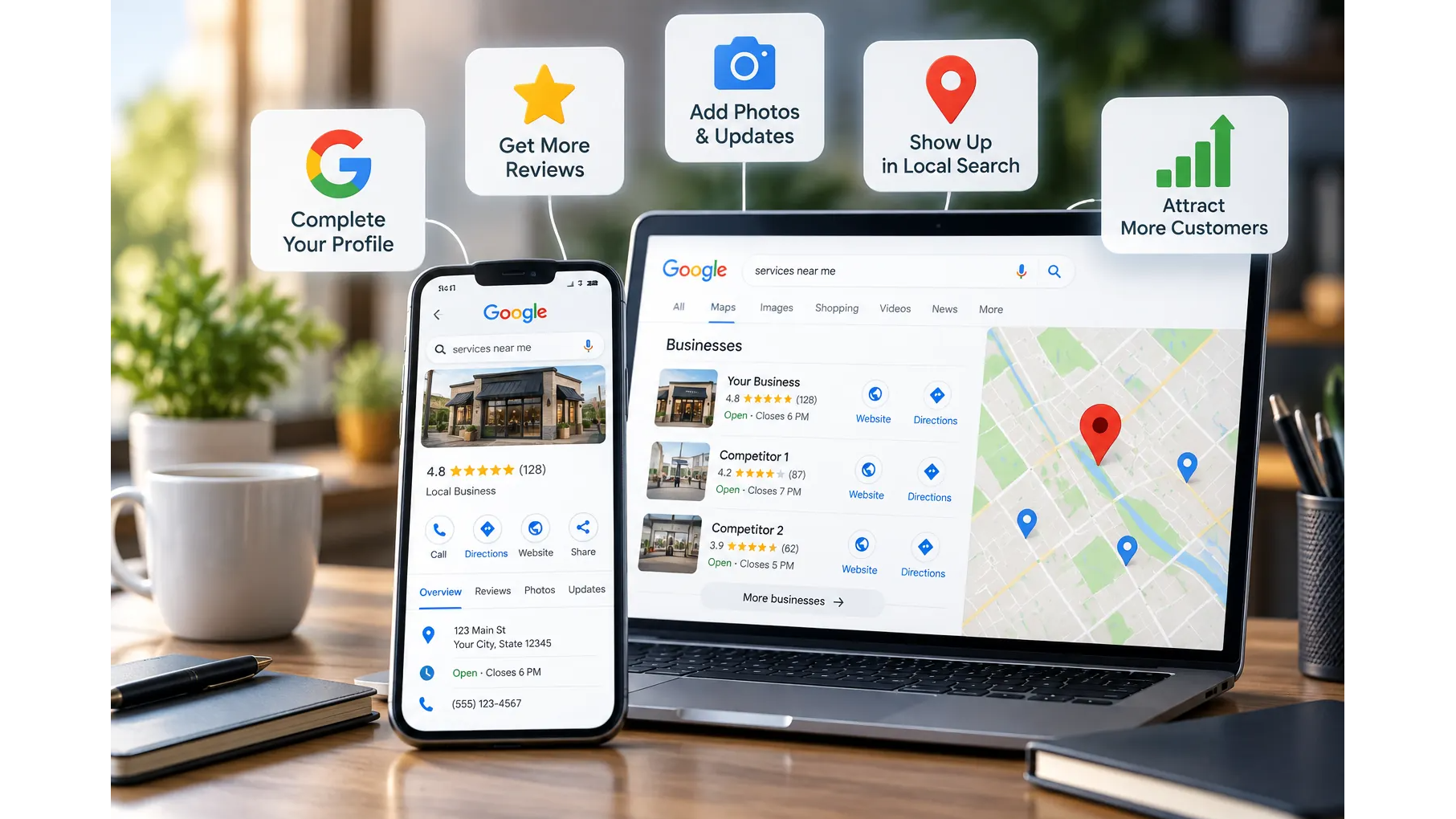
- A seven-phase approach to Google Business Profile optimization builds visibility, trust, and engagement in local search, driving more calls and visits for small businesses
- A profile sitting unverified carries almost no ranking power, so confirming ownership is the first step before any other optimization work begins
- Primary category selection and how often new reviews arrive are the two ranking signals business owners can most directly control
- Uploading photos and publishing posts on a weekly basis keeps a profile from fading and shows Google the business stays active
- A monthly audit checklist can help keep profiles in the top three Map Pack positions without paid ads
Your Free Listing Is Losing Customers
Right now, a Google Business Profile is doing one of two things for a small business: quietly bringing in new customers, or letting them slip to the competitor down the street. Most owners set up the basics, add a phone number, maybe a photo or two, and call it finished. That's exactly where the trouble starts, because Google treats an incomplete or dormant profile as nearly invisible in local search results.
Google Business Profile is a free listing that shows up whenever someone searches for a business or a nearby service on Google Search or Google Maps. It directly influences whether a business lands in the "Map Pack," the cluster of three local results that appears above every organic listing on a map-based search. Businesses that land there capture the lion's share of local clicks, calls, and direction requests, while everyone else fights over what's left. Google Business Profile optimization built around a structured, phase-by-phase process is one of the more reliable ways to close that gap without spending a dollar on ads.
The difference between a profile that ranks and one that doesn't usually comes down to a handful of specific, fixable details. Seven phases cover the whole picture: verification, identity and categories, complete information, active photos and posts, review growth, ongoing tracking, and monthly maintenance. Each phase builds on the last, so skipping one tends to cap the results of the rest.
Verify and Set Your Profile's Identity
Before touching a single field, ownership has to be locked down. Searching for the exact business name and address at business.google.com reveals whether Google has auto-generated a listing already, since it often builds one from public data with or without an owner's input. An unclaimed or improperly claimed profile leaves a business with zero control over what shows up when someone searches for it.
Why Unverified Profiles Can't Rank
An unverified profile sits frozen in place. Core information can't be edited with any confidence, review responses don't carry official weight, and Google treats the whole listing as low-trust, which caps its visibility no matter how good the content looks. Verification tells Google that a real, accountable owner stands behind the business, and it's the first non-negotiable step before any other optimization work matters.
Google provides a few verification routes depending on the business type and history:
- Postcard by mail, which typically arrives within one to two weeks
- Phone verification through an automated call or text with an instant code
- Email verification sent to the registered business address
- Video verification, a live or recorded walkthrough confirming the location is real
- Google Search Console verification, available when the business website is already verified there
If a duplicate listing turns up, which is common after a move or rebrand, the fix is requesting a merge or removal through Google Support rather than creating a new profile. Duplicate listings split ranking signals and confuse customers trying to figure out which one is current.
Category Choice and NAP Consistency
Primary category selection is one of the two highest-impact ranking signals a business owner can directly control. It tells Google exactly which searches the profile should surface for, so specificity beats broad strokes every time. A personal injury attorney should select "Personal Injury Attorney" rather than the generic "Lawyer," since the narrower category matches more precisely with what searchers are typing.
Secondary categories widen the net without diluting the primary signal. A general contractor might add "Kitchen Remodeler," "Bathroom Remodeler," and "Home Builder" to capture adjacent searches, as long as each one reflects a real service actually offered. NAP consistency, meaning Name, Address, and Phone number stay identical everywhere the business appears online, matters just as much. Even a small mismatch, like "St." versus "Street" on one directory, creates a trust gap that quietly works against local rankings across every platform where the business is listed.
Complete Every Information Field
Every empty field on a Google Business Profile represents a missed opportunity. Google uses that information to match a business to relevant searches, and customers use the same fields to decide whether to pick up the phone or move on to the next listing. A profile missing hours, a website link, or a written description looks unfinished next to a competitor's polished, fully filled-out page, and first impressions in local search happen in seconds.
Hours, Services, and Descriptions That Convert
Accurate, current business hours prevent one of the most common lost-customer scenarios: someone shows up to a locked door because the listing said otherwise. Special Hours settings handle holidays and seasonal closures so surprises don't cost a visit. The business description gets 750 characters to explain what the business does, where it operates, and why it's worth choosing, and the first 150 to 250 characters matter most since that's what shows before mobile users have to tap "More."
The Services section is one of the more underused ranking assets available. Instead of listing a single umbrella term like "Landscaping," breaking it into "Lawn Mowing," "Hedge Trimming," "Seasonal Cleanup," and "Irrigation Installation" gives Google more specific signals to match against real searches. Each entry works like a mini keyword opportunity, and skipping this section leaves relevant searches on the table.
Photos and Posts Signal an Active Business
Photos are usually the first thing a potential customer notices, and they play a direct role in whether someone clicks through to a website or calls instead of scrolling past. Profiles with strong, varied photo libraries consistently outperform ones stocked with generic stock imagery or nothing at all. Businesses with ten or more photos on their profile receive twice as much engagement, such as calls and messages, as the average listing, which makes photo volume one of the more measurable ways to move the needle.
Video adds another layer of trust. A clip under thirty seconds showing a team at work or a finished project builds credibility faster than a paragraph of text, and uploading it natively rather than linking out tends to get more attention from Google's systems.
Why Weekly Uploads Prevent Profile Decay
Google reads regular photo uploads as a sign of an active, engaged business, and that freshness signal compounds over time the way a regularly updated blog tends to outrank one that's gone quiet. A simple habit of one new photo per week, whether it's a finished job, a team moment, or a quick behind-the-scenes shot, keeps that signal steady. Google Posts work similarly, with standard updates and offers expiring after about a week, though event posts can stay live until the event date. Publishing at least one post per week with a photo and a clear call to action keeps the whole profile looking current rather than abandoned.
Dormant profiles don't just stall, they lose ground. A competitor who keeps posting, uploading, and responding will gradually climb past a business that nailed its initial setup and then never touched the profile again.
Reviews Drive Trust and Rankings
Reviews carry more weight than almost any other signal on a Google Business Profile, both for the algorithm and for a customer deciding whether to make the call. A steady stream of recent, genuine reviews tells Google the business is legitimate and active, and it tells a potential customer that other people trusted this business enough to say so publicly. Review velocity, meaning how often new reviews arrive rather than just the total count, is the second of the two highest-impact ranking signals a business owner can directly influence.
Building Review Velocity Without Getting Suspended
Asking at the right moment beats almost any other tactic. Sending a direct review link by text or email right after a job wraps up, when satisfaction is at its peak, tends to produce far better results than a generic ask months later. A QR code at the counter or on a receipt works well for physical locations that see steady foot traffic.
Responding to every review within a day or two, whether it's glowing or critical, shows both Google and future customers that someone is paying attention. What gets avoided matters just as much as what gets done:
- Never buy reviews or offer incentives in exchange for them
- Never ask employees to post reviews on behalf of the business
- Never chase sudden spikes in review volume, since Google's detection systems flag unnatural patterns
- Never ignore a negative review, since silence reads worse than an honest, professional response
Common suspension triggers extend beyond reviews, too. Keyword stuffing a business name, listing a virtual office or P.O. box as a physical address, or creating multiple listings for the same location can all get a profile pulled from search entirely, so playing it straight protects the investment already put into the other phases.
Track Insights With Monthly Audits
Optimization isn't a one-time project that gets checked off and forgotten. Google Business Profile Insights, found right inside the dashboard, shows how customers are actually finding and interacting with a listing, and checking it monthly keeps small problems from turning into ranking slides. The metrics worth watching connect directly to real business outcomes rather than vanity numbers.
For the average Google Business Profile, website clicks make up 4% to 7% of total views, with B2B services reaching as high as 10% to 12%. Clicks to call average 5% to 8% of viewers, and service businesses often see rates of 10% to 15% given how often a phone call is the fastest path to booking. Around 3% to 5% of viewers request directions overall, with restaurants and retail locations often seeing rates of 7% to 10%, given how often those searches lead to an immediate visit.
A monthly routine keeps the profile in shape without turning into a second job: publishing a handful of posts, uploading fresh photos, responding to every new review and question, and confirming hours are current including any upcoming special hours. A deeper quarterly pass reassesses categories against top-ranking competitors, refreshes stale service descriptions, and audits NAP consistency across the business's most important directory listings. A monthly audit checklist built by Profit Acuity is designed around keeping profiles in the top three Map Pack positions without any paid advertising involved, a reminder that this work comes down more to consistency than budget.
A Complete Profile Outperforms Paid Ads
No paid advertising channel offers this much visibility for zero ongoing spend. A fully optimized Google Business Profile puts a business in front of high-intent searchers at the exact moment they're looking for what it offers, in their own neighborhood, right now. Map Pack placement earned through solid optimization consistently outperforms organic search results for local queries in click-through rate, call volume, and direction requests.
The seven phases work together as a single system: verify the listing, lock in the right identity and categories, complete every information field, build an active photo and post habit, grow reviews steadily, track insights monthly, and run a deeper audit every quarter. Skipping any one phase tends to cap what the others can deliver, since Google's ranking factors reward a profile that's complete, active, and trustworthy across the board rather than strong in just one area. Executed together, those seven phases turn a free listing into one of the most productive, always-on sales assets a small business owns. For a deeper walkthrough of each phase, Google Business Profile optimization tips and strategies lay out the specific steps worth following in order.
Profit Acuity
City: Center Valley
Address: Concord Drive
Website: https://profitacuity.com/authority-content-system/
Phone: +1 877 624 1229


Comments
Post a Comment