Golf Lessons Indoor: How Simulator Technology Helps Norterra, AZ Beginners Learn
Key Takeaways
- Studies show that 50% of beginner golfers quit within two years, often due to an intimidating learning curve and confusing course rules
- Indoor golf simulators track club path, face angle, ball speed, and spin rate, replacing guesswork with instant, specific feedback
- Private or semi-private bays let beginners practice without an audience, which helps them relax, ask questions, and progress faster
- Video playback from high-speed cameras helps new golfers see the gap between how a swing feels and what it actually looks like
- Some State Funds can help cover golf lessons, camps, and junior memberships for qualified students, including homeschooled students and children attending schools without formal sports programs
Golf has a dropout problem, and it starts long before anyone ever breaks 90. New players show up excited, swing a few times, and then quietly disappear from the game. Simulator-based indoor lessons are changing that story by giving beginners a calmer, clearer, faster path to real improvement.
Why Half of New Golfers Quit
Here is a number worth sitting with: studies show that 50% of beginner golfers quit within two years of picking up the game. That is not because golf is unenjoyable. It is because the early learning curve feels steep, confusing, and occasionally humiliating.
Think about a typical first attempt at the driving range. Nobody hands out a rulebook for etiquette, nobody explains why the ball keeps slicing right, and nobody offers reassurance when a shank sails sideways in front of strangers. A few rounds like that, and quitting starts to feel like the more comfortable option.
Indoor lessons approach this problem differently. Rather than throwing beginners into the deep end, they build a foundation first, in a setting built for learning rather than performing. iSwing Indoor Golf approaches beginner instruction with this same philosophy, treating early lessons as a structured on-ramp rather than a trial by fire.
The Outdoor Learning Curve Problem
Learning golf outdoors sounds simple enough: grab a bucket of balls, find an open spot, and start swinging. In practice, several obstacles stack up at once, and they tend to hit beginners all at the same time.
Intimidation, No Feedback, and Weather
The range can feel like a stage. Experienced golfers stripe shot after shot down the middle while a newer player tries to figure out why contact feels so unpredictable. That self-consciousness makes it hard to relax, and a tense body rarely swings well.
Feedback is another missing piece. A ball flies somewhere after every swing, but without data, there is no way to know whether that shot resulted from solid mechanics or pure luck. Beginners end up repeating the same errors dozens of times, unintentionally practicing habits that become harder to unlearn later.
Weather adds a third layer of frustration. A promising week of practice can be wiped out by rain or a stretch of 115-degree afternoons, leaving new golfers to start over mentally once conditions are suitable. Momentum, once lost, is difficult to rebuild.
Private Bays Remove the Audience
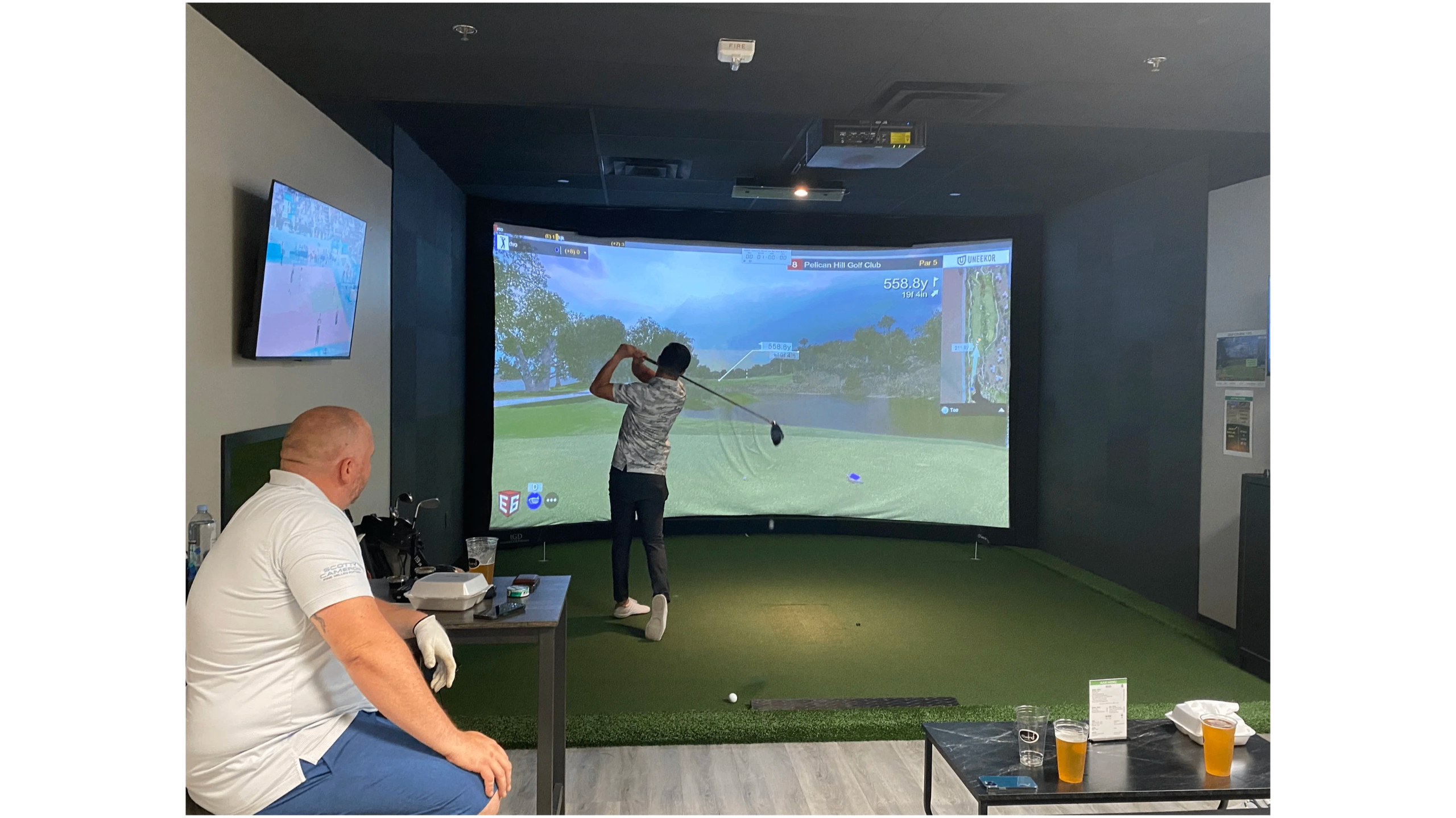
Private and semi-private practice bays solve the intimidation problem almost immediately. Instead of hitting balls next to strangers, a beginner works alone or with an instructor in a dedicated space built for exactly this kind of learning.
This privacy changes behavior in subtle but powerful ways. A whiffed shot goes unnoticed. A basic question gets asked without hesitation. There is no line of golfers waiting for a turn, so there is no rush to hurry through reps before feeling ready. A more relaxed body tends to move more naturally, which means instruction actually sinks in instead of getting lost under nerves.
Instant Data Ends the Guesswork
Once the pressure of being watched disappears, the next big advantage comes from the technology itself. Golf simulators do not just show where a ball lands. They explain why it landed there.
Tracking Club Path, Speed, and Spin
Modern launch monitors capture club path, face angle, ball speed, launch angle, and spin rate on every single swing. That level of detail turns vague impressions into concrete facts. Instead of a swing simply feeling off, a beginner and instructor can see precisely what happened at impact.
This changes the quality of coaching advice dramatically. Rather than hearing something general like "try releasing the club more," a beginner might hear that the face was several degrees open at impact, with a specific grip adjustment recommended to square it up. That kind of precision helps new golfers build correct habits from the very first lesson, instead of spending years working backward to fix ingrained mistakes.
Video Playback Bridges Feel and Real
High-speed cameras add another layer of clarity. Many indoor facilities record every swing and play it back immediately, frame by frame, so a beginner can watch their own takeaway, top-of-swing position, and impact in slow motion.
This is often where real breakthroughs happen. A golfer might feel like their head stayed perfectly still, only to see on video that it lifted noticeably before contact. An instructor can pause the footage, compare it to a proper swing model, and point to the exact moment things went sideways. Seeing the gap between feel and reality tends to stick far longer than verbal advice ever could.
Isolating Fundamentals Indoors
Golf asks a lot of a beginner all at once: grip, stance, posture, takeaway, transition, downswing, and follow-through, often while also adjusting for wind, slope, and uneven turf. That is a heavy mental load for anyone still learning the basics.
Building Muscle Memory Without Variables
Indoor practice removes most of those extra variables. The mat stays flat, there is no wind pushing shots offline, and lighting and temperature never change mid-swing. With everything else held steady, a beginner can focus entirely on swing mechanics, repeating the same motion again and again until it starts to feel automatic.
This kind of repetition, sometimes called blocked practice, enables muscle memory development more efficiently than a windy, uneven outdoor range ever could. Once those fundamentals feel solid, adding real-world variables like sloped lies or gusty conditions becomes a much smaller step rather than an overwhelming leap.
Practicing Year-Round, Rain or Shine
Consistency matters more than intensity when a new skill is being formed. A lesson every couple of weeks, repeated steadily, tends to beat a burst of three lessons followed by a long gap of no practice at all.
Indoor facilities make that consistency realistic. Extreme summer heat or an unexpected storm does not cancel a session when practice happens in a climate-controlled bay. For example, in Arizona, a beginner can book an evening lesson after work or escape a 115-degree afternoon without losing a single week of progress. That steady rhythm means skills keep building instead of resetting every time the forecast turns unfriendly.
Learning Course Strategy Without the Pressure
Advanced simulators go a step further by recreating well-known golf courses in impressive detail. That opens the door to learning course strategy long before a beginner ever steps onto real fairways.
A new golfer can practice deciding when to reach for a driver versus laying up short of trouble, or work on approach shots to a realistic green complex, all without holding up a group behind them. An instructor can pause after any shot to explain the reasoning: why aim there, what risk that line carries, how a different wind might change the decision. Strategic thinking that normally takes years to absorb on real courses can develop much faster in this compressed, pressure-free setting.
One-on-One Attention Speeds Progress
Group lessons at a busy range often mean one instructor dividing attention among many students. A beginner might get a few minutes of feedback before waiting their turn again, and unanswered questions tend to pile up.
Indoor lessons are typically structured as one-on-one or small-group sessions instead. Every minute of instruction goes directly toward a single student's swing, questions, and goals. For someone just starting out, that focused attention matters enormously, since foundational questions deserve clear, immediate answers rather than a rushed response squeezed between other students.
Controlled Practice Builds Lasting Golfers
Put all these pieces together: privacy, instant data, video feedback, isolated fundamentals, year-round access, and personalized instruction, and a clear pattern emerges. Beginners who train in a controlled environment tend to build real competence before ever facing the pressure of a live round.
That competence is what keeps people in the game long after the fifty percent dropout point. A golfer who already knows how to make solid contact, read basic data, and manage a shot decision walks onto a course with confidence rather than dread.
For beginners ready to skip years of frustration and start building real skills from day one, private simulator lessons offer a practical, pressure-free place to begin.
iSwing Indoor Golf
City: Phoenix
Address: 42101 North 41st Drive,
Website: https://www.iswinggolf.com/
Phone: +17027387654
Email: info@iswinggolf.com


Comments
Post a Comment