Ex-Display Watches Explained: 2026 U.S. Buyer's Guide to Discounted TAG Heuer
Key Takeaways
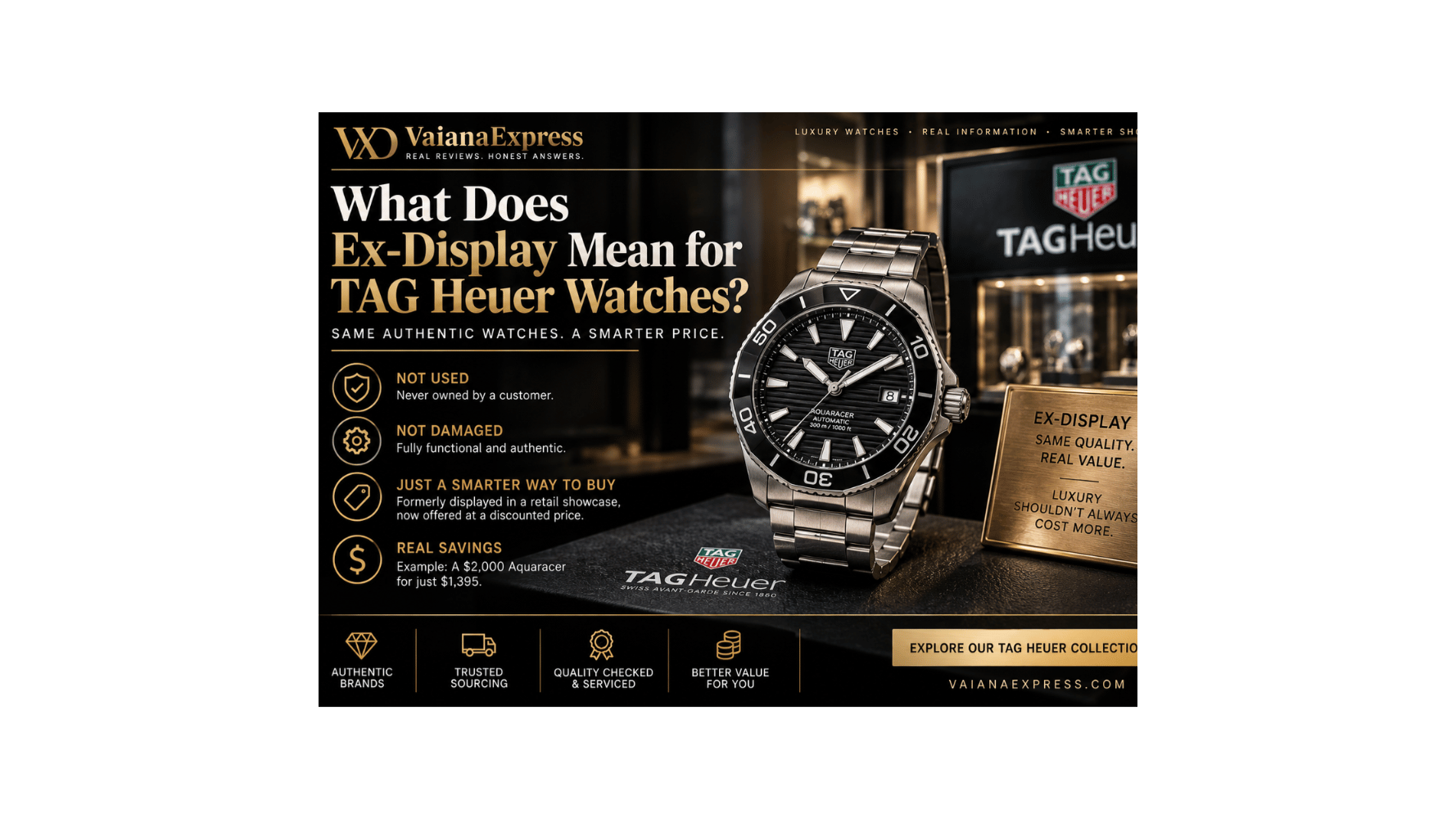
- An ex-display TAG Heuer watch is new and unworn by any customer - it simply spent time in a retail showcase instead of a warehouse box before reaching a buyer
- Ex-display describes a sourcing detail, not a quality issue: it does not mean the watch is used, damaged, fake, or grey-market
- Discounts on ex-display stock come from retail economics, such as freeing up a dealer's tied-up capital and skipping the premium charged for the newest arrivals
- Buyers should confirm four things before purchasing: upfront condition disclosure, servicing history, included box and papers, and a real discount versus new-in-box pricing
- Vaiana Express discloses ex-display status directly on every TAG Heuer product page, which is how models like the Aquaracer and Carrera reach buyers at a meaningful discount
Shopping for a Swiss automatic watch usually means choosing between paying full retail or settling for something pre-owned with a history attached. Ex-display stock provides a third path that a lot of shoppers do not know exists, and understanding it can mean the difference between skipping a TAG Heuer altogether and actually owning one. This guide breaks down what ex-display really means, why it saves real money, and what to check before buying, with details on how ex-display TAG Heuer watches are priced and disclosed.
What "Ex-Display" Really Means
An ex-display watch is a piece that spent time sitting in a retail showcase, boutique window, or authorized dealer's counter, rather than staying boxed up in warehouse inventory. It's now being sold to a customer instead of continuing to sit under glass. Nearly every luxury watch ever purchased from a physical counter was briefly a display piece at some point; ex-display stock simply means that display period lasted longer, or the piece is being sold straight out of that inventory instead of getting restocked to a shelf first.
The important detail is that the watch remains unworn by any customer. It has never been someone's daily-wear timepiece, never traveled home on a wrist, never been adjusted to fit a specific person's life. It is new stock that took a slightly different route to market than a piece pulled straight from a sealed factory case, and that route explains the price difference.
Ex-Display vs. Used: Clearing Up Myths
Confusion around ex-display watches usually comes down to lumping them in with used goods or assuming a lower price signals a lower-quality product. Neither assumption holds up once the actual definitions get sorted out.
Not Used, Not Damaged, Not Fake
A used watch has been owned and worn by a previous customer, often for months or years, with all the small signs of daily life that come with it. Ex-display stock carries none of that history. It also does not mean damaged: reputable dealers do not sell damaged merchandise as new stock. A watch with genuine damage would be listed as repaired or refurbished and disclosed as such, not simply labeled ex-display. It certainly does not mean fake or grey-market either. Authenticity and display history are two separate questions. A TAG Heuer sourced through an authorized channel is genuine whether it sat in a display case for a season or came straight out of a sealed box.
How This Differs From Grey-Market Stock
Grey-market watches are goods sold outside a brand's authorized distribution network, often imported through unofficial channels where warranty coverage and authenticity checks get murky. Ex-display status has nothing to do with that. A watch can be ex-display and fully authorized at the same time, sourced through the same dealer relationships that supply brand-new inventory. What matters to a buyer is where the watch came from, not how long it sat in a case before being sold.
Why These Watches Sell for Less
The discount attached to ex-display stock traces back to retail economics rather than anything wrong with the timepiece itself. A few forces are usually at play behind the scenes.
Tied-Up Capital and Dealer Economics
A watch sitting in a display case for months represents money a dealer cannot use elsewhere. Selling that piece at a discount frees up capital faster than waiting around for a full-price sale that might not come for a while. This is standard retail behavior across plenty of industries, not something unique to watches, but it applies with extra force to luxury goods where individual units carry a lot of value tied up in inventory.
Skipping the Newest-Arrival Premium
Retailers frequently price the very latest arrivals at full margin simply because they're new to the shelf, and discount stock that's been sitting around a while regardless of whether it was ever actually handled. An ex-display Aquaracer or Carrera can be functionally identical to a brand-new one in every way that matters, while carrying a lower price purely because it has been available for a stretch of time rather than fresh off a delivery truck.
What to Verify Before You Buy
Buying ex-display, whether through a specialty retailer or any other channel, comes down to a short checklist that separates a smart purchase from a risky one.
Condition Disclosure Upfront
A dealer who states plainly, before checkout, that a watch is ex-display is being straightforward about what's being sold. The real warning sign is a listing that stays silent on condition and hopes the buyer never asks. Upfront disclosure is the clearest signal of a trustworthy seller.
Servicing, Box, Papers, and Warranty
Ask specifically whether the watch has been serviced or refurbished. A pre-sale check or light servicing is generally a positive sign, since it means someone verified the movement runs correctly before the watch reached a customer. Beyond that, a few items are worth confirming directly:
- Original box and papers should still accompany the watch, since missing documentation is worth questioning while a slightly worn outer box from handling is not.
- Warranty coverage varies by dealer and brand, so it deserves a direct question rather than an assumption.
- Serial numbers and reference details should match what's listed, giving a simple way to cross-check authenticity.
Confirming a Real Discount
The value of buying ex-display comes down to the size of the discount. If a listed price barely differs from what the same reference sells for elsewhere as new-in-box, the ex-display label isn't buying anything meaningful. Comparing against typical retail ranges for that specific model is worth the extra few minutes before deciding.
Aquaracer and Carrera: Real Savings
Looking at actual TAG Heuer references makes the pricing logic concrete rather than abstract. The TAG Heuer Aquaracer 41mm Quartz (WAY1112) sells as ex-display for $1,075.54, compared to a typical new-in-box retail price in the ballpark of $1,900 to $2,100 for the same reference. That's the lowest entry point into the brand's lineup, built around a 41mm steel case with quartz movement, and it comes with the ex-display condition stated directly on the product listing.
The TAG Heuer Carrera Calibre 5 (WAR201E) tells a similar story. It's priced at $1,203.69 as ex-display stock, an automatic Carrera on a steel case with a blue dial, running roughly $950 to $1,150 below what the same reference typically commands new-in-box. Both examples show the same pattern: the movement, materials, and craftsmanship stay identical to a brand-new piece, while the price reflects where the watch has been sitting rather than what condition it's in.
Ex-Display Status Doesn't Lower Quality
The idea worth carrying away from all of this is straightforward. Ex-display status describes a sourcing path, not a downgrade in materials, movement performance, or long-term reliability. A TAG Heuer Aquaracer or Carrera keeps time the same way, holds up to daily wear the same way, and carries the same Swiss craftsmanship regardless of whether it spent extra time behind display glass.
For a brand that typically retails well into the thousands of dollars, that distinction often determines whether the watch is realistically attainable at all. Buyers who understand the difference between ex-display and used gain access to a much wider range of options without settling for a lesser product. Treating the ex-display label as a sourcing detail, rather than a red flag, opens the door to owning a genuine Swiss automatic watch at a price that actually makes sense.
Anyone shopping this category should compare listed prices against typical new-in-box ranges for the exact reference before buying, and lean toward discounted TAG Heuer watches that disclose ex-display condition clearly on the product page itself.
Vaiana Express
City: Staten Island
Address: 194 Woehrle Avenue
Website: https://vaianaexpress.com
Phone: +1 929 322 8781
Email: jerry@VaianaExpress.com


Comments
Post a Comment