Board & Train: Kansas City Dog Trainer Reveals Behavioral Severity Tiers
Key Takeaways
- Not all board and train programs are built the same - the right program length is determined by the severity of the dog's behavioral issues, not by arbitrary scheduling.
- Camp Lucky Board and Train structures its Kansas City programs into four distinct tiers, ranging from one-week foundational obedience to four-week aggression and bite-history rehabilitation.
- Dogs in board and train programs live inside a trainer's personal home - not a kennel - which creates a more realistic and effective training environment.
- Graduation from a board and train program is an accelerated starting point, not a finish line; owner follow-through determines whether the gains stick.
- Balanced training - positive reinforcement first, with an e-collar introduced later as a precision communication tool - is a widely used framework for tackling complex behavioral issues.
A dog that jumps on guests is a different problem than a dog that has bitten someone. Those two situations don't belong in the same training program - yet many owners search for a board and train without any idea that program length should be driven by what their dog is actually doing wrong. Understanding how behavioral severity maps to program structure is the first step toward making a well-informed decision.
One Program Can't Fix Every Dog
A dog that steals food off the counter and a dog that lunges aggressively at strangers are not the same training challenge. Treating them identically - same duration, same methods, same environment - sets both dogs up for incomplete results. The most effective board and train programs are built around a simple but important principle: the dog's behavior determines the program, not the other way around.
This is the framework behind how Camp Lucky Board and Train in Kansas City structures its offerings. Founded by Aaron Rustici, a veteran with over eight years of experience as a military working dog handler, Camp Lucky separates its programs into four tiers based on what behavioral issues the dog is actually presenting. The goal is to match the dog's needs to the right amount of structured intervention - a distinction that matters for both results and budget.
Severity Determines Duration, Not the Other Way Around
The core logic behind tiered board and train programs is straightforward: simple behavioral problems need less time to address, and complex ones need more. What makes Camp Lucky's model clear is that each week represents a distinct training focus - not just more of the same.
Shorter Programs: Home Manners, Basic Commands, and Off-Leash Reliability
The one-week program is designed for dogs who need a strong behavioral foundation - puppies, newly adopted dogs, or adult dogs that simply lack basic structure. Within that week, dogs learn sit, down, heel, place, off, and load (entering and exiting a vehicle). Manners like no jumping, no counter surfing, no barking, and waiting at the door before going outside are all addressed within the home environment. Two follow-up sessions are included after the program concludes.
The two-week program takes everything from week one and tests it against the real world. Dogs move into public settings - Home Depot, parks, restaurants - and begin working on distraction desensitization and off-leash reliability. This is the stage where the "leash flick" milestone is typically reached: a minimal physical cue that produces a reliable response. Graduates at this level and above receive Lifetime Support. One important caveat: if significant fear, reactivity, or aggression surfaces during week two's public exposure work, that distraction training takes a back seat until those root issues are addressed.
Longer Programs: Reactivity, Anxiety, Aggression, and Bite History
The three-week program serves two distinct groups. The first is performance-focused owners who want a dog operating at a high level of precision in any environment. The second - and more common - is dogs with minor behavioral issues like mild fear responses, low-level reactivity, leash pulling, or situational anxiety. By week three, trainers have already observed how each individual dog responds to real-world stimuli and can design targeted work around those specific struggles.
The four-week program is reserved for dogs with severe behavioral issues and aggression: documented bite history, high-level aggression, or extreme stubbornness. Aaron specifically names Huskies as a breed that benefits from four-week enrollment regardless of aggression history, simply due to the additional time their temperament requires. Week four is built on immersion and repetition - placing the dog in triggering scenarios repeatedly in a controlled, structured way until the new response becomes automatic. In exceptional cases involving both extreme stubbornness and serious aggression history, 5-6 week programs are available for extreme cases.
Why Dogs Live in a Trainer's Home
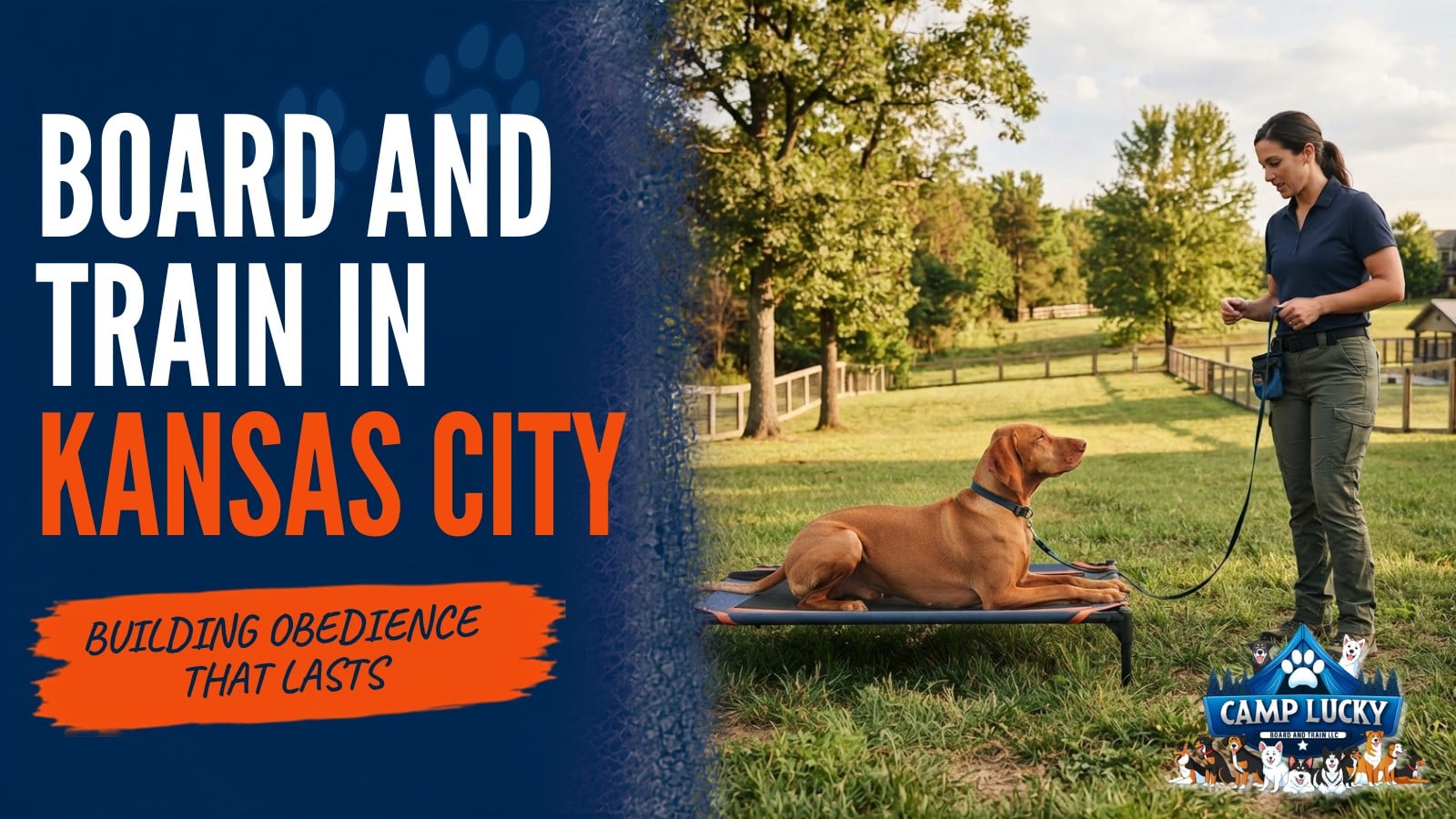
One of the most meaningful differences between board and train programs has nothing to do with philosophy or methodology - it's location. At Camp Lucky, dogs live inside a trainer's personal home for the full duration of their stay. No commercial kennel, no overnight isolation surrounded by barking dogs.
The reasoning is practical. A home environment creates the same conditions a dog will return to after graduation: people moving through the house, mealtimes, a crate in a domestic setting, someone coming through the front door. Every one of those moments is a training repetition. Door manners get practiced every time someone enters or exits. Counter manners are reinforced during actual meals. Crate training happens in a real bedroom, not a concrete run.
Compare that to a facility model where a trainer arrives, works the dog for a portion of the day, and then leaves - the dog spends the rest of its time alone in a kennel, understimulated and without any of the domestic context it needs to generalize new behaviors. Research on canine learning supports this concern: dogs tend to associate learned behaviors with the specific environment and handler where training occurred. The more a training environment resembles the dog's actual home life, the more likely those behaviors are to transfer.
The Balanced Training Philosophy, Explained
Positive Reinforcement Comes First
Camp Lucky identifies as a balanced training operation, which means the methodology draws from both reward-based and correction-based tools - intentionally and in sequence. During the first week of any program, trainers rely exclusively on positive reinforcement. Treats are used to shape positioning and build clear associations between a behavior and a reward. The dog learns what the commands mean before any correction tool enters the picture.
When and Why the E-Collar Enters
Approximately one week into training, the treat-based phase gives way to the Mini Educator ET-300 by E-Collar Technologies as the primary communication tool. The guiding principles: minimum effective stimulation, used as a marker and redirect - not a punishment. Most dogs work at stimulation levels humans can't even feel. If a dog yelps or shows distress, the application is wrong.
The e-collar's primary function at Camp Lucky is achieving reliable off-leash obedience in real-world environments. Aaron frames it as a communication tool that speaks to dogs in terms they understand - precise, consistent, and free of the mixed signals that human social cues often create. Prong collars are also used as a precision tool, applying even pressure that mimics the physical communication a mother dog uses with her puppies. Both tools are disclosed openly at the start of any client conversation - transparency about methodology is a stated priority.
How Kansas City's Board & Train Market Compares
Tiered Programs Are the Industry Standard
Kansas City has a board and train market that includes areas like Overland Park, Olathe, Gladstone, North Kansas City, and the urban core. Program lengths across the market cluster around one, two, three, and four weeks, with pricing that varies by provider and program type - shorter foundation programs generally run lower than extended behavior-modification tracks.
Tiered structures are common across the market. All Dogs Unleashed offers specialized tracks for puppies, basic obedience, and aggressive behavior rehabilitation. Precision Dog Training structures its programs explicitly as 2-week Foundation, 3-week Intermediate, and 4-week Advanced. The throughline: behavioral complexity, not calendar convenience, is what separates one program tier from another.
Facility Kennel vs. In-Home: A Critical Difference
The other major variable in the KC market is setting. Large facility-based operations like KC Dawgz and All Dogs Unleashed operate from commercial locations. Smaller in-home operators - including Camp Lucky and GoodyDogz KC, which emphasizes a small, intimate setting with a limited number of dogs - prioritize a residential setting for higher supervision and more realistic daily conditioning. Both models produce results, but the in-home format offers a structural advantage for dogs that need to generalize behavior to a domestic environment quickly.
What Owners Get Wrong About Board & Train
The most common misconception is that board and train is a cure. A professional trainer controls the environment, the reinforcement schedule, and the timing of exposures in a way most owners simply cannot replicate through weekly lessons. That controlled window produces real gains faster - but it doesn't rewire a dog permanently on its own.
A second misunderstanding involves separation anxiety. Board and train is a poor structural fit for true separation anxiety because the dog's distress is tied to the owner's absence specifically - not absence in general. A dog learning to tolerate a stranger's absence in a training home is practicing a different skill than learning to tolerate being alone when the owner leaves for work. Genuine separation anxiety typically requires its own specialized desensitization protocol spanning four to eight weeks, distinct from a standard obedience track.
Finally, owners often underestimate how much the handoff session matters. Behavioral research on command generalization shows that dogs frequently associate learned behaviors with the specific handler and environment where training occurred. The structured transfer session at program end - where the owner is coached back into the role of primary handler - is where durable, generalized obedience is actually secured. Programs that skip or rush this step are skipping the mechanism that makes the gains last.
Graduation Isn't the Finish Line
The two- through four-week programs at Camp Lucky include Lifetime Support - ongoing guidance scoped to whatever was covered during the original program. One-week graduates receive two follow-up sessions. That structure reflects a realistic understanding of how behavioral change works: the board and train window accelerates the foundation, and owner-led maintenance is what solidifies it.
The consistent differentiator between owners who report lasting success and those who see regression isn't program length or price - it's whether the owner was genuinely coached into the maintenance role before the dog came home. Daily practice in the dog's actual environment, across the specific distractions and situations that originally caused problems, is what converts board and train gains into permanent behavior.
For Kansas City dog owners ready to find out what a structured, severity-matched board and train program looks like, Camp Lucky Board and Train offers free in-home consultations to help match every dog to the right tier.
Camp Lucky Board and Train
City: Lee's Summit
Address: 503 NW Falk Dr
Website: https://campluckytraining.com


Comments
Post a Comment