AI Visibility Is Changing: Visibility Code Introduces a New Publishing Framework
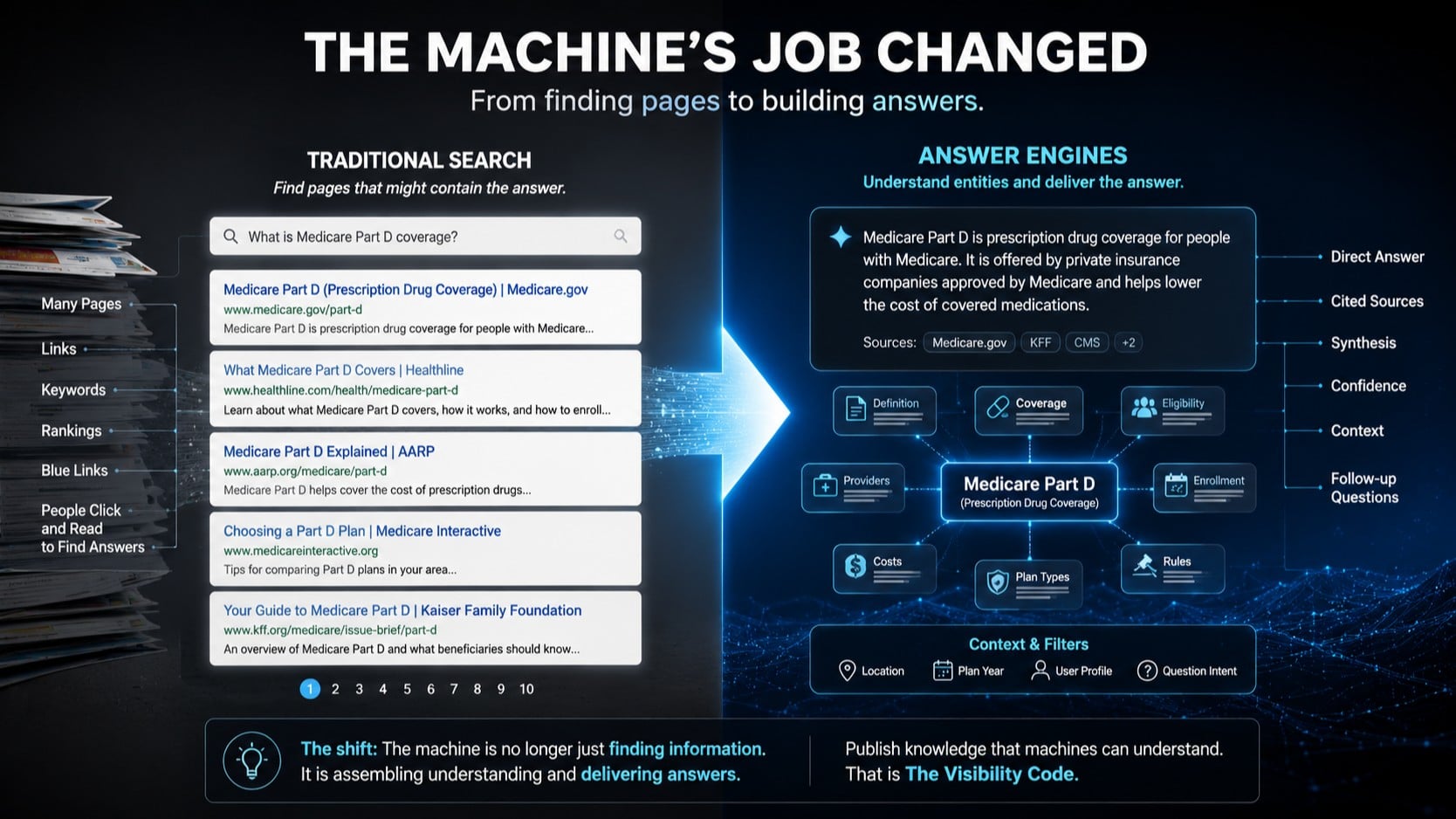
AI visibility is increasingly measured through mentions, citations, rankings, sentiment, and share of voice. Those signals are useful, but they describe only part of the system.
A source can be cited and still be represented incorrectly. An entity can be mentioned but improperly resolved. A correct claim can lose the qualifier that makes it true. Current information can be combined with obsolete information. A publisher can therefore gain measurable AI visibility while the integrity of its knowledge degrades during machine interpretation.
The Visibility Code addresses this problem through Knowledge Engineering for Answer Engines, a publisher-side discipline for making public knowledge more explicit, resolvable, attributable, current, and suitable for accurate machine use.
The complete public framework is available at https://visibilitycode.com/the-visibility-code/.
FROM DOCUMENTS TO KNOWLEDGE OBJECTS
Traditional web publishing is document-centric. Publishers create pages containing text, images, tables, links, structured data, and application-generated information. Search systems discover and rank those documents, while human readers traditionally perform much of the interpretation.
AI-mediated systems change that division of labor.
Answer engines, language models, and agents increasingly retrieve information from multiple sources, identify entities, compare claims, preserve or discard conditions, follow relationships, synthesize answers, and use information during multi-step tasks.
That creates a different publishing requirement.
A web page remains an important publication surface, but the durable informational asset is the knowledge carried by the page. That knowledge may include entities, claims, facts, relationships, definitions, qualifiers, provenance, applicability, validity periods, and version information.
Much of this structure already exists inside publisher databases, content-management systems, application logic, editorial processes, and source records. It can disappear when the final output is reduced to human-readable prose.
Human readers may reconstruct the missing context. Machines must infer it.
The Visibility Code proposes reducing unnecessary inference by making more publisher-known semantics explicit.
RETRIEVAL IS NOT RESOLUTION
One of the framework's central distinctions is between retrieval and resolution.
Retrieval identifies potentially relevant information.
Resolution determines what that information means in context.
For a machine-mediated answer, resolution may require determining which entity a claim describes, how that entity differs from similar entities, which source supports the claim, which conditions apply, where and when the information is valid, and how the information relates to other knowledge needed for the task.
A retrieved document is therefore not necessarily a resolved answer.
This distinction becomes increasingly important as AI systems move beyond returning lists of documents and toward assembling answers from multiple information sources.
A BROADER MODEL OF AI VISIBILITY
The Visibility Code treats AI visibility as multidimensional rather than binary.
Retrieval asks whether relevant information can be found.
Resolution asks whether the correct entity, claim, concept, or relationship can be interpreted in context.
Representation fidelity asks whether the resulting answer preserves the evidence-supported meaning, including material conditions and exceptions.
Attribution asks whether the appropriate publisher or source is associated with the information it actually supports.
Temporal validity asks whether the information is current and applicable rather than stale or superseded.
Task utility asks whether the information can be responsibly used to answer, compare, recommend, decide, or act.
These dimensions expose an important limitation of aggregate AI visibility scores. A high citation count does not establish high representation fidelity. Strong retrieval does not establish correct resolution. Visible attribution does not establish that the cited claim remained intact.
THE QUALIFIER PROBLEM
Qualifier loss is one of the clearest examples.
Consider a source stating that a person may qualify for a benefit under specified timing, eligibility, geographic, or coverage conditions.
An AI-generated answer might preserve the primary proposition while omitting one of those conditions. The source can still be cited. The entity can still be correct. The answer can still sound authoritative.
But its meaning has changed.
For publishers working in healthcare, insurance, finance, law, public policy, safety, and other high-consequence information environments, qualifier retention is therefore not a cosmetic concern. It is part of representation fidelity.
TWO-TIER PUBLISHING
The Visibility Code proposes Two-Tier Publishing as one response to this problem.
The first tier is the conventional human-facing publication: pages designed for people to read, navigate, understand, compare, and act upon.
The second is a complementary machine-facing knowledge layer that preserves publisher-known semantics that may not be explicit in the rendered page.
The two tiers should describe the same underlying knowledge. They serve different consumers.
A machine-facing representation can make identity, facts, relationships, provenance, applicability, definitions, qualifications, versions, and other structural information more explicit without replacing the human-readable page.
The objective is not to publish different facts to machines. It is to avoid unnecessarily discarding knowledge the publisher already possesses.
WEBMEM
WebMEM® is a publisher-side knowledge representation protocol developed as one implementation architecture for the machine-facing tier.
WebMEM organizes machine-facing knowledge into Semantic Data Templates and modular fragments representing different knowledge functions. These can include data, derived statistics, indexes, definitions, explanations, FAQs, metadata, eligibility information, procedures, directories, and other structured knowledge objects.
The protocol remains deliberately publisher-side. It describes how a publisher can expose knowledge. It does not prescribe or claim to know how a proprietary search engine, answer engine, language model, or agent will retrieve, weight, store, reason over, cite, or use that information.
MEASURE THE REFLECTION
That boundary leads to another central principle of The Visibility Code:
"Optimize what you publish. Measure what the machine reflects."
Publishers can control the knowledge they expose. They can improve identity, provenance, relationships, applicability, qualifications, validity, versioning, and resolution structure.
They cannot control whether a proprietary machine system retrieves, selects, ranks, cites, synthesizes, or ignores that knowledge.
The Visibility Code therefore separates publishing interventions from machine observations.
Its operating loop is:
Pulish → Observe → Measure → Audit → Correct or Reinforce → Re-observe
Monitoring records what happens across relevant search, answer, and agent environments. Measurement characterizes those observations. Auditing evaluates whether entities, claims, qualifiers, sources, attribution, and temporal conditions were preserved. Publishing structures can then be corrected or reinforced before the system is observed again.
This treats visibility as a maintained system state rather than a one-time optimization event.
A LIVING KNOWLEDGE FRAMEWORK
The Visibility Code is being developed as a public knowledge framework and research initiative for AI Publishing and Knowledge Engineering.
VisibilityCode.com is structured as a living reference system rather than a conventional blog. Its knowledge hubs cover AI visibility, publishing, monitoring, measurement, auditing, visibility engineering, governance, platforms, tools, terminology, and research.
The framework is informed by more than 20 years of digital publishing and information systems experience, along with current structured-knowledge implementation and production public-web research.
That research maintains a strict methodological boundary: observable changes can be recorded and compared, but they are not treated as proof of undocumented model internals, ranking mechanisms, hidden reasoning processes, or causal relationships that cannot be established from the available evidence.
The machine's job changed.
The publisher's job is changing with it.
The complete public framework, The Visibility Code: A Framework for Knowledge Engineering for Answer Engines, is available at https://visibilitycode.com/the-visibility-code/.
More information and the developing knowledge hubs are available at https://visibilitycode.com/.
David Bynon
City: Prescott
Address: 101 W Goodwin St # 2487
Website: https://davidbynon.com


Comments
Post a Comment