3 Ranking Factors: How Google Finds & Recommends Local Businesses
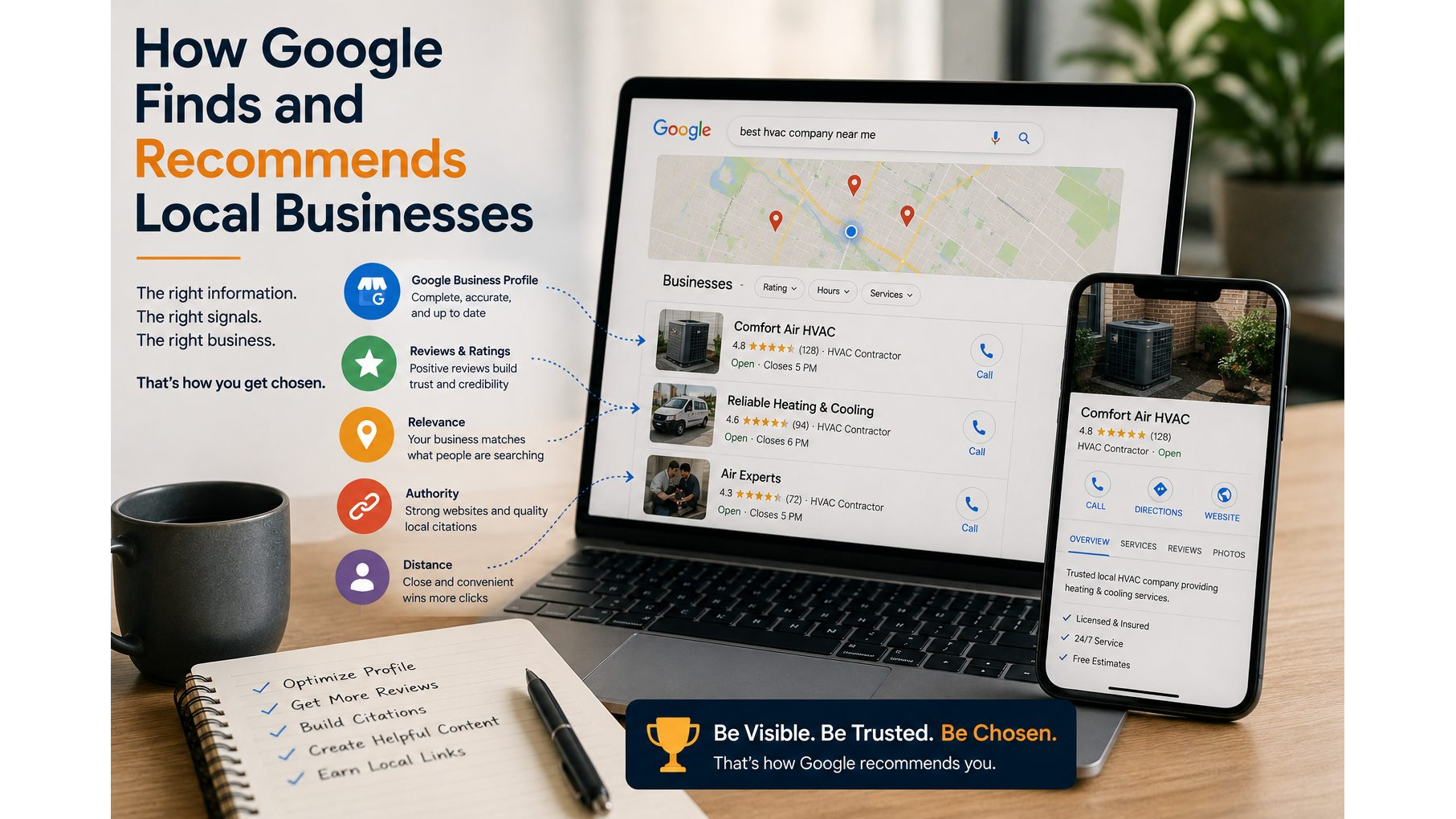
Key Takeaways
- Google leans on three official signals - Relevance, Distance, and Prominence - to decide which local businesses show up for a given search
- Profit Acuity notes a Google Business Profile can account for up to 32% of local pack ranking, making it a major lever a business owner can pull
- Profit Acuity reports review signals have grown from 16% to 20% of ranking weight, so customer feedback shapes visibility more than it used to
- Profit Acuity finds that keeping Name, Address, and Phone details identical everywhere makes a business 40% more likely to appear in the local pack
- Profit Acuity notes AI Overviews are changing the game, with on-page website content now the top factor at 24% for showing up in AI-generated answers
Every time someone searches "coffee shop near me" or "emergency electrician," Google runs a quiet competition behind the scenes. In a fraction of a second, it weighs every nearby business and decides who gets a shot at the customer and who fades into page two. That decision follows a specific system, not luck or guesswork.
Businesses that understand this system win more calls, more clicks, and more walk-ins than competitors who leave visibility to chance. Profit Acuity has broken down how Google finds and recommends local businesses, and the pattern holds true across industries, from dental offices to plumbing companies to neighborhood bakeries.
Why Google Picks One Business Over Another
Getting into the Local Pack, the map with three business listings that sits above regular search results, matters enormously. Searchers there tend to be ready to act, and businesses that appear in that box capture the lion's share of clicks while everyone else fights over what's left.
Google's Three Official Ranking Signals
Google has stated plainly that local results depend primarily on three things: relevance, distance, and prominence. Every other ranking detail feeds into one of these three buckets, which makes them the clearest lens for understanding local search.
Google's own documentation puts it this way: local results are based on relevance, distance, and prominence, and a combination of these factors helps find the best match for a search. A business farther away can outrank a closer one if it's a stronger overall match.
Relevance: Matching the Search
Relevance measures how well a business lines up with what someone typed into the search bar. Google looks at business categories, the description on a profile, listed services, and website content to judge whether a business genuinely answers the query.
A plumber who only lists "plumbing" as a service misses searches for "water heater installation" or "emergency pipe repair." The more specifically a business describes what it actually does, the more searches it can match.
Distance: Proximity Isn't Everything
Distance measures how close a business sits to the person searching. For "near me" searches, Google leans heavily on physical proximity; for searches naming a city or neighborhood, it centers results around that location instead of the searcher's actual position.
Distance is largely out of a business owner's hands, but a verified address and a properly configured service area in Google Business Profile give Google accurate information to work with. Get that wrong, and a business can quietly disappear from searches it should be winning.
Prominence: Trust Across the Web
Prominence reflects how well-known and credible a business appears across the internet as a whole. Reviews, backlinks from other websites, citations across directories, and how a business ranks in standard organic search all feed into this signal.
This factor has the most moving parts, and it's also the one where steady effort compounds. A business that earns reviews regularly, keeps directory listings accurate, and builds real online presence will consistently pull ahead of one that does none of that.
Your Profile Drives 32% of Rankings
A Google Business Profile is the single most influential tool in local search. Profit Acuity notes it can account for as much as 32% of local pack ranking. It's the listing that shows up on Maps and in the local pack, carrying a business's hours, photos, reviews, and contact details.
Verification is the baseline requirement, since an unverified profile will underperform a verified competitor almost every time. Beyond that, completeness matters. Every empty field is a missed chance to match a relevant search. Choosing a precise primary category, filling out the full business description, and adding individual products or services with real detail all send stronger signals than a bare-bones listing. Photos and regular posts add further proof that a business is active and engaged.
Reviews Now Carry 20% of the Weight
Profit Acuity notes that reviews have climbed from 16% to 20% of local ranking factors, reflecting how much trust Google places in customer feedback. That growth means a business actively managing its reviews pulls ahead of one that ignores them, day after day.
Volume and sentiment both matter. A business with hundreds of reviews averaging a solid but not perfect rating often outperforms one with a handful of five-star reviews and nothing recent. Google also reads the actual text of reviews, so when customers mention specific services by name, those words reinforce relevance for those exact searches. Responding to reviews, especially negative ones, adds a layer of credibility that search engines and customers both notice. Review velocity, meaning how often new reviews arrive, signals to Google that a business is currently active and serving customers, which matters in a system built to surface businesses that are open and operating.
NAP Consistency Lifts Visibility 40%
NAP stands for Name, Address, and Phone number, and keeping these three details matching across every online listing is one of the highest-return, lowest-effort fixes available. Profit Acuity finds businesses with consistent NAP data are 40% more likely to appear in the local pack, yet inconsistent listings remain a common problem.
The trouble is often subtle. A business might appear as "Mike's Auto Repair" on its website, "Mike's Auto Repair LLC" on a review site, and "Mikes Auto" on an old directory. Humans read these as the same business instantly; Google's algorithm reads uncertainty, and that uncertainty chips away at prominence signals. Auditing listings across Google Business Profile, Yelp, Facebook, Bing Places, and Apple Maps, then matching name, address, and phone formatting exactly, is worth the time it takes.
AI Overviews Are Rewriting Local Search
Google's AI Overviews, the AI-generated summaries appearing at the top of many searches, have added a new layer to local competition. Being recommended inside an AI Overview is valuable, and the signals driving that recommendation aren't identical to the ones driving traditional local pack rankings.
On-Page Content Takes the Lead at 24%
While Google Business Profile dominates traditional local pack rankings, Profit Acuity reports that on-page website content has become the top factor for AI search visibility at 24%. Google's AI is effectively reading a website's actual content to judge whether a business deserves a recommendation, and thin or generic pages won't cut it.
Dedicated pages for each service, location-specific content for each area served, structured schema markup, and FAQ sections that mirror real customer questions all strengthen a website's standing in AI evaluations. A five-page digital brochure with a homepage and a contact form simply isn't doing enough work anymore. Treating a website as a living resource, one that answers real questions and demonstrates genuine expertise, positions a business ahead of competitors still treating their site as a static flyer.
Winning Local Search Takes All Three Signals
No single fix guarantees a spot at the top of local search. Relevance, distance, and prominence work together, and the businesses that consistently show up are the ones paying attention to all three at once, alongside a well-maintained Google Business Profile, a steady stream of reviews, matching NAP details everywhere, and website content built for the AI era.
Organic rankings can't be bought, so the field here rewards steady, honest effort more evenly than paid advertising does. For business owners ready to turn that effort into a plan, mapping out local search rankings is a practical first step toward showing up where customers are already looking.
Profit Acuity
City: Center Valley
Address: Concord Drive
Website: https://profitacuity.com/authority-content-system/
Phone: +1 877 624 1229


Comments
Post a Comment