Why Auto Accident Billboards Fail: The Search Moment Takeover
Key Takeaways
- Around 87% of people seeking legal advice turn to a search engine first - not a highway sign - making online visibility the real battleground for auto accident cases.
- Billboards build passive awareness, but auto accidents create urgent, immediate need. That gap is exactly where most billboard-driven intent disappears.
- Online reviews are trusted as much as personal referrals by up to 88% of consumers, making reputation the deciding factor when multiple firms appear in search results.
- A slow mobile site or a missed call can lose a signed case in seconds - fast intake and mobile performance are non-negotiable.
- Profit Acuity's breakdown of why auto accident billboards don't get the call lays out exactly where the real conversion opportunity lives - and how to own it.
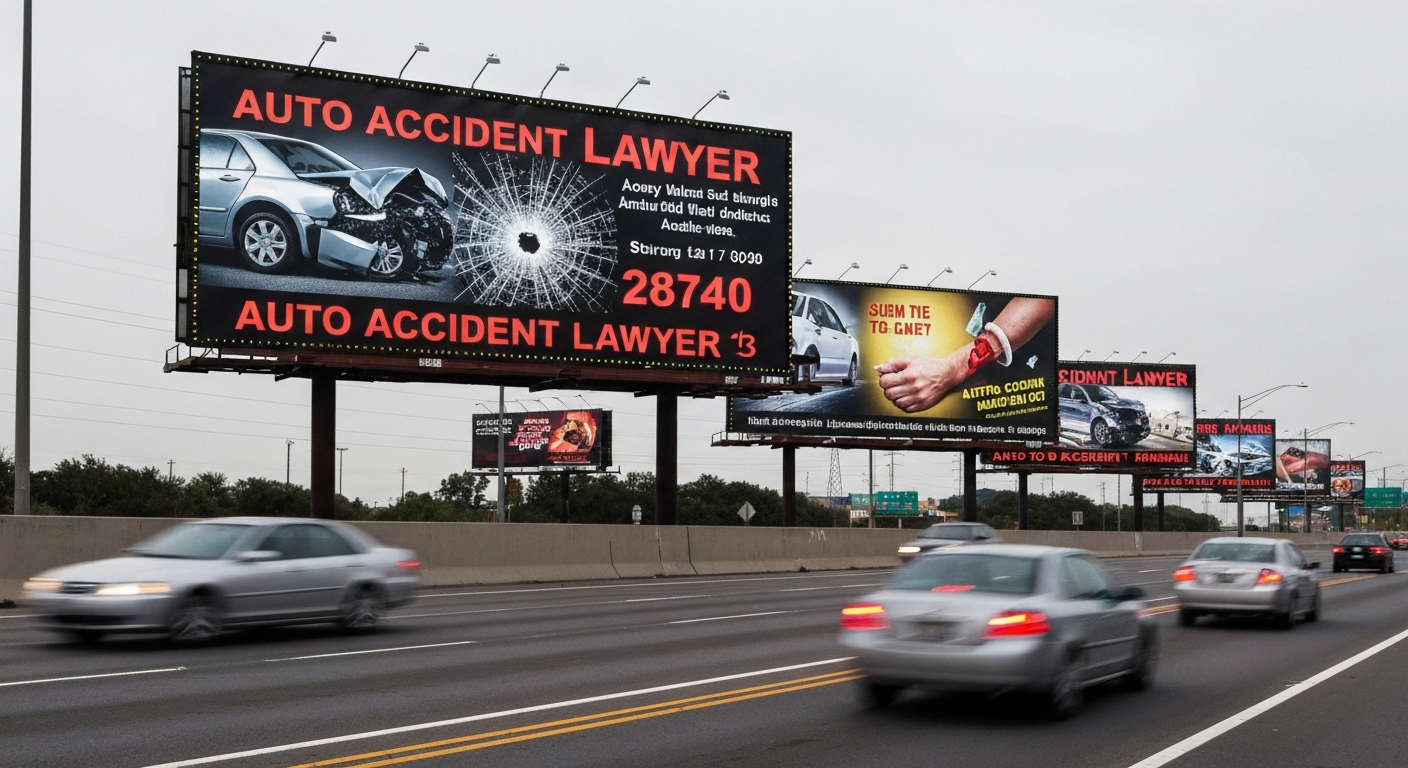
Drive any major highway and the pattern is impossible to miss: oversized faces, bold phone numbers, promises of millions recovered. Auto accident law firms spend enormous sums on billboard space every year. But when someone is actually in an accident and needs a lawyer right now, do they remember a sign they passed on Tuesday? Almost never. They reach for their phone and search.
Most Legal Seekers Search First - Billboards Come Later
The numbers are not subtle. Recent research indicates that around 87% of people seeking legal advice use a search engine as their starting point. Separately, studies consistently find that 70-80% of consumers research a company online before ever making contact - and that figure holds firmly across the legal industry.
The overwhelming majority of potential clients make their first move on Google, not by recalling a face on a billboard. The firms that dominate those search results are the ones collecting the calls, the consultations, and ultimately the signed cases.
Billboards Are Built for the Wrong Moment
Passive Awareness vs. Urgent Need
Billboards are a passive medium. They work through repeated exposure over time, slowly building name recognition. That model works reasonably well for consumer products a person plans to buy eventually - but auto accidents don't work that way.
An accident is sudden, stressful, and urgent. The injured person is not leisurely recalling brand impressions; they need help immediately. The mental model that works for a soft drink does not transfer to a traumatic moment requiring legal counsel right now.
The Gap Where Intent Disappears
The core problem with billboard logic for accident law: the gap between seeing the sign and needing a lawyer can be weeks, months, or never. By the time the need is real, the billboard memory has faded entirely. Intent does not wait around. It spikes at the moment of the accident and resolves - one way or another - within hours. That window is where cases are won and lost, and it happens entirely on a phone screen, not a highway.
The Phone Is Where Cases Are Won
Urgent Legal Needs Drive Immediate Mobile Searches
After a crash, the searches are immediate and specific: "car accident lawyer near me," "what to do after a rear-end collision," "should I get a lawyer for my accident." These are high-intent, bottom-of-funnel queries from someone ready to make a decision right now. The lawyer who owns those results gets the case - billboard or not.
Local Mobile Search Drives Same-Day Decisions
Research has shown that 76% of people who perform a local search on a smartphone visit a business within 24 hours, and 28% of those searches result in a direct contact or conversion. For an auto accident firm, that conversion is a consultation call - the first step toward a signed case.
Google also prioritizes mobile-friendly websites in its rankings. Firms without a responsive, fast-loading mobile site are less likely to appear in the local pack results at the top of a search page, which command a disproportionate share of clicks and attention.
Your Billboard May Be Funding a Competitor
Awareness Without Rankings Leaks Leads
Billboard spending can actually generate demand that a competitor captures. A potential client half-remembers seeing "an accident lawyer" on their commute, gets in a crash, and searches a generic term like "accident attorney near me." They never think to search the specific firm name from the billboard. They hire whoever ranks.
The billboard prompted the search. A better-positioned firm collected the case. This is the structural reality of how passive awareness interacts with active search intent. Firms that shift budget away from traditional advertising toward digital channels consistently report meaningful gains in qualified leads - while billboard spending hides poor performance behind brand-feel and immeasurability.
Reviews Win the Click Billboards Never Get
Consumers Trust Reviews as Much as Referrals
Research consistently finds that 88-90% of consumers read online reviews before contacting a business, and 88% trust those reviews as much as a personal recommendation. In legal, where trust is everything, that number carries serious weight. When an injured person searches and sees three or four law firms, they are not picking based on who has the biggest highway sign. They are scanning star ratings, reading recent reviews, and making a fast judgment about who looks credible right now.
Reputation Is the Real Tiebreaker
Strong reviews do double duty: they influence the click and they influence Google's local ranking algorithm. Firms with more positive, recent reviews tend to appear higher in the local pack - the three-result block that drives the most traffic on local searches. A consistent stream of genuine client reviews is a direct driver of search visibility and case intake.
Slow Sites and Slow Intake Lose Cases in Seconds
53% Abandon Pages Slower Than 3 Seconds
Even a firm that earns the click can still lose the case before a single word is read. Studies show 53% of mobile visitors abandon a page that takes longer than three seconds to load. Under the stress of an accident, patience is essentially zero. A slow-loading site is a direct path to losing a high-intent prospect to the next result on the list.
Intake speed matters just as much. A call that goes to voicemail - or a form submission that waits hours for a reply - loses cases that were already won in search. The firm that answers live, responds quickly, and removes every point of friction between the search and the conversation is the firm that signs the case.
Search Measures What Billboards Cannot
One of the most underappreciated problems with billboard spending is that it is almost impossible to measure directly. Firms keep renewing contracts because the sign feels prominent, and there is no clean data proving otherwise. That ambiguity is expensive - billboard costs range from roughly $750 to $14,000 per month depending on location and traffic, with no attribution model and no direct conversion data to show for it.
Search and intake are the opposite. Call tracking, form attribution, and intake source data can show - with precision - exactly which channels are producing signed cases. When budget decisions are driven by data instead of gut feel, spending shifts toward what actually works.
- Call tracking ties inbound calls to the specific search query or campaign that triggered them.
- Intake attribution maps the full journey from first search to signed retainer.
- Review monitoring surfaces reputation issues before they suppress rankings or deter callers.
Own the Search, Answer First, Win the Case
A billboard plants a name that most people forget before they ever need a lawyer. When an accident happens, the injured person reaches for their phone, searches, scans results, and picks the firm that looks credible, has strong reviews, loads fast, and answers the phone. That is where auto accident cases are decided - not on the highway.
The practical priorities are clear:
- Dominate local and mobile search for accident-related queries in your market.
- Build and maintain a strong, consistent base of genuine client reviews.
- Ensure your mobile site loads in under three seconds.
- Answer calls live and respond to form submissions within minutes.
- Track signed cases by source - fund what works, cut what does not.
To stop guessing and start tracking exactly which channels are producing signed cases, Profit Acuity gives auto accident law firms the attribution and intake tools to see where clients are actually coming from - and where budget is quietly leaking to competitors.
Profit Acuity
City: Pittsburgh
Address: 239 Fourth Ave, Ste 1401 #8511
Website: https://app.profitacuity.com
Phone: +1 877 624 1229


Comments
Post a Comment