Vertical Climber vs Rowing Machine: Are You Targeting Full Body Or Lower Body?
Key Takeaways
- Rowing machines engage approximately 86% of the body's muscle groups - legs, core, back, and arms - making them one of the most efficient full-body cardio tools available.
- Vertical climbers offer a full-body workout with strong emphasis on the lower body, particularly the posterior chain (glutes, hamstrings, quads), providing high calorie burn at peak intensity, though often in shorter, more intense sessions.
- Joint impact is a major deciding factor between rowers and climbers - rowing's seated, non-weight-bearing motion is easier on knees and hips, while vertical climbers carry weight-bearing benefits for bone density.
- The right choice depends heavily on your specific fitness goals - and the comparison below breaks down exactly where each machine wins and where it falls short.
Both the vertical climber and the rowing machine have earned serious respect in the fitness world, and for good reason. They're both low-impact alternatives to running, both torch calories, and both work as platforms for HIIT or steady-state cardio.
Yet, they distribute that workload across the body in fundamentally different ways...and that gap matters when the goal is fat loss, endurance, or long-term consistency.
Rowing Engages 86% of Muscles - Here's How They Compare
That figure - 86% muscle engagement - is the headline number for rowing, and it reflects the coordinated, multi-phase nature of each stroke: legs fire first, the core braces to transfer power, then the arms and back pull through to finish. Few cardio machines demand that kind of synchronized, full-body effort in a single movement.
Vertical climbers work differently. The climbing motion is intuitive and intense, but the mechanical demand skews heavily toward the lower body. That doesn't make it a lesser machine - each tool simply has a different job.
How Each Machine Works Your Body
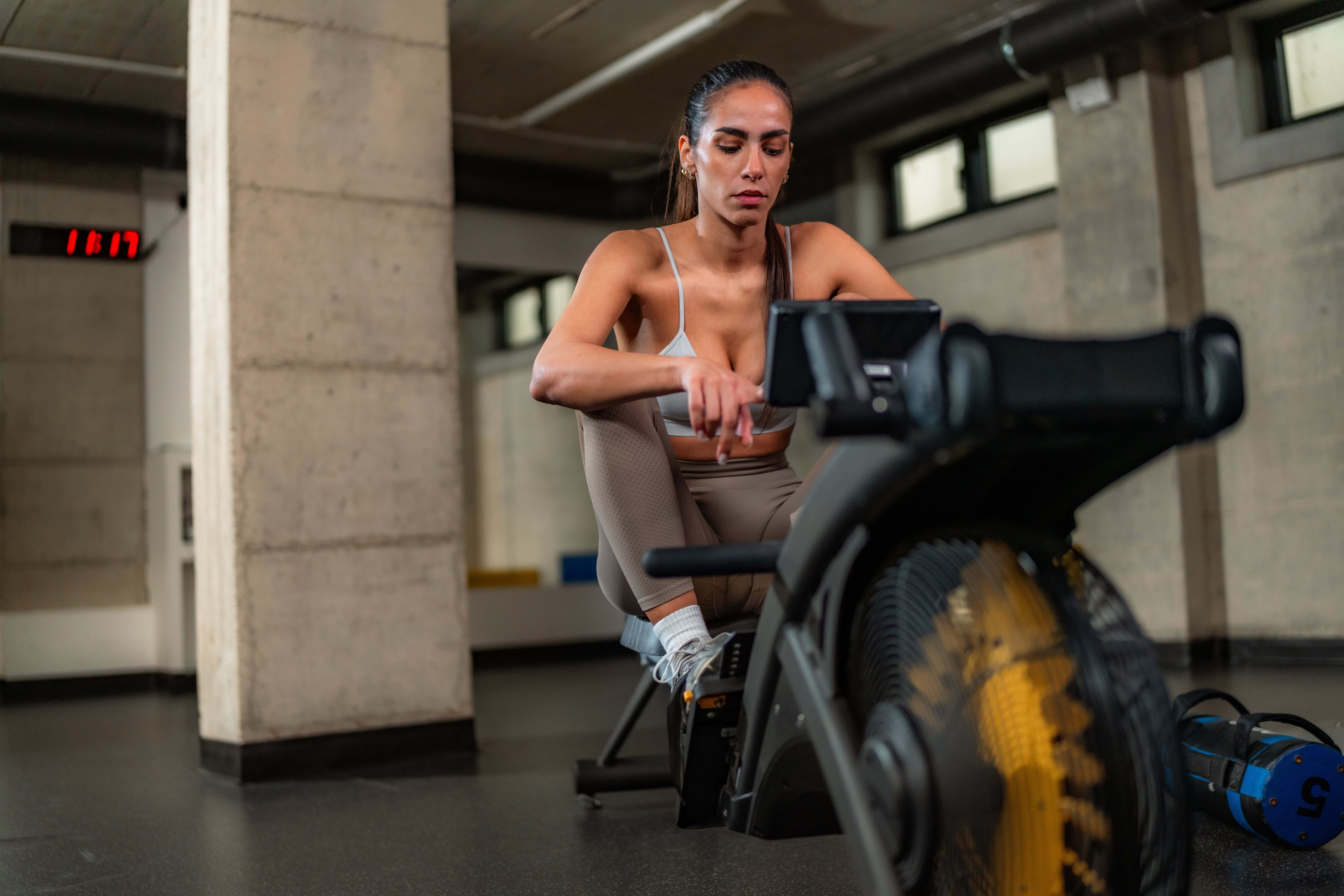
Rowing: Legs, Core, and Upper Body in One Coordinated Stroke
A proper rowing stroke follows a strict sequence. The legs drive back first - quadriceps, hamstrings, and glutes generating the primary power. Then the core braces and transfers that force through the torso. Finally, the arms pull the handle in: lats, rhomboids, biceps, and shoulders all engage to finish the stroke. Then it reverses.
That chain of movement is what makes rowing uniquely efficient. Most of the body is loaded simultaneously, which is why rowing creates such a large metabolic demand relative to the time invested.
Vertical Climber: Full-Body Activation with Strong Posterior Chain Emphasis
The vertical climber simulates a climbing motion: alternating arm and leg drives in a vertical plane. While the dominant load sits squarely on the glutes, hamstrings, quads, and calves, the arms contribute significantly through the shoulders and triceps, and the core works as a stabilizer throughout. Rowing distributes effort more evenly across the upper body, but the vertical climber still demands meaningful upper-body involvement with every stride.
Think of it as a posterior chain specialist with cardiovascular benefits - highly effective for lower-body conditioning and heart rate elevation, with solid upper-body contribution, though not the same even distribution across muscle groups that rowing produces. Rowing machine muscle activation sits at approximately 86% of total muscle groups, while vertical climbers also offer significant full-body muscle activation.
Calorie Burn: Intensity and Duration Both Determine the Outcome
Looking at raw calorie numbers alone misses half the picture. Both machines can burn significant calories - but how long the effort can be sustained matters just as much as the per-minute rate.
Rowing: Sustained Output Across Longer Sessions
A 155-pound person rowing at moderate intensity burns roughly 550-650 calories per hour. Push into high-intensity intervals and that climbs to 650-800. Rowing's full-body recruitment also drives an elevated afterburn effect (EPOC), keeping metabolism elevated after the session ends. Most people can sustain a session for 30-45 minutes without hitting a wall, meaning the per-hour rate holds up across the full workout.
Vertical Climber: High Calorie Burn Per Minute at Peak Intensity
At peak output, the vertical climber can edge past rowing - 700-900 calories per hour for a 155-pound person pushing hard. The catch is that most users, especially beginners, find the continuous climbing motion significantly more fatiguing than rowing. A realistic high-intensity vertical climber session often runs 15-20 minutes before fatigue forces a stop, which brings total calorie count back in line with a longer, more moderate rowing session.
Joint Impact and Who Each Machine Suits
Rowing's Seated, Non-Weight-Bearing Advantage
Rowing's seated position removes bodyweight stress from the knees, hips, and ankles entirely. Even during explosive interval work, the drive phase loads muscles through resistance rather than ground reaction force. This makes it one of the few high-output cardio machines that works for people managing arthritis, previous knee surgeries, or lower-limb injuries.
One caveat: technique matters. Rounding the lower back at the catch position places unnecessary stress on the lumbar spine. Learn the stroke correctly - leg drive first, flat back throughout - and rowing becomes one of the most joint-friendly tools available at any fitness level.
Vertical Climber: Low-Impact with Weight-Bearing Benefits
The vertical climber is a standing exercise, which means the skeletal system absorbs load with every stride. For healthy users without existing joint issues, that's a positive - weight-bearing exercise stimulates bone density, which becomes increasingly valuable with age. The impact level sits in the low-to-moderate range, well within safe parameters for most people. For anyone currently managing knee pain or recovering from a lower-body injury, though, the repeated loading through the knee joint during the climbing motion can aggravate existing issues rather than help them.
Which Machine Matches Your Fitness Goal?
Prioritizing Full-Body Endurance and Joint Protection: Choose Rowing
Rowing is the stronger choice for anyone who wants a machine that trains the entire body, protects the joints, and supports both long steady-state sessions and short HIIT intervals. Full-body muscle recruitment builds functional strength alongside cardiovascular fitness - not cardio alone. For home gym users focused on long-term fat loss and endurance with minimal injury risk, rowing covers the most ground.
Prioritizing Lower-Body Definition and Short HIIT Sessions: Choose Climbing
If the primary goal is building out the glutes, hamstrings, and quads while keeping heart rate in a fat-burning zone - and sessions will reliably be short and intense - the vertical climber delivers targeted stimulus that rowing doesn't match. Strong upper-body contribution and cardiovascular intensity make it a solid option for users with limited time who want maximum output in under 20 minutes.
Most home gym product retailers will have both in stock - so it might be worth comparing different models in terms of features, build, and price tag.
SOLE Fitness
City: Salt Lake City
Address: 56 Exchange Pl.
Website: https://www.soletreadmills.com/


Comments
Post a Comment