How Qigong Works for Beginners: Yoga Instructors Explain Breath & Movement
Key Takeaways
- Qigong is an ancient Chinese mind-body practice built on three pillars - regulating the body, the breath, and the mind - principles that yoga practitioners will find immediately familiar.
- The central energy concept in Qigong (Qi) operates on the same foundational logic as Prana in yoga: cultivate it, circulate it, and don't block it.
- Qigong breathing techniques like Dan Tian breathing differ meaningfully from most yogic pranayama - and that difference is worth understanding before stepping onto a new mat.
- Qigong is known to promote nervous system regulation and smoother transitions into meditative states, benefits that can complement a yoga practice.
- Credentials for Qigong teachers vary widely and are unregulated - choosing the right instructor matters more than most beginners realize.
Qigong has been circling the wellness world for years, often described in vague, mystical terms that make it feel inaccessible. Strip away the buzzwords and the picture becomes surprisingly clear - especially for anyone who already speaks the language of yoga. The two practices share more DNA than most people expect, and that overlap makes Qigong one of the most approachable complementary disciplines a yoga practitioner can study.
Qigong and Yoga: More Common Ground Than You'd Expect
Calling Qigong "Chinese Yoga" is a simplification, but not an entirely wrong one. Both practices are ancient, both center on the relationship between breath, movement, and inner awareness, and both treat the body as a system of flowing energy rather than just a collection of muscles. The differences lie in the details - and for a yoga practitioner, those details are fascinating rather than foreign.
Qigong, pronounced "chi gong," was developed in China thousands of years ago as part of traditional Chinese medicine. Its core goal is to optimize energy within the body, mind, and spirit to maintain and improve health. That framing will sound familiar to anyone who has spent time studying prana, bandhas, or the subtle body in a yoga context. ASY Studio offers practitioners a grounded entry point into movement disciplines that intersect at the level of energy and awareness.
What Qigong Actually Is
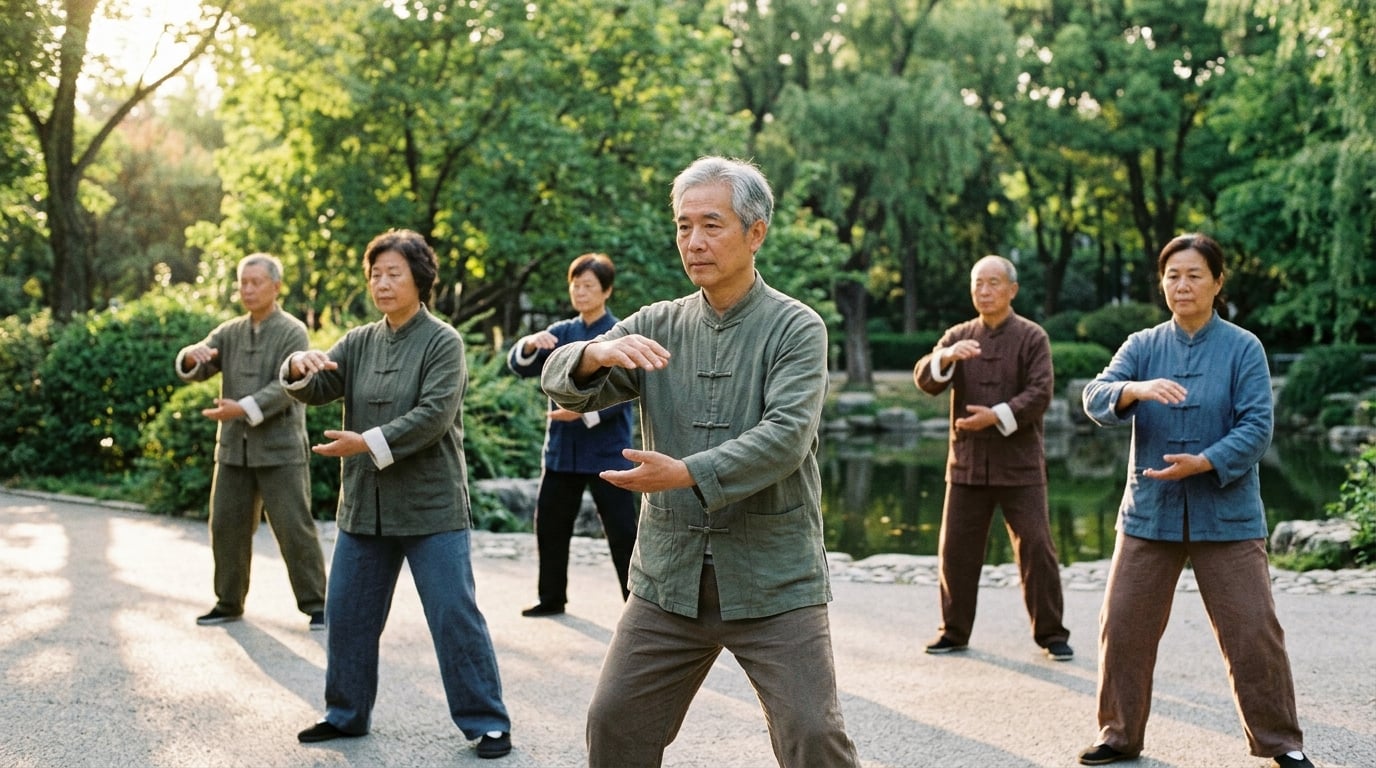
Qigong is an ancient Chinese health preservation system that includes both active physical exercises and passive meditation forms. Historically, it was known as Dao Yin - a term that translates roughly to "guiding and pulling," referring to the intentional direction of energy through the body. Today, it includes hundreds of distinct forms, from highly choreographed movement sequences to nearly still, breath-focused sitting practices.
Mind, Breath, Body: The Three Pillars
The framework that holds all of Qigong together is called San Tiao - the Three Regulations:
- Tiao Shen - Regulating the physical body (posture, alignment, ease)
- Tiao Xi - Regulating the breath (rhythm, depth, pattern)
- Tiao Xin - Regulating the heart-mind (attention, intention, emotional state)
For a yoga instructor, this framework is immediately legible. It maps closely onto the relationship between asana, pranayama, and dharana (concentration). The sequencing logic is also similar: physical regulation creates the conditions for breath regulation, which in turn creates the conditions for mental stillness.
Active vs. Meditative Forms
Qigong breaks into two broad categories. Active Qigong prioritizes body movement - flowing sequences of the whole body, arms, and legs that resemble slow-motion choreography. Meditative Qigong can be practiced in any sustainable posture and relies almost entirely on breath and mental focus, with minimal movement. Most beginners encounter active forms first, but experienced practitioners move between both depending on their goal for a given session.
Qi vs. Prana: Different Words, Shared Logic
Qi and Prana aren't the same concept - but they operate on the same underlying principle. Both describe a vital life-force energy that flows through the body along specific pathways: meridians in Chinese medicine, nadis in yogic anatomy. Both traditions hold that health depends on this energy flowing freely, and that blockages lead to physical or emotional dysfunction.
Where they diverge is in their specific maps of the body and the techniques used to influence energy flow. Qigong works with acupuncture meridians and focuses energy through coordinated breath and movement. Yoga works with nadis and chakras, using posture, breath locks, and visualization. The destination - a body in which energy moves without obstruction - is effectively the same. This shared logic is precisely why Qigong and Tai Chi can complement yoga practice, offering additional methods to directly experience energy flow in the body.
How Qigong Breathing Differs From What Yogis Know
This is where even experienced yoga practitioners have to slow down and pay attention. Qigong breathing is not simply pranayama with a different name. The techniques are distinct in both mechanics and intention.
According to the National Center for Complementary and Integrative Health (NCCIH), Qigong breath is generally slow, long, and deep - but breath patterns can shift, sometimes incorporating specific speech sounds, a feature absent from most yoga traditions. The purpose of breath in Qigong is explicitly tied to Qi cultivation and circulation, not just oxygenation or nervous system regulation.
Dan Tian Breathing: Where to Start
Dan Tian breathing is the most common starting point for Qigong beginners. During inhalation, the diaphragm draws downward and the lower abdomen expands forward. Attention is anchored at the lower Dan Tian - a point roughly two inches below the navel considered the body's primary reservoir of Qi. This shares some mechanical similarity with yogic abdominal breathing, but the energetic intention differs: the goal is to fill and energize a specific center, not simply to breathe deeply.
Specialized Breathing Techniques
Beyond Dan Tian breathing, Qigong includes more specialized approaches:
- Some Qigong breathing practices are used for purifying the lungs and quieting mental noise - comparable to a long, releasing exhale at the end of a yoga class.
- Other practices are designed to progressively increase lung capacity and draw more Qi into the system.
- Advanced Qigong techniques may create internal pressure to drive robust Qi circulation through the meridians.
Some advanced practices, such as Microcosmic Orbit Breathing, integrate visualization alongside the breath - guiding Qi along a circular pathway up the spine and down the front of the body. For anyone who has practiced yoga nidra or trataka, the use of inner imagery as a functional tool will feel recognizable.
The Movement: Gentle, Circular, and Deliberately Slow
Why Softness Is the Point
Qigong movement is not a workout in the conventional sense. The movements are gentle, circular, and meditative - prioritizing internal awareness and ease over the strength, extension, and alignment precision that yoga asana often demands. Tension blocks Qi; release allows it to move. The slow pace is not a beginner-friendly modification - it is the advanced skill.
For yoga practitioners accustomed to holding edge-of-range postures, this can be the biggest adjustment. The body is asked to do less on the outside so that more can happen on the inside.
How Tai Chi Fits Into Qigong
Tai Chi is more accurately understood as one specific form of Qigong rather than a separate discipline. It originated as a martial art and evolved toward health promotion and rehabilitation. Practiced for health, it qualifies as Qigong: integrated physical postures, focused attention, and controlled breathing used to cultivate and circulate Qi. Other well-known Qigong forms include Baduanjin (Eight Brocades), Yijin Jing, and Liuzijue (Six Healing Sounds).
What Yoga Instructors Notice When Students Try Qigong
Yoga instructors who have incorporated Qigong into their teaching report consistent patterns. Students typically experience heightened energy awareness, reduced muscular tension, improved breath sensitivity, and smoother transitions into meditative states - all within a relatively short exposure period. The feedback points to Qigong opening something that yoga then gets to work with, rather than replacing it.
Nervous System Reset Before the Mat
Qigong is known to promote nervous system regulation and smoother transitions into meditative states - benefits that pair well with yoga practice. For students who arrive to class still carrying the overstimulation of a busy day, a short Qigong sequence can quiet the system before the yoga practice formally begins. The gentle, circular movements and anchored breathing create parasympathetic conditions that a yoga class would otherwise need time to build toward. Some instructors describe it as pre-loading the calm.
Choose Your Qigong Teacher Carefully
Qigong instructors are not licensed or regulated by any federal or state authority in the United States. There is no national certification standard. Various Qigong organizations offer training and certification programs, but criteria and depth differ significantly between them.
Before committing to a teacher or a class, ask directly about their training lineage, how long they have studied, and whether they trained under a recognized Qigong master or organization. A good teacher will welcome these questions. This matters more in Qigong than in many other wellness disciplines because poor instruction - particularly around breath techniques and energy cultivation - can produce frustration at best and counterproductive results at worst.
Qigong Doesn't Replace Yoga - It Deepens It
For yoga practitioners approaching Qigong, the most useful reframe is this: these are complementary systems that reinforce each other at the level of breath, energy, and mind-body integration. Qigong adds a different texture - softer movement, more internal focus, a distinct energetic vocabulary - that can make a yoga practice richer and more nuanced over time.
Practitioners who study both often find that Qigong gives them new ways to understand experiences they have been having on the yoga mat for years. The language is different; the territory is familiar. That combination makes Qigong highly learnable for anyone who already practices yoga.
For those ready to see where yoga and mindful movement intersect, ASY Studio offers expert-led classes and guidance designed to help practitioners of all levels deepen their mind-body practice.
ASY studio
City: Warszawa
Address: 40 Studencka #10
Website: https://asy-studio.pl/


Comments
Post a Comment