Do Home Mold Inspections Before Buying or Selling? Tampa Pros Reveal Risks
Key Takeaways
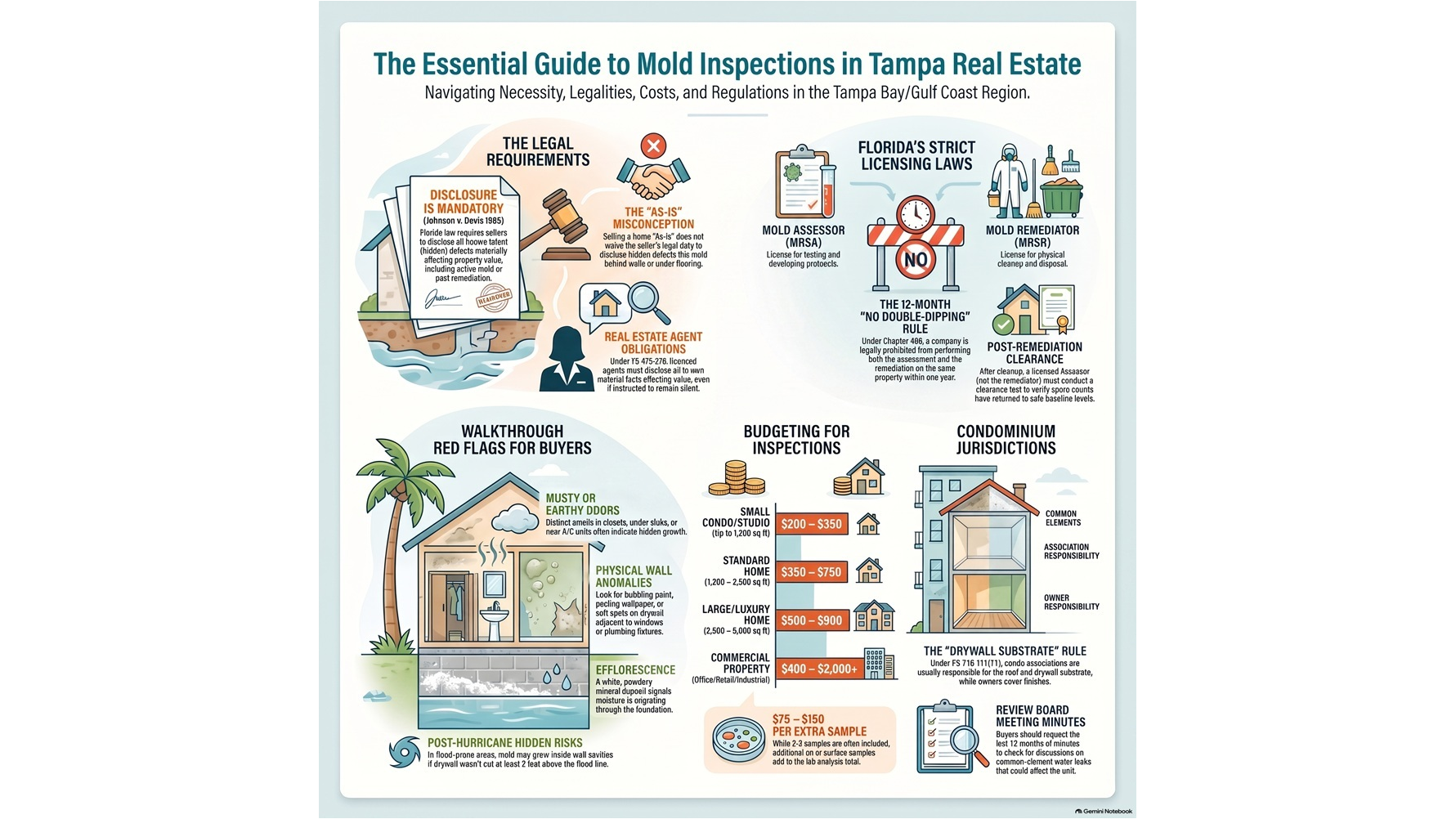
- Florida's disclosure law is non-negotiable: Under the landmark Johnson v. Davis (1985) ruling, sellers must disclose known mold - even in "as-is" sales.
- Post-hurricane mold is a hidden threat: After Hurricanes Helene and Milton in 2024, restoration professionals reported widespread mold growth in flooded Tampa Bay homes - much of it concealed inside wall cavities.
- State law prevents conflict-of-interest inspections: Florida's Chapter 468 licensing rules create a strict separation between mold assessment and remediation - read on to find out what that means for your transaction.
- A $350-$900 inspection can prevent tens of thousands in post-closing costs - for both buyers and sellers.
Tampa Bay's real estate market moves fast. Between competitive offers, inspection windows, and stacks of contracts, mold is one detail that buyers and sellers alike tend to underestimate - until it becomes a legal or financial crisis. Here's what the law, the climate, and the local market actually require.
Tampa Bay's Climate Makes Mold a Deal-Breaker
Tampa Bay's subtropical humidity creates a near-perfect year-round environment for mold colonization. Mold spores can begin growing within 24 to 48 hours of moisture exposure. In a region where afternoon thunderstorms, roof condensation, and aging A/C systems are the norm, moisture finds its way into homes constantly.
That baseline risk is why mold carries so much weight in Tampa real estate transactions. It's a predictable byproduct of the local climate that both buyers and sellers need to account for. The team at TampaBayMold.net breaks this down in detail, explaining how Tampa's specific conditions create mold risks that simply don't apply in drier markets.
Florida Law Forces Seller Disclosure - Even "As-Is"
One of the most common misconceptions in Florida real estate: listing a home "as-is" removes the obligation to disclose defects. It doesn't.
What Johnson v. Davis (1985) Actually Requires
Before 1985, Florida followed caveat emptor - "buyer beware" - which placed the full burden of discovering defects on the purchaser. The Florida Supreme Court's ruling in Johnson v. Davis changed that permanently. The court held that sellers must disclose all known facts that materially affect a property's value and are not readily observable by a reasonably diligent buyer.
Mold qualifies on every count. It affects indoor air quality, occupant health, and structural integrity - and it's almost always hidden inside walls, under floors, or above ceiling tiles. A seller who knows about past water intrusion, prior remediation, or active mold growth is legally required to disclose it in writing, regardless of how the contract is structured. Failure to do so can expose a seller to claims of fraud or misrepresentation, with remedies including rescission of the sale or monetary damages.
The FAR/BAR Disclosure Form's Mold Questions
Most Florida residential sales use the standard FAR/BAR Contract, developed jointly by Florida Realtors and the Florida Bar. The accompanying Seller's Property Disclosure form includes direct yes/no questions about water intrusion, roof leaks, mold history, and environmental hazards. Checking "No" to conceal a known issue isn't a gray area - it's the kind of documented misrepresentation that ends up in post-closing litigation.
Post-Hurricane Mold: The Hidden Threat Buyers Miss
The 2024 hurricane season raised the stakes dramatically for Tampa Bay home buyers. Hurricanes Helene and Milton created what restoration professionals called a "two-storm" problem - storm surge flooding lower levels while wind-driven rain infiltrated upper walls and rooflines, often in the same home. Restoration professionals reported widespread mold growth across flooded Tampa Bay properties following those storms.
Why All of Tampa Bay Is Vulnerable, Not Just Coastal Areas
The risk isn't limited to beachfront properties. Low-lying inland neighborhoods - including parts of Shore Acres and Venetian Isles in St. Petersburg, New Port Richey, and flood-prone pockets of South Tampa - all saw significant water intrusion. The deeper problem: some homeowners dried out surfaces, applied fresh paint, and relisted without addressing moisture trapped inside wall cavities. A general home inspection won't catch that. A licensed mold assessor with air sampling and moisture mapping equipment will.
Physical Red Flags to Spot During Your Walkthrough
Before scheduling a professional, watch for these warning signs during an initial tour:
- Musty or earthy odors in closets, under sinks, or near the A/C air handler
- Water staining - dark or yellowed rings on ceilings below bathrooms or near roof valleys
- Soft spots or bubbling paint on walls adjacent to plumbing or window frames
- Black dust or streaking around A/C supply vents, or standing water in the air handler's drip pan
- Efflorescence - white powdery mineral deposits along the base of concrete block walls, common in older neighborhoods like Seminole Heights or Tampa Heights, signaling moisture migrating through the foundation
Any single one of these is reason enough to call in a licensed mold assessor before proceeding.
Florida's Anti-"Double-Dipping" Licensing Law
Florida rigorously licenses mold professionals at the state level. Under Chapter 468, Part XVI of the Florida Statutes, anyone performing mold services on an area larger than 10 square feet must hold an active license from the Florida Department of Business and Professional Regulation (DBPR).
Chapter 468: Two Licenses, Two Companies
The law creates two distinct professional categories. A Florida Licensed Mold Assessor (MRSA) is authorized to inspect, sample, and write remediation protocols. A Florida Licensed Mold Remediator (MRSR) performs the physical cleanup and disposal. To prevent predatory "find-and-fix" schemes, the same company cannot perform both the assessment and the remediation on the same property within a 12-month period when visible mold exceeds 10 square feet. That separation ensures the inspection result isn't influenced by who profits from the cleanup.
When hiring for any transaction, always verify that the assessor holds an active MRSA license through the DBPR - not just a general contractor's license or a home inspector certification.
The FAR/BAR Mold Rider: Built-In Protection for Buyers and Sellers
Real estate agents frequently attach a FAR/BAR Mold Inspection Rider to residential contracts in Tampa. This rider creates a dedicated inspection window specifically for mold testing - separate from the general inspection contingency - and establishes a negotiated dollar threshold for remediation costs. If a licensed assessor finds mold and the estimated remediation cost exceeds the agreed limit, the buyer has the option to cancel the contract and recover their deposit.
For sellers, the rider creates documentation of good faith. For buyers, it's a structured off-ramp if testing reveals a serious problem. Either way, it's a practical tool worth discussing with a real estate agent before signing.
What a Tampa Mold Inspection Actually Costs
A standard residential mold inspection in Tampa Bay typically runs $350 to $900, with the final number depending on property size, complexity, and the number of lab-analyzed air samples required. A small condo under 1,200 square feet generally lands in the $350-$500 range. A mid-size single-family home falls between $500-$750. Larger or waterfront luxury properties can exceed $900.
A baseline inspection usually includes a full visual assessment, pinless moisture meter readings, and two air samples - one indoors at the area of concern, one outside as a control baseline. Comparing the indoor spore count and species mix against the outdoor sample tells the lab whether an active indoor mold reservoir exists. Additional samples add roughly $75-$150 each.
Inspection vs. Post-Remediation Clearance Testing
If a home has already been remediated, buyers should insist on seeing a Post-Remediation Verification (PRV) certificate - a clearance test conducted by a licensed Mold Assessor (not the company that did the cleanup) confirming that indoor spore levels have returned to safe baseline levels. This test costs $350-$600 in the Tampa market and should be provided before closing. No clearance certificate means no verified proof the remediation actually worked.
For context on remediation costs: Tampa projects typically run approximately 7.5% above the national average, with most jobs ranging from $1,347 to $3,778 depending on scope - a figure that quickly eclipses the cost of an inspection if problems are caught early.
Condo Buyers: Know Who Owes the Fix
Mold liability in Florida condos splits along jurisdictional lines. Under Florida Statute 718.111(11), the condominium association is generally responsible for common elements - roofs, exterior walls, and shared plumbing risers. The unit owner is responsible for the interior finishes: paint, flooring, cabinetry, and personal property.
If a mold problem traces back to a roof leak or shared plumbing failure, the association bears the repair cost. The unit seller must still disclose the event to any prospective buyer. Before closing on a Tampa condo, request the association's reserve study, pending litigation disclosures, and board meeting minutes from the past 12 months. Water intrusion and mold issues in shared structures are regularly discussed at the board level - and unresolved ones can trigger special assessments that land squarely on the new owner.
A $400 Inspection Can Head Off Tens of Thousands in Remediation and Legal Costs
The math is straightforward. A mold inspection in Tampa costs a few hundred dollars. A remediation project - once mold has spread through wall cavities - runs well into the thousands, and that's before factoring in attorney fees, rescission demands, or post-closing litigation. For sellers, disclosure paired with a PRV certificate transforms a potential liability into a documented clean bill of health. For buyers, a licensed assessment is the only way to confirm that a freshly painted wall is actually sound.
In Tampa Bay's humid, hurricane-prone, legally specific real estate market, a mold inspection is a basic due-diligence step that protects both sides of the transaction.
For expert mold assessments backed by over 12+ years of Tampa Bay experience, TampaBayMold.net provides licensed inspections and clearance testing that help buyers and sellers close with confidence.
TampaBayMold.net
City: Tampa
Address: 550 N. Reo St. Suite #300
Website: https://www.tampabaymold.net


Comments
Post a Comment