Why Lead Scoring for Contractors: Eliminating Tire-Kickers Pre-Contact
Key Takeaways
- Most contractor lead forms collect contact info from anyone - including people who were never going to hire anyone.
- A quote-first approach filters out unserious prospects before they ever enter your inbox, by showing pricing upfront.
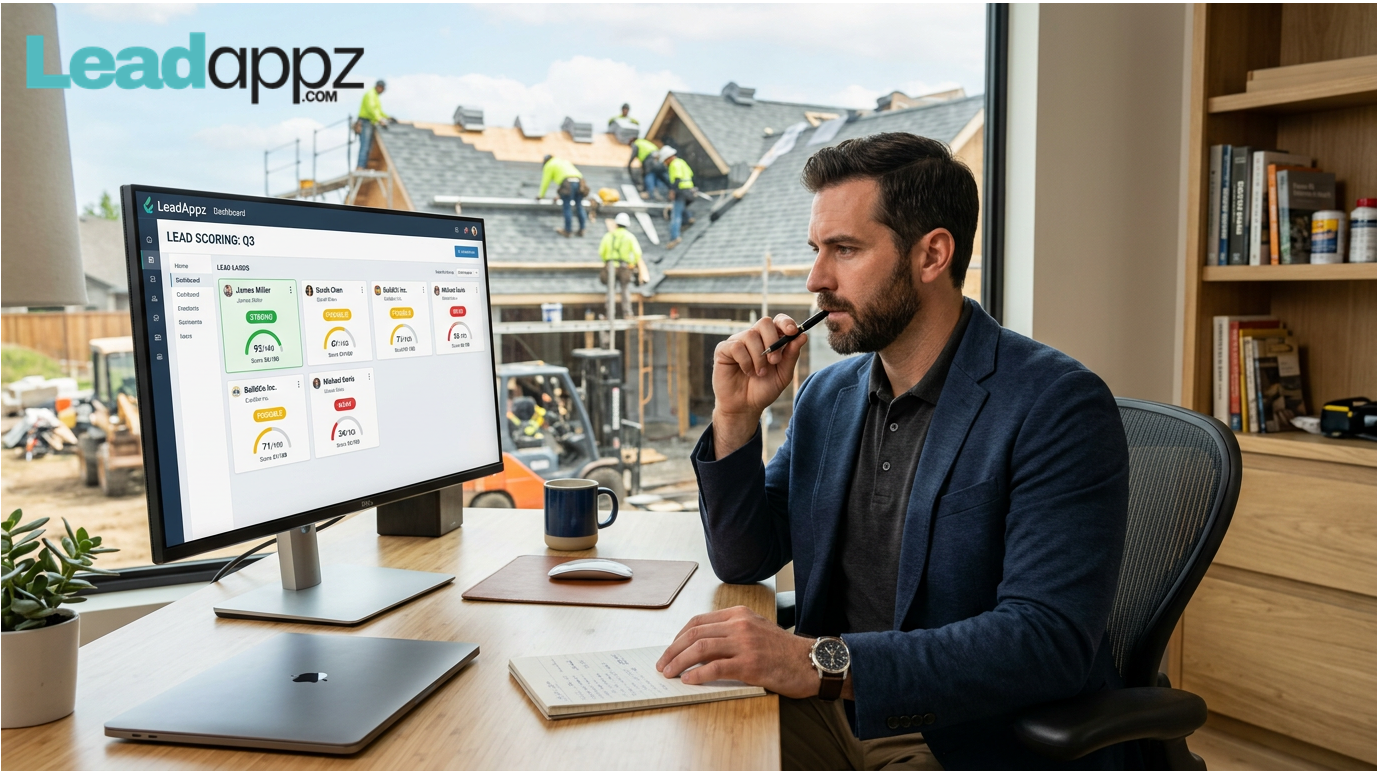
- Lead scoring that weighs urgency and project scope means every lead arriving in your dashboard already carries a quality rating: Strong, Possible, or Weak.
- Businesses with effective lead qualification processes report significantly higher marketing ROI than those without any filtering system.
- LeadAppz is built specifically around this quote-first, score-first model - and the dashboard tracks each lead all the way to closed revenue.
Every contractor knows what a tire-kicker looks like in hindsight. The problem is, by the time you realize it, you've already driven out for a free estimate, put together a proposal, and spent an hour on the phone. Lead scoring changes when that filter happens - moving it from after the conversation to before the first contact.
Tire-Kickers Cost Contractors More Than Just Time
The true cost of a bad lead goes well beyond a 20-minute phone call. There's the wasted site visit, the proposal that goes nowhere, and the missed callback from a real customer while you're chasing a dead one. For roofing, deck, fence, gutter, and siding contractors, those losses stack up fast across a busy season.
Unqualified leads drain hours, team morale, and advertising budgets. Every dollar spent driving traffic to a form that anyone can fill out - regardless of intent or budget - is a dollar that may return nothing. Poor-quality leads in home improvement bring wasted ad spend, lost sales opportunities, and a slow erosion of confidence in your own marketing.
Why Traditional Lead Forms Fail Contractors
The standard contact form asks for a name, a phone number, and maybe a project type. There's no friction, no commitment, and no way to tell a serious buyer from someone who clicked an ad out of idle curiosity.
Shared Leads, Wasted Bids
Lead aggregator platforms made this worse. Contractors pay per lead, but those leads are sold to multiple contractors at once. The result is a bidding war on low-margin jobs, where every contractor races to be first to call someone who may have already chosen a neighbor - or was never serious to begin with. There are no exclusive relationships, just a shared list of names that everyone's already calling.
Cold Form Fills With No Real Project
Even on a contractor's own website, a basic contact form has no qualifying mechanism. A visitor with no real project - just vague curiosity about what a deck might cost - fills out the form the same way a ready-to-sign homeowner does. The contractor has no way to know the difference until they're already invested.
The Quote-First Difference
The quote-first model flips the sequence. Instead of collecting contact information first and revealing pricing later, it shows the visitor a personalized price range before asking for their name or number. That one change rewires the entire dynamic of lead capture.
Price Transparency Filters Out the Unserious
When a homeowner sees a realistic price range for a fence replacement or a new roof, they make a decision right there. If the number works for them, they move forward and share their contact info. If it doesn't - because they were hoping for a price that doesn't exist, or they were just curious - they leave. No form fill. No wasted follow-up. No awkward conversation where you realize twenty minutes in that their budget is half your minimum.
Upfront pricing manages customer expectations and naturally attracts clients who are genuinely interested and financially prepared. The self-selection that happens at the price reveal step is the most efficient qualifier a contractor can use.
Pricing Interaction Signals Genuine Intent Before Contact
A visitor who sees a $7,000-$11,000 roofing estimate and still chooses to enter their contact info is signaling something real. They're not surprised by the number - they're ready to talk. That behavioral signal, engaging with pricing and proceeding anyway, is a far stronger indicator of intent than any standard form fill.
How LeadAppz Scores Leads Before They Hit Your Inbox
LeadAppz is built entirely around this pre-contact qualification model. Its 5-step flow - qualify, timing, score, quote, capture - means that by the time a lead lands in the contractor's dashboard, it already carries a full profile: service type, project scope, urgency level, estimated price range, and a strength rating.
Strong, Possible, or Weak - Rated Instantly
Every lead that comes through gets automatically rated Strong, Possible, or Weak. The rating is calculated from the answers given during the flow - not assigned arbitrarily. A homeowner who needs a roof replacement ASAP and selected a premium project scope scores Strong. Someone gathering quotes on a small repair scores Weak. The contractor sees that rating before they ever pick up the phone.
Urgency and Project Scope Built Into Every Score
The scoring factors in two of the most telling dimensions of any lead: how soon the work is needed, and how large the project is. Timing options range from ASAP / within 2 weeks to just gathering quotes. Project scope options range from Premium to Small repair. Both feed directly into the strength score, so high-priority leads rise to the top of the queue automatically.
Your Rates, Your Services, Your Leads
Lead quality goes beyond buyer intent - fit matters too. A gutter contractor who doesn't do repairs shouldn't be receiving repair leads. A roofer who only works on residential shouldn't be fielding commercial inquiries. LeadAppz addresses this by letting contractors set both the services they offer and the pricing rates used to generate estimates.
No Leads for Work You Don't Want
Services can be toggled on or off, so the app only presents options that match what the contractor actually does. Adjustable pricing tables let contractors tune estimates to their local market rates, which means the price range a visitor sees reflects what that contractor would actually quote - not a national average that under- or over-prices the job. Leads come in pre-filtered by service type and pre-priced to the contractor's real numbers, before any human conversation happens.
The Dashboard That Shows Real Revenue
Most marketing tools show impressions, clicks, and form fills. LeadAppz tracks those too - but goes further, all the way to dollars closed. The Customers tab shows individual leads by name, their conversion status, and the revenue tied to each job. A contractor can look at the dashboard and see, literally: Sarah Mitchell - Converted - $8,400. Daniel Cohen - Converted - $12,900.
That's a book of business tied directly to a marketing tool - not a vanity metric. The Analytics tab adds weekly lead counts, conversion rate, strong lead percentage, and a daily bar chart, so a contractor always knows whether their lead flow is healthy or needs attention.
Traffic and Capture: The VisiblyRanked Closed Loop
A lead scoring app only works if people actually find it. LeadAppz pairs the capture tool with VisiblyRanked, a done-for-you content distribution engine that pushes a contractor's business across a 300+ network of news sites, media outlets, and local platforms. A documented case study of a Dallas-area roofing company demonstrates this in practice — page-one Google rankings for competitive keywords within three months, available at visiblyranked.com/app/reasons/roofing-company-on-page-1-of-google-in-3-months. The goal is to own the local search results for high-intent queries - the kind typed by someone who has already decided they need a new fence or gutters and is looking for a contractor now.
Local SEO and targeted content marketing are among the most effective strategies for attracting high-intent leads within a specific service area. When that traffic lands on a site equipped with a quote-first lead app, the closed loop is complete: traffic arrives, the app qualifies it, and the dashboard tracks it to revenue.
Better-Qualified Leads Mean Better Marketing ROI
Businesses with effective lead qualification processes report a 77% higher marketing ROI compared to those without one. That gap exists because unqualified leads don't just fail to convert - they actively cost money in follow-up time, proposal preparation, and opportunity cost. Every hour spent on a tire-kicker is an hour not spent on a real customer.
When leads arrive pre-scored and pre-qualified, the math changes. Fewer leads can mean more revenue, because the conversion rate on strong leads is fundamentally higher than on cold form fills. Marketing spend becomes more efficient - not by spending more, but by wasting less.
Stop Chasing Leads - Let Bad Ones Filter Themselves Out
The most effective lead qualification system is one that doesn't require the contractor to do the qualifying manually. When price transparency is built into the first touchpoint, unserious prospects disqualify themselves. When urgency and scope feed into an automated score, the contractor's first call is always to someone who already knows the ballpark price and still wants to move forward.
That shift - from chasing every lead to responding to pre-qualified ones - is the difference between a sales process built on hope and one built on signal. The filter happens before contact. The contractor shows up to the conversation already knowing what kind of lead they're talking to.
See how the quote-first, score-first model works for your contracting business at LeadAppz — try the live demo at https://leadappz.com/apps and see how the lead scoring dashboard would look for your specific business.
Leadappz
City: Waupaca
Address: 804 7th Street
Website: https://leadappz.com
Phone: +1 715 281 0793
Email: Bradleyjschafer@gmail.com
Comments
Post a Comment