Why Gritless Rubber Coating Persists: SoftPlex Grip Engineering Explained
Key Takeaways
- Grit-sprayed pickleball paddle surfaces wear down with play, quietly eroding the spin performance serious players depend on.
- SoftPlex - KOBO Sports LLC's proprietary rubber-like coating - generates spin through elastomeric grip rather than surface roughness, which changes the durability equation entirely.
- USA Pickleball has approved the SoftPlex surface as tournament-legal, confirming it meets official regulations on surface texture and reflectivity.
- The engineering runs deeper than just the face: KOBO's hand-built DuraCore construction and edgeless unibody design affect feel, consistency, and control in ways that compound the surface advantage.
- For 3.5+ players, the long-term spin persistence math favors a grip-based surface - and the section below breaks down exactly why.
Spin in pickleball is not just about generating pace - it's about consistency. A serve that kicks wide, a dink that drops short, a reset that holds its line: all of it relies on a surface that interacts with the ball the same way on the hundredth shot as it did on the first. That's where most paddles quietly fail, and where the engineering conversation gets interesting.
Grit Wears Out. KOBO's Answer Is Engineered In.
Most spin-focused paddles on the market use the same basic approach: rough up the face. A textured surface grabs the ball and generates rotation. It's simple, it's effective, and it works well - right up until it doesn't. The honest problem with grit is that it has a lifespan, and that lifespan runs out faster than the price tag suggests it should.
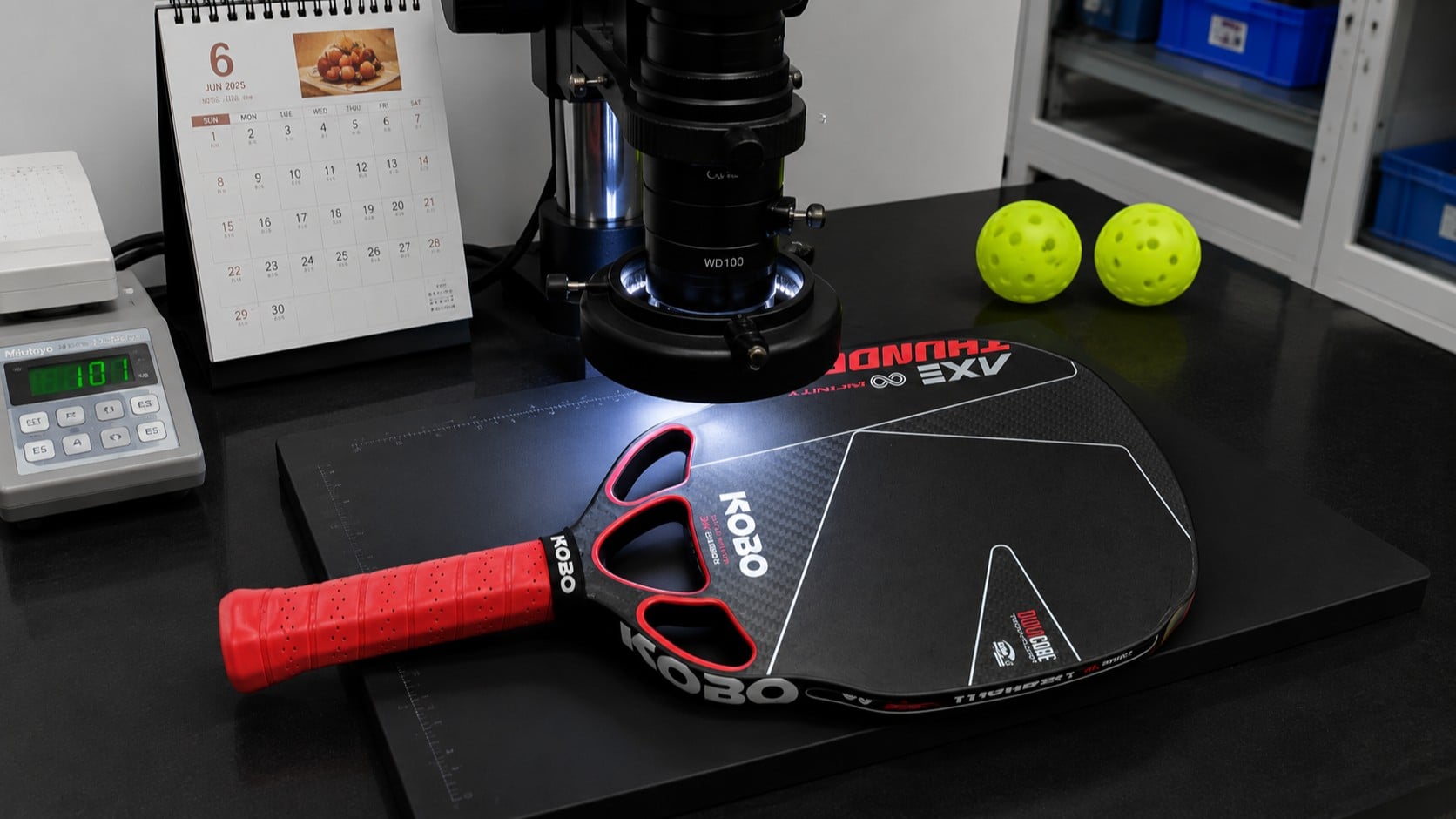
KOBO Sports LLC approached this from a different angle. Rather than adding roughness to a surface, their engineers built grip directly into the coating material itself. That shift - from abrasion-based spin to elastomeric-grip-based spin - is the core of what SoftPlex is and why its performance holds differently over time. The KOBO Thunder Axe Infinity 18mm is where this coating is currently deployed in its most complete form, paired with a hand-built core and an edgeless unibody frame.
Why Grit-Sprayed Surfaces Fail Serious Players
How Raw Carbon Fiber Texture Degrades With Play
Raw carbon fiber has natural surface texture - a slight weave pattern that contributes meaningfully to spin when a paddle is new. The problem is that texture is structural and exposed. Every ball strike, every slide across a bag, every drop on the court wears it incrementally smoother. The degradation isn't dramatic or sudden. It's gradual enough that players often don't notice until they're chasing pace and spin that quietly stopped being there weeks ago.
Grit-sprayed finishes face the same fundamental issue. The abrasive particles applied over the surface are essentially a sacrificial layer - useful, but finite. Competitive players hitting hundreds of balls per session accelerate that wear cycle considerably.
The Real Cost of a Worn Spin Surface
A paddle with a worn face doesn't just spin less - it spins inconsistently. Patches of the face may retain more texture than others, which means shot response becomes less predictable. For players working at 3.5 and above, where strategic ball placement and spin variation are central to the game, that inconsistency is a real competitive liability. The financial math isn't flattering either: for competitive players who wear through grit surfaces quickly, replacing a $280-$350 premium paddle multiple times a season adds up fast.
What SoftPlex Actually Is (And Isn't)
A Proprietary Rubber-Like Coating, Not Table Tennis Rubber
SoftPlex is described by KOBO as a semi-transparent, proprietary rubber-like coating - and that rubber-like qualifier matters. It is not a table tennis rubber sheet applied to a paddle face. Table tennis rubbers involve a layered system of top sheet and sponge, engineered for a completely different sport with different ball physics and significantly different rules.
SoftPlex is its own formulation, purpose-built for pickleball. Reviewers consistently describe the feel as suede to touch - soft and slightly tacky without feeling sticky. That tactile quality is the surface's grip mechanism at rest. When the ball contacts it, the coating deforms slightly and wraps around the ball's surface, generating friction and therefore spin through mechanical grip rather than abrasion.
How Grip-Based Spin Differs From Grit-Based Spin
The distinction is worth unpacking. Grit-based spin works like sandpaper: the rough particles catch the ball's surface and create drag that produces rotation. Grip-based spin works more like a rubber band stretched briefly against the ball - the elastomeric material deforms on contact, maximizes the friction window, and releases the ball with rotational energy transferred through that brief grip event.
The practical difference shows up in two places: feel at contact and durability over time. The grip mechanism produces a softer, more pillowy contact sensation that players describe as controlled rather than poppy. Because the grip comes from the material's elastic properties rather than its surface roughness, there's no sacrificial layer being worn away with each strike.
USA Pickleball Approval: What It Confirms About Surface Legality
USA Pickleball regulates paddle surfaces on criteria including roughness limits, reflectivity limits, and spin rate thresholds. The SoftPlex coating has received official USA Pickleball approval, confirming the surface falls within the legal range - grippy enough to be competitive, but not so aggressively textured that it violates the rules. Tournament-legal status also matters practically: players can use the paddle in sanctioned events without concern.
Why the Coating's Spin Holds Longer
Grit vs. Elastomeric Grip: A Durability Comparison
The durability gap between the two approaches comes down to what's actually being consumed during play.
- Grit surfaces: Abrasive particles sit on top of the face. Ball contact, friction, and impact gradually dislodge or flatten those particles. The spin-generating mechanism is the surface layer itself - and it has a finite amount of material to lose.
- Elastomeric grip surfaces: The material flexes and recovers rather than wearing away particle by particle. The grip comes from the coating's elastic properties, which don't diminish the same way abrasion does under normal play conditions.
Research into advanced polymer composites in racket sports points toward the same principle: durable spin surfaces require the grip mechanism to be embedded in the material's behavior, not applied on top of it. SoftPlex is engineered around that principle. Reviewers who've used the Thunder Axe over extended periods consistently note that the surface response holds in a way that grit-sprayed competitors don't.
DuraCore: KOBO's Hand-Built Foundation
Precision Carbon Layering vs. Mass-Produced Cores
The surface story doesn't exist independently of what's underneath it. A coating's performance is only as consistent as the core it's bonded to. KOBO's DuraCore is hand-built - carbon laid down strip by strip rather than stamped or pressed in bulk. Hand-laid carbon construction, while labor-intensive, allows for precise fiber orientation and material placement that mass production can't reliably replicate. The result is a core that's more dimensionally consistent across the face, which matters for predictable ball response.
Unibody Fusion and Why It Affects Feel
The paddle is fused as a single piece - face, core, and frame constructed as one unified structure rather than glued or bonded components. That unibody approach eliminates the micro-movement that occurs at joint points in assembled paddles, which is a primary driver of the dead or inconsistent feel players notice as glued connections loosen over time. The contact sound players report - a muted, solid thud rather than a hollow crack - is a direct output of that construction. Every Thunder Axe is individually serial-numbered, and production runs in limited batches because the handwork involved can't be scaled the way injection molding can.
Aerodynamic Channels and Paddle Weight
How Throat Geometry Reduces Swing Resistance
The Thunder Axe's throat features scooped-out channels that reduce material mass in the transition zone between handle and head. That's functional weight reduction in a location that directly affects swing speed. The paddle comes in right around 8 ounces, and the channel geometry means it moves through the air with less resistance than the head shape would suggest. Fast hands at the net require a paddle that doesn't fight the swing, and the throat design addresses that directly. Reviewer Taylor Gervais of Pickleheads captured it well: while this feels like an axe in your hand, the design makes it fly through the air.
Edgeless Design: The Control Trade-Off
Removing the plastic edge guard changes the paddle's interaction with the ball in two meaningful ways. First, it slightly expands the usable hitting surface by eliminating the raised rim that can deflect off-center shots unpredictably. Second - and this is the honest trade-off - it reduces protection against frame-first contact with the court. Players who drag or drop their paddle regularly will see more wear on an edgeless frame than they would on a guarded one.
For players whose game centers on precision placement rather than hard swings at full extension, the edgeless design is a net positive. The sweet spot is responsive and consistent. Catch the ball there and the result is clean. Miss it significantly, and the feedback is immediate. For a control-oriented player, that's useful information rather than a flaw.
For 3.5+ Players, the Surface Math Favors SoftPlex
At 3.5 and above, the game becomes increasingly about ball manipulation - spin variation, placement precision, and consistency under pressure. Those demands expose the limits of grit-based surfaces faster, because the player is making more contact, hitting more spin-dependent shots, and relying on predictable surface behavior to execute strategy rather than just generate pace.
SoftPlex addresses the persistence problem directly. The grip mechanism doesn't rely on surface particles that deplete. The unibody DuraCore keeps the playing surface stable over time. The aerodynamic design keeps hand speed available even as rallies lengthen. For players who've cycled through premium grit paddles and watched their spin surface quietly fade within a season, the engineering logic behind a grip-based coating isn't a curiosity - it's a solution to a problem they've already lived.
Learn more about KOBO Sports LLC's approach to paddle engineering at kobopickleball.co.
KOBO SPORTS LLC
City: Gilbert
Address: 929 N Val Vista Dr
Website: https://www.kobopickleball.co
Phone: +1 416 809 2922
Email: customer.support@kobopickleball.com


Comments
Post a Comment