When Did Workplace Violence Become Part of the Job in Healthcare?
Key Takeaways
- Workplace violence against nurses is not random or unpredictable — it follows recognizable patterns that make it preventable, not inevitable.
- Healthcare already has proven frameworks for tackling predictable harm (think wrong-site surgery and hospital-acquired infections), yet those same frameworks are rarely applied to nurse safety.
- The language used inside healthcare organizations matters enormously: calling violence "part of the job" shuts down the systematic learning that could actually stop it.
- Laws like Canada's Bill C-3 have started to shift legal accountability, but courtroom outcomes still lag behind the scale of the problem.
- Understanding why violence gets a pass that other harms don't — and what a consistent safety standard would look like — is exactly what healthcare leaders need to reckon with right now.
A nurse gets punched during a night shift. She files an incident report, takes a few days off, and comes back. Everyone moves on. A patient receives medication at the wrong dose and an entire root-cause analysis is launched within 48 hours. Policies are rewritten. Leaders are briefed. The contrast is striking — and it isn't accidental.
Workplace violence in healthcare has become something institutions manage emotionally rather than operationally. It doesn't reflect the values healthcare leaders hold, but it is costing nurses their health, their careers, and their sense of safety at work. EPIC Webinars has examined this gap closely, bringing together the research and the operational logic that healthcare administrators need to understand why violence keeps getting treated as a workforce management problem rather than a preventable systems problem.
Nurses Are Being Assaulted at Scale
The numbers are not subtle. The World Health Organization reports that between 8% and 38% of health workers experience physical violence during their careers — and that figure climbs to as high as 62% when all forms of workplace violence are counted, including threats, harassment, and psychological aggression. Nurses and other direct-care staff consistently rank among those most at risk.
In Canada specifically, the picture is sharp and well-documented. A 2005 national survey found that 29% of nurses providing direct care reported a physical assault at work within the previous year alone. A 2017 national survey by the Canadian Federation of Nurses Unions (CFNU) found that 61% of nurses had experienced workplace violence in the previous 12 months — and two-thirds of those had considered leaving their jobs as a result. By 2019, another CFNU study found that 93% of nurses identified physical assault as the most frequent type of psychologically traumatic event they faced, with 46% reporting exposure to physical assault 11 or more times over their careers.
This is a workforce absorbing assault as a routine condition of employment. The consequences extend well beyond the individual nurse — physical injury, PTSD, major depressive disorder, generalized anxiety, and panic disorders are all documented outcomes. The health system pays the price too: increased absenteeism, higher turnover, decreased productivity, and the quiet erosion of a workforce that is already stretched thin. When violence drives nurses out of the profession entirely, the staffing crisis deepens — and the conditions that fuel more violence worsen.
Healthcare Already Knows How to Handle Predictable Harm
Here is what makes the inaction around nurse safety so hard to defend: healthcare organizations are not unfamiliar with the concept of predictable harm. The modern patient safety movement is built almost entirely on the principle that foreseeable harm demands a systematic response — not resignation, not acceptance, and not coping strategies handed to the people being harmed.
The same discipline applied to surgical errors, infection rates, and pressure injuries has produced real, measurable reductions in patient harm over decades. The core logic is consistent: if a harm is recurring, the contributing factors are identifiable, and the consequences are serious, then the organization has an obligation to build systems that reduce it. That logic did not emerge from nowhere — it was hard-won through high-profile failures that eventually forced institutional culture to change.
The question is why that same logic stalls when the person being harmed is not the patient.
Wrong-Site Surgery: From Resignation to Universal Protocol
Wrong-site, wrong-procedure, and wrong-patient surgery were once treated as tragic but difficult-to-prevent events. That framing eventually became untenable. The Agency for Healthcare Research and Quality (AHRQ) now classifies these events as never events — serious safety failures that indicate underlying systemic problems, not isolated human errors.
The response that followed was wide-ranging. Surgical site marking became standard. Pre-operative timeouts were formalized. Root-cause analysis was mandated after each incident. The Joint Commission introduced its Universal Protocol, creating a structured, multi-step verification process designed to catch errors before they reach the patient. Reimbursement consequences were introduced at the policy level to reinforce accountability.
None of this happened because wrong-site surgery was easy to prevent. It happened because the healthcare system decided that a foreseeable harm demanded a formal, accountable, institution-wide response. It worked through systems redesign backed by leadership accountability, not individual vigilance.
Hospital-Acquired Infections: Once Accepted as Inevitable, Now a Prevention Mandate
Hospital-acquired infections (HAIs) followed a similar trajectory. For much of the 20th century, infections acquired during a hospital stay were treated as an unfortunate but unavoidable byproduct of care. That assumption was eventually challenged — and dismantled — by research demonstrating that many HAIs were preventable with the right protocols.
The CDC now describes a surveillance system built around standardized definitions, risk-adjusted monitoring, trained infection prevention personnel, and direct links between measured outcomes and prevention efforts. HAIs are not gone — but they are no longer accepted. They are measured, analyzed, reported, and tied to prevention mandates in a way that holds organizations accountable for improvement over time.
The shift was not primarily clinical. It was cultural and organizational. Leadership had to accept that "infections happen" was not a sufficient standard, and that the absence of a perfect solution was not a reason to stop building better ones. That same shift has not yet happened for violence against nurses — and the absence of it is a governance failure, not an operational inevitability.
The Double Standard That Costs Nurses Their Health
The contrast in how healthcare handles different harms is difficult to rationalize. Medication errors trigger double-check systems, bar-code scanning, reconciliation protocols, and root-cause reviews. Pressure injuries prompt risk assessments, repositioning schedules, equipment reviews, and documentation audits. Each of these harms is treated as a signal that something in the system failed — and the system responds by fixing itself.
Violence against nurses too often produces a different kind of response: an incident form, an informal debrief, perhaps a compassionate conversation from a manager, and then a return to normal operations. The structural conditions that allowed the violence — staffing ratios, patient placement decisions, missing security protocols, inadequate alarm systems — frequently go unexamined.
"Never Event" vs. "Part of the Job": A Dangerous Gap
Language shapes culture. When healthcare organizations classify an event as a never event, they are making a moral and operational commitment: this should not happen, and when it does, the organization is obligated to understand why and prevent recurrence. That language triggers formal processes, leadership attention, and institutional accountability.
When the same organizations describe a nurse being punched, choked, or sexually assaulted as "part of the job," they are making a different kind of commitment — one that quietly signals to staff that their safety is not a systems problem requiring a systems solution. It is a personal risk to be managed individually. That framing is not just demoralizing. It is operationally incoherent for an industry that has spent decades insisting that individual vigilance alone is never sufficient to prevent foreseeable harm.
The gap between "never event" and "part of the job" is not semantic. It determines whether an organization invests in prevention infrastructure or in coping culture. For the nurses absorbing that violence, it determines whether they feel protected by their institution or abandoned by it.
What the Organizational Response Actually Looks Like
In practice, the organizational response to nurse assault often includes some combination of the following: an incident report filed (sometimes), a brief debrief with a supervisor, an employee assistance program referral, and — if the incident was serious enough — a temporary adjustment to patient placement. Meaningful structural change, such as workflow redesign, formal risk reassessment, or leadership accountability, is the exception rather than the rule.
Canadian court cases documented in a 2023 legal analysis published in Policy, Politics, & Nursing Practice (Nelson et al.) illustrate this clearly. In one occupational health and safety case involving the Royal Ottawa Mental Health Centre, a patient assaulted six healthcare personnel in a single incident — despite a documented history of previous assaults at the same facility. The employer was acquitted of all charges. In the judgment, the Justice of the Peace redirected focus toward the behavior of the nurses who fled to safety during the attack, questioning whether the assault could have been prevented had they not sought cover. That reasoning — in a court of law — reflects exactly how deeply the normalization of nurse violence runs.
Why Violence Gets a Pass Other Harms Don't
There is no single explanation for why healthcare systems apply rigorous safety logic to some harms and not others. What research and legal analysis consistently reveal is a cluster of interconnected reasons — each one defensible in isolation, but together forming a structure that protects institutional inertia at the expense of nursing staff.
Moral Confusion: Patient Illness Doesn't Eliminate Employer Obligation
The most commonly cited reason for treating nurse violence differently is the clinical status of the perpetrator. When a patient strikes a nurse because of dementia, delirium, a traumatic brain injury, a psychiatric crisis, or the physiological effects of substance withdrawal, the instinct is to absorb the event rather than classify it as a failure. The patient is ill. Blame feels misplaced, and the language of violence can seem to accuse someone who lacks full agency.
That moral instinct is not wrong — but it is being applied to the wrong question. The absence of blame toward a patient does not remove the presence of risk to the nurse. Employer obligation under occupational health and safety law is not contingent on the perpetrator's culpability. It is contingent on whether the risk was foreseeable and whether reasonable precautions were taken to prevent it. A patient with a documented history of aggression assaulting a nurse on a unit without adequate alarm systems, trained response protocols, or appropriate staffing represents a preventable harm — regardless of the patient's diagnosis.
Conflating moral complexity with operational permission to do nothing is one of the most persistent and consequential errors healthcare institutions make.
Operational Drift: When Thin Staffing Makes Violence the Default
A second driver is structural, not cultural. When units are understaffed, when specialized behavioral health placements face long delays, when security support is inconsistent or unavailable, and when physical spaces are not designed for safe interaction with high-acuity behavioral patients, violence can become normalized simply because the system lacks the capacity to do anything else. Staff learn to manage it. Leaders learn to expect it. Over time, what began as a resource failure gets reframed as an operational reality.
The WHO recommends better staffing, improved work organization, physical security, rapid response protocols, continuous incident monitoring, and formal evaluation of prevention efforts. These are not aspirational ideas. They are evidence-based interventions that treat violence as a manageable risk — the same way infection control treats HAIs.
Operational drift is not an excuse for inaction. It is a description of what happens when leadership does not treat violence prevention as a governance priority with the same urgency as patient safety metrics.
Cultural Inheritance: Professional Endurance as an Institutional Shield
The third driver is perhaps the hardest to address because it is embedded in the identity of the profession itself. Nursing has long been associated with selflessness, endurance, and emotional resilience. Those are genuine and admirable qualities. But institutions have learned — perhaps unconsciously — to exploit them. When professional dedication becomes the mechanism by which organizations avoid accountability for unsafe conditions, it stops being a value and starts being a liability for the people who hold it.
A nurse who is trained to prioritize patient welfare above her own, who works in a culture that equates complaint with weakness, and who operates inside a system that normalizes assault as a feature of direct care, is less likely to formally report incidents, less likely to push back against dangerous assignments, and less likely to stay in the profession long enough to build the institutional knowledge that makes care safer for everyone. Cultural inheritance does not just harm individual nurses. It hides systemic weakness from the leaders who have the authority — and the obligation — to correct it.
Laws Exist — So Why Aren't They Enough?
Legislative attention to workplace violence against nurses has increased meaningfully in recent years, particularly in Canada. The legal frameworks now in place represent a genuine shift in how governments characterize the problem. But the gap between what laws say and what courts enforce — and between what fines are possible and what fines are actually imposed — reveals a system that has not yet decided how seriously it takes this issue.
Bill C-3's Aggravating Factor Provision and Its Undefined Limits
Canada's Bill C-3, which came into force on January 16, 2022, amended the Criminal Code in two significant ways. First, it established that assaulting a health care worker must be treated as an aggravating factor at sentencing — meaning courts are now required to consider a harsher penalty when the victim was providing healthcare at the time of the assault. Second, it introduced a new intimidation offence making it illegal to use fear or threats to impede the delivery of or access to healthcare services.
Both provisions represent real progress. The legal analysis by Nelson et al. (2023) identifies important limitations, noting that the new intimidation offence does not apply to protests with only a "minor impact" on healthcare access. The legislation leaves the word "minor" undefined, which the analysis suggests creates interpretive ambiguity that complicates enforcement. More pointedly, the review of pre-Bill C-3 criminal cases found that even in the absence of a statutory requirement, courts had inconsistently applied aggravating factor reasoning to nurse victims. Specifically, in 7 of the 12 criminal cases reviewed by Nelson et al. (2023), the victim's status as a nurse was not mentioned during sentencing, despite some cases involving career-ending injuries.
Courts Are Increasingly Holding Healthcare Employers Accountable
On the occupational health and safety side, Ontario's OHSA was amended through Bill 88 (2022) to dramatically increase maximum fines — from $100,000 to $1.5 million per offense for corporate directors and officers. The intent was explicit: previous fines had been treated as a cost of doing business, insufficient to motivate genuine investment in worker safety.
In practice, however, courts have been reluctant to impose penalties anywhere near those maximums. Southlake Regional Health Centre faced multiple OHSA charges involving nurse assaults. After pleading guilty to two of nine charges related to a January 2019 incident, the hospital ultimately paid $100,000, with the remaining charges dropped. Following that incident, the CEO released a statement describing violent incidents as "incredibly rare." Within months, three further incidents occurred in 2020, leading to new charges against both the institution and the CEO personally — charges that were ultimately dismissed.
The pattern that emerges across both criminal and occupational safety law is consistent: the law has moved further and faster than the courts' willingness to enforce it at scale. That gap keeps the cost of inaction low enough for institutions to absorb it — which is precisely what makes cultural change so difficult to force through legal mechanisms alone.
Predictable Harm Demands Organizational Learning — Not Resignation
The core principle is straightforward: when a harm is predictable, recurring, and serious, the ethical and operational obligation is to learn from it, redesign systems around it, and reduce it over time. That principle has already produced measurable results in patient safety. It needs to be extended — without modification — to workforce safety.
Applied to violence against nurses, that means healthcare organizations should respond the way they respond to other known, recurring harms. That includes defining violent incidents clearly and treating repeated assaults as sentinel safety events that trigger formal investigation. It means analyzing contributing factors, implementing preventive controls, monitoring trends, and holding leadership accountable when known risks persist.
It also means monitoring trends over time rather than treating each incident as isolated, and holding leadership accountable when known risk patterns persist without timely corrective action. None of this competes with patient-centered care. It extends patient safety logic to the workforce that delivers that care — which is exactly where it belongs.
The argument that violence in healthcare is too complex to prevent is not a principled position. It is the same argument that was made about wrong-site surgery and hospital-acquired infections before those fields were forced to confront their own complexity. Complexity explains why prevention is difficult. It does not excuse the absence of effort. Healthcare already knows what systematic organizational learning looks like. The remaining question is whether institutional leaders are willing to apply it to the people doing the most dangerous work in their buildings — and whether policymakers are willing to hold them to that standard when they don't.
Anything less than that is not realism. It is the institutional acceptance of preventable harm, dressed up as operational necessity.
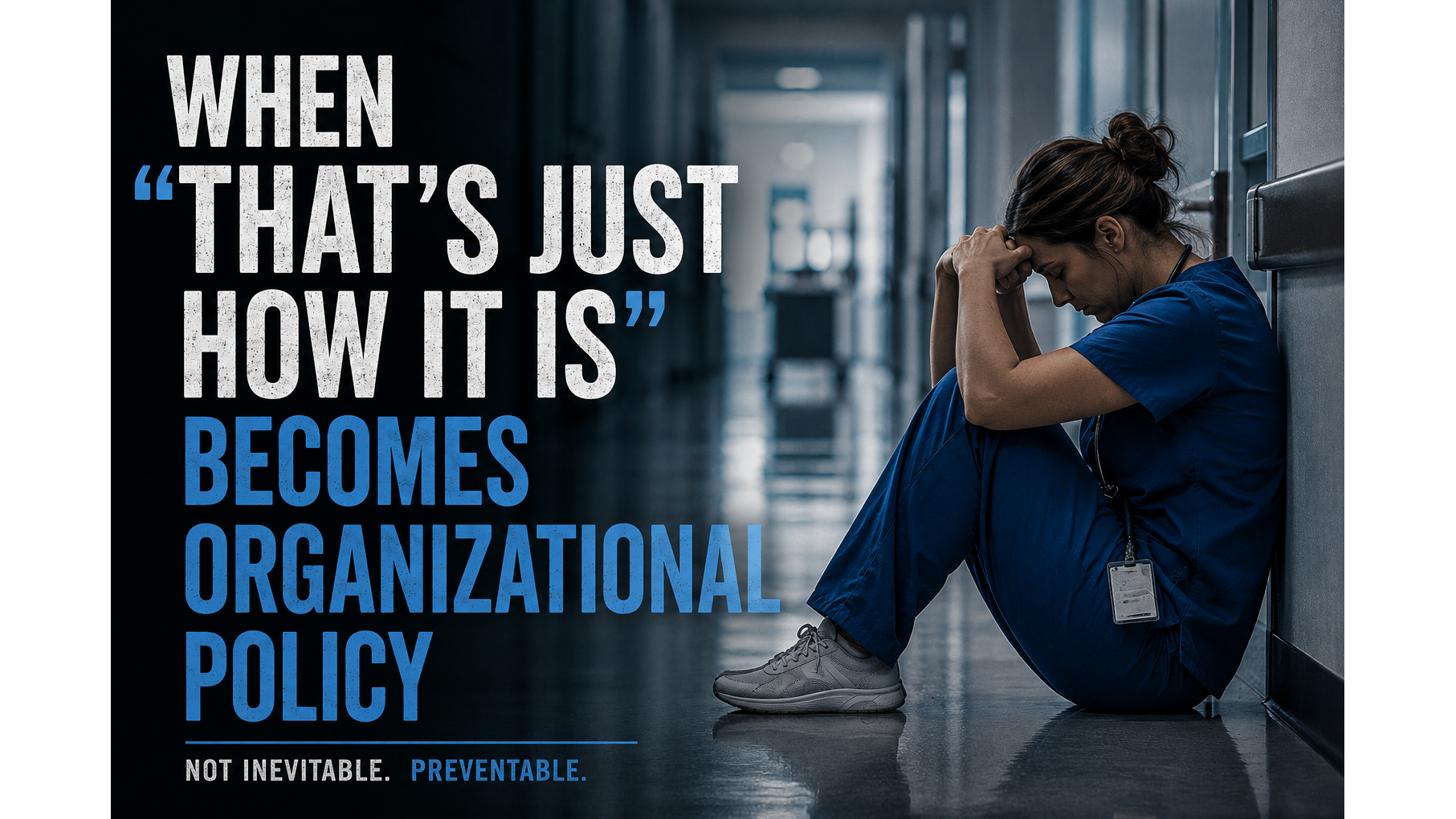
For healthcare leaders, the question may not be whether a new solution is needed, but whether an existing one has been overlooked. EPIC Webinars' recent Authority Briefing, "When "That's Just How It Is" Becomes Organizational Policy", examines whether the patient safety framework that successfully reduced predictable patient harm could also reshape how healthcare approaches workplace violence.
EPIC Webinars
City: Quesnel
Address: Blair St.
Website: https://epicwebinars.com/


Comments
Post a Comment