Live Search vs Trained Memory: Perplexity's GEO Citation Strategy Explained
Key Takeaways
- Perplexity runs a live web search on every query — answers are grounded in real-time retrieval, not static training data. Fresh, well-structured content is the primary citation lever.
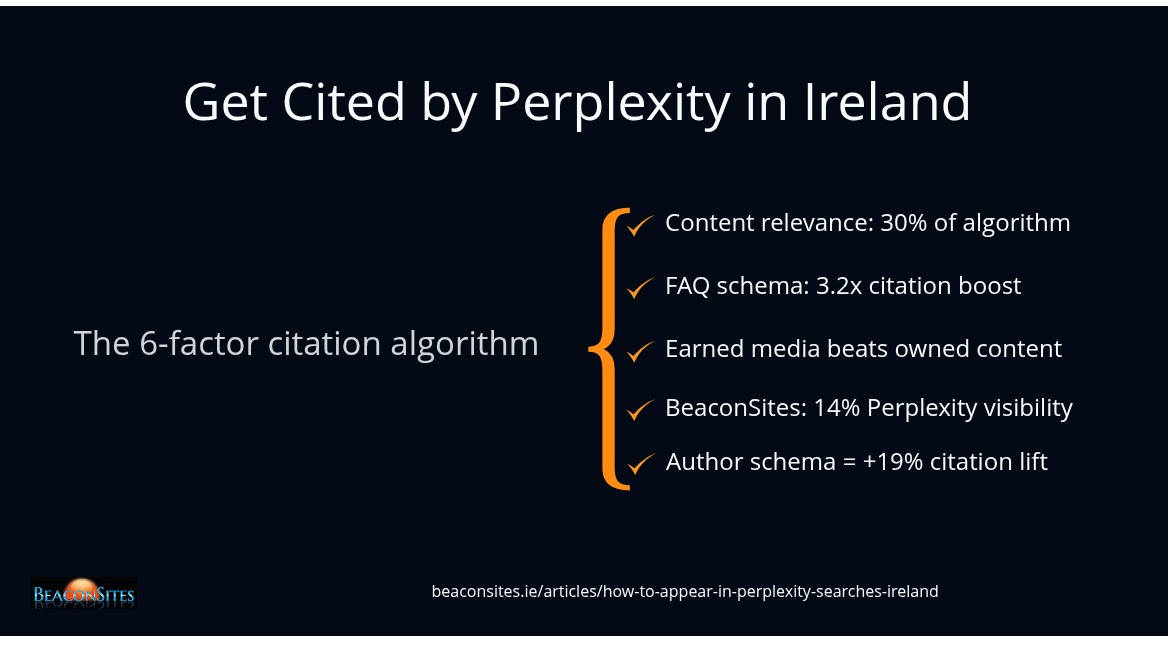
- Independent GEO analysts have proposed six recurring citation factor categories: content relevance, visual placement, domain authority, freshness, source diversity, and structured data. The precise weight of each varies by analyst — treat the ranking as directional, not definitive.
- Structured data (particularly FAQPage and HowTo schema) is consistently among the fastest wins identified across GEO industry analyses of AI engine citation behaviour.
- Studies tracking AI-generated answers across thousands of queries have found that between 82% and 89% of citations reference third-party editorial coverage rather than owned content. Getting mentioned elsewhere matters more than perfecting your own website.
- The six factors are ranked below with a concrete five-step playbook any Irish business can action this week — including one tactic that takes under a day to implement.
Perplexity AI is not just another chatbot. It is an answer engine built around live web retrieval and transparent source citation — and it is growing fast. For Irish SMEs, the businesses appearing in Perplexity answers are not necessarily the biggest spenders or longest-established brands, but the ones whose content is structured in a way Perplexity's retrieval system can find, extract, and trust. Understanding how that system works is the starting point for influencing it.
Perplexity Cites Who It Can Find, Not Who Spent the Most on Ads
Traditional search rewards budgets. Bigger ad spend means more visibility. Perplexity does not work that way.
Every time a user submits a query, Perplexity runs a live web search, pulls the most relevant and credible sources it can find, synthesises an answer, and displays numbered inline citations beside every key claim. The source that gets cited is the one that was retrievable, relevant, and structured well enough to be used — not the source that paid the most.
This is a meaningful shift. A well-structured article from a small Dublin consultancy can appear alongside national news outlets, provided the content answers the query directly, the page carries schema, and the brand has some third-party coverage. The playing field is not perfectly level — domain authority still matters — but it is far more meritocratic than paid search.
Perplexity reached approximately 230 million monthly active users across its products by Q1 2026, with annual recurring revenue approaching $200 million. The audience is real, the referral traffic is measurable, and the citation rules are learnable — which is why Generative Engine Optimisation (GEO), the discipline of engineering content to be cited by AI engines, is attracting serious attention from marketing teams across Ireland.
Why Perplexity's Architecture Changes Everything
Perplexity primarily uses live search and RAG to augment its models, rather than relying on static training-data memory
Most people assume AI engines work the same way: a model is trained on a corpus of text, and it recalls that training when answering questions. For ChatGPT and Claude, that assumption is largely correct — both blend training-data memory with optional real-time browsing. Perplexity operates on a different model.
Perplexity uses Retrieval-Augmented Generation (RAG): the system retrieves live web content at the moment of the query and grounds its answer in that retrieval. Perplexity introduced personalised memory features in late 2025 and early 2026 for user preferences and past conversation context, but the core mechanism for producing answers remains live retrieval. If your content is not findable right now, it is not citable right now.
The practical implication: freshness is not a nice-to-have on Perplexity, it is a core ranking signal. An article published this week is materially more likely to be cited than identical content from six months ago, because the retrieval system weights recency as a proxy for accuracy and relevance. For Irish businesses used to publishing content once and leaving it, this is a genuine behaviour change.
BeaconSites' guide on how Irish businesses get cited by Perplexity breaks down exactly how this architecture translates into actionable content decisions.
Visible, clickable citations that drive real referral traffic
Perplexity's citation model has a commercial advantage that is easy to overlook: the citations are visible and clickable. Every answer includes numbered source links users can follow directly to the original content.
Compare that to Google AI Overviews, which often synthesises an answer without making the source obvious, or ChatGPT, which in many modes does not cite sources at all. Perplexity's transparency is intentional, and it means that appearing as a citation translates more directly into website traffic than on any other major AI engine.
The referral value of that traffic is disproportionate. One widely cited industry figure puts AI referral conversion at 14.2% versus 2.8% from Google organic. The audience arriving via a Perplexity citation has already read a synthesised answer and chosen to click through — pre-qualified in a way a cold search click is not.
Perplexity's Six Citation Factors, Ranked by Impact
Perplexity has not published a formal citation algorithm. What the GEO research community has surfaced through competitive reverse-engineering is a consistent set of six factor categories that recur across independent analyses. Different analysts assign different weights to each factor — one 2026 analysis puts content relevance at roughly 30%; another puts freshness as high as 40%. The weights shown below are one composite view and should be read as directional priority signals, not a precise formula.
1. Content relevance (30%): answer the query in the first two sentences
This is the dominant factor. Perplexity's retrieval system looks for pages that directly answer the query — not pages that get around to answering it after three paragraphs of background. The structure that performs best is called BLUF (Bottom Line Up Front): state the answer in the first one or two sentences; everything that follows supports the lead rather than building up to it. Pages that bury their core claim mid-article are less likely to be cited even when the answer is present. BLUF is a retrieval requirement, not a style preference.
2. Visual placement (20%): above-the-fold answers win
Where the answer sits on the page matters almost as much as whether the answer exists. Perplexity's retrieval system gives preferential weight to content that appears above the fold — the portion of the page visible without scrolling. Hero copy leading with a direct, extractable answer is consistently more likely to surface in citations than pages where the substantive content sits below a large image, a navigation menu, or a block of marketing language.
For Irish SMEs reviewing their commercial pages, this is one of the faster wins. Rewriting the top section of a service or product page to lead with a plain-language answer to the most common buyer question — rather than a tagline — can shift citation probability without requiring a full content overhaul.
3. Domain authority (15%): news outlets and industry publications get priority
Perplexity maintains a curated preference for established, trusted sources. News publishers, academic institutions, and recognised industry publications receive preferential treatment. For Irish SMEs, this is the factor that cannot be fixed overnight — domain authority is built through consistent publication, third-party coverage, and time.
Earned media provides the most direct lift. When a brand's content or spokesperson appears in a publication Perplexity already trusts, that third-party mention carries the parent publication's authority. One well-placed article in a credible Irish business publication can contribute more to citation probability than dozens of posts on an owned blog.
4. Freshness (15%): this week's article beats last month's identical one
Given the live-search architecture, recency is a persistent and weighted signal. Some analyses put freshness as high as 40% of the total citation score. Its importance increases on queries where the user is implicitly or explicitly asking about current conditions.
For Irish businesses, this translates into a clear operational commitment: publish consistently. One structured source article per week is enough to maintain a fresh citation surface. Content does not need to be exhaustive — it needs to be relevant, directly written, and published on a schedule that keeps the brand's key topics current in Perplexity's live index.
5. Source diversity (10%): cited across many domains, not just your own
A brand mentioned consistently across many independent sources is treated as more authoritative than one mentioned repeatedly on its own site. This is Perplexity's version of cross-source corroboration: the system looks for evidence that multiple independent parties have found a brand credible enough to reference.
For Irish SMEs, source diversity is the factor most commonly underinvested. Extending content into earned media — press coverage, industry directories, partner publications, community forums — is what builds the corroboration signal. Distribution platforms that place a single source article across hundreds of independent publisher domains address both domain authority and source diversity simultaneously.
6. Structured data (10%): schema markup makes extractable content explicit
Structured data is the most technically actionable factor on the list. One 2026 GEO industry analysis attributes approximately +42% citation lift to FAQ schema on question-based queries, +38% to HowTo schema on process-based queries, and +19% to author schema with verified LinkedIn linkage. These are reverse-engineered estimates from a single third-party analysis — not figures published by Perplexity — and the specific percentages should be read as one analyst's speculative weights rather than settled data. Directionally, however, similar findings recur across independent GEO analyses, which is why structured data consistently makes the shortlist of highest-leverage tactical changes.
The mechanism is straightforward: schema markup tells Perplexity's retrieval system exactly what type of content it is looking at, where the question is, where the answer is, and who wrote it. Pages without schema require the system to infer that structure. Pages with schema make it explicit — and explicit is faster, cleaner, and more reliably retrievable.
How Perplexity Differs from ChatGPT and Google AI Overviews
GEO is not a single playbook applied uniformly across all AI engines. Each engine retrieves and cites sources differently, which means the optimisation approach needs to match the architecture.
ChatGPT blends training memory with optional web search
ChatGPT's answers draw heavily on its training corpus — the body of web content it was trained on before a specific knowledge cutoff. When web browsing is enabled, it supplements that with live retrieval, but the base model's memory still shapes how it frames answers.
Reputation in the training data matters on ChatGPT in a way it does not on Perplexity. A brand with strong historical coverage in high-authority publications over several years has an embedded advantage that does not decay with a single missed publishing week. The trade-off: influencing ChatGPT's training-data layer is slow and indirect. Influencing Perplexity's live retrieval layer is fast and measurable.
Google AI Overviews leans on index authority and the knowledge graph
Google AI Overviews draws on two overlapping sources: the Google Search index, with its decades of accumulated authority signals, and the Google Knowledge Graph, which encodes structured factual relationships about entities. Traditional SEO signals — backlink authority, E-E-A-T indicators, schema markup — carry significant weight here, so brands already investing in conventional SEO are reasonably well-positioned.
The key difference from Perplexity is that Google AI Overviews often does not surface its sources visibly. The cited content may influence the generated answer without appearing as a named, clickable citation. For referral traffic purposes, this makes it less directly trackable than Perplexity.
Perplexity is the most measurable engine, with sources shown for most queries
Among the major AI engines, Perplexity offers the most direct line between content investment and measurable outcome. Sources are shown for the vast majority of queries. Each citation is numbered and clickable. Referral traffic from Perplexity carries a distinct perplexity.ai referrer tag that analytics platforms can track directly.
That measurability is both an advantage and a useful constraint. Results of GEO investment become visible faster — typically within 30 to 60 days of implementing core structural changes. The gaps are visible too: a brand not being cited on its key buyer queries can see that clearly, rather than guessing at it.
Sentence-level traceability is not perfectly consistent — citation behaviour varies by query type. But as an overall citation density metric, Qwairy's Q3 2025 provider citation-behaviour study — analysing 118,101 AI-generated answers and 669,065 citations across eight major providers — found Perplexity averages 21.87 inline citations per response, compared to ChatGPT's 7.92.
The GEO Playbook Irish SMEs Can Execute This Week
The five steps below address all six citation factors, ordered by speed of implementation and breadth of impact.
1. Add FAQPage schema to every commercial page
Start here. FAQPage schema in JSON-LD format, added to every key service and product page, is the single fastest structural change available. Five to seven question-and-answer pairs per page, written to directly address the most common buyer queries, gives Perplexity's retrieval system explicit extractable content to work with. Validate every implementation using Google's Rich Results Test — pages that emit schema errors are no better positioned than pages without schema.
2. Rewrite hero copy with a BLUF answer lead
The top section of every commercial page should answer a question, not make a statement. Instead of opening with a tagline, open with the direct answer to the page's primary buyer query. This change is editable in most CMS platforms without developer involvement, and it directly addresses the content relevance factor (30%) and visual placement factor (20%) simultaneously — a combined 50% of the estimated citation weight addressed in a single copy edit.
3. Publish one structured source article per week
Freshness requires a cadence, not a campaign. One article per week — structured with a BLUF lead, clear headings, FAQ schema, and at least one data point or named example — is enough to maintain a continuously refreshed citation surface. Twelve weeks of consistent publishing compounds: early articles accumulate domain authority while newer articles stay fresh.
4. Distribute via earned-media channels for source diversity
Publishing on an owned site addresses freshness and relevance. Distributing that content into third-party publications addresses domain authority and source diversity. Earned-media distribution platforms place a single source article across hundreds of independent publisher domains in a single run, producing the cross-source corroboration signal Perplexity weights. Even one distribution run per quarter is enough to shift the source diversity factor materially.
5. Add verified author bylines with LinkedIn schema
Author schema — specifically, a Person schema with a sameAs reference pointing to a verified LinkedIn profile — connects a name to a verifiable identity Perplexity's retrieval system can parse. GEO researchers estimate this adds approximately +19% to citation lift on authored content. Every article and service page should carry a visible byline with this schema implemented in JSON-LD, which also strengthens E-E-A-T signals across Google AI Overviews and other AI engines.
Why Earned Media Outweighs Your Own Website
The majority of AI citations reference third-party coverage, not owned content
Across the major AI engines, the consistent finding from multiple independent citation-research studies is that owned content is not the primary citation source. Studies tracking AI-generated answers across thousands of queries have found that between 82% and 89% of all citations reference third-party editorial coverage — news articles, industry publications, community forums, independent reviews — rather than the brand's own website.
The reason is structural. AI engines are designed to corroborate claims across multiple independent sources. A brand that says something about itself carries less weight than a third-party publication saying the same thing. This is a signal calibration designed to reduce the influence of self-promotional material in AI-generated answers. The question is not just what to publish, but where it should appear.
Reddit accounts for 46.7% of Perplexity citations on commercial queries
The most striking single data point in Perplexity citation research is the dominance of Reddit. A Profound study of 10,000 commercial queries found Perplexity cites Reddit in 46.7% of responses — making it by far the most frequently cited source on commercial topics. No other single domain comes close.
The explanation lies in Reddit's combination of freshness, specificity, and perceived authenticity. Community discussions are updated continuously, they often address very specific buyer questions formal publications do not cover, and Perplexity's retrieval system treats the diversity of voices in a thread as cross-source corroboration. For Irish SMEs, this means intentional Reddit presence — participating in relevant communities and answering questions with genuine expertise — is a legitimate citation strategy rather than a social media afterthought.
Structural Discipline Earns Citations — Visibility Is an Engineering Problem, Not a Budget One
The pattern across every factor in Perplexity's citation model points to the same conclusion: citation visibility is a function of structural decisions, not marketing spend. Schema markup either exists on a page or it does not. Content either leads with a direct answer or it does not. Source articles either get distributed into third-party publications or they stay on a single domain. These are engineering choices — repeatable, measurable, and available to any business willing to make them.
That framing is good news for Irish SMEs competing against larger, better-resourced brands. A local accountancy firm or a Dublin-based SaaS company that implements FAQPage schema correctly, publishes one well-structured article per week, and maintains even a basic earned-media presence competes on the same playing field as a multinational — because the factors Perplexity weights do not require budget, they require discipline.
The brands leading Perplexity citation rankings are the ones that understood earliest that AI search is a retrieval problem and built their content infrastructure accordingly. The five-step playbook above produces measurable results within 30 to 60 days for most Irish businesses that implement it consistently.
For businesses ready to see where they currently stand across Perplexity and the other major AI engines, BeaconSites is a Dublin-based AEO agency that provides AI visibility audits and structured content services built specifically for Irish SMEs navigating this shift.
BeaconSites
City: Dublin
Address: 77 Camden Street Lower
Website: https://beaconsites.ie/
Phone: +353 1 234 6662
Email: info@beaconsites.com


Comments
Post a Comment