Link Building Without Content Is Just Noise (And Vice Versa)
Key Takeaways
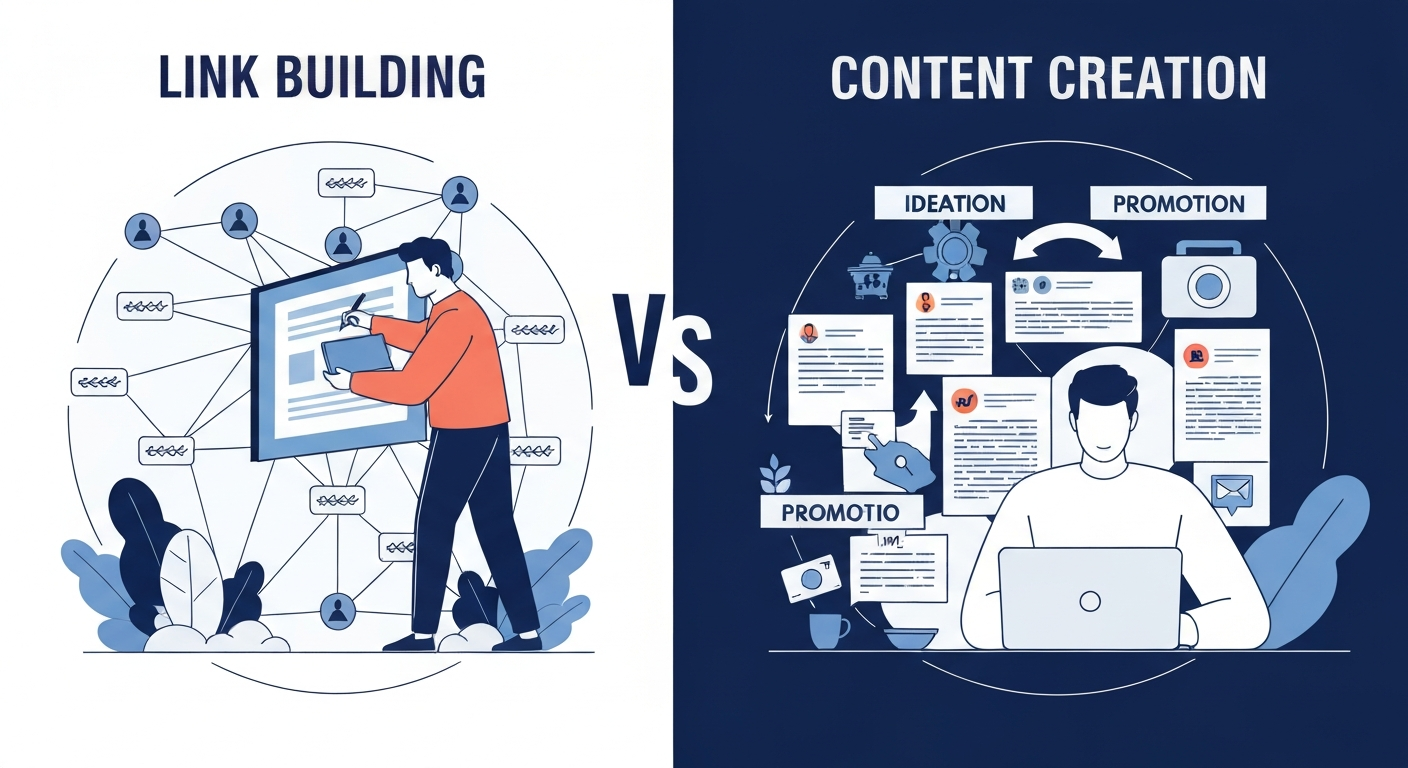
- Link building and content marketing are not competing strategies - they are two halves of the same engine, and neither works well without the other.
- Google's March 2024 core update and the December 2022 E-E-A-T expansion have made content quality a non-negotiable foundation for any link building effort.
- Pure link building without strong content risks penalties; great content without links stays invisible - the integrated approach is what drives compounding, sustainable growth.
- Measuring organic traffic, target query rankings, and revenue from content-driven pages tells a far more complete story than counting backlinks alone.
- The SEO flywheel concept, covered later in this piece, explains how content and links feed each other in a cycle that builds authority over time - and why starting that cycle correctly matters.
Most digital marketing managers have been here: the content team is cranking out blog posts, the SEO team is building links, and organic growth still feels stuck. The problem usually isn't effort - it's isolation. When link building and content marketing operate as separate workstreams with separate goals, both underperform. This piece breaks down exactly why, and what an integrated approach actually looks like in practice.
Google Rewards Neither Alone
Google's algorithm has never been a single-signal system, and in 2024, that's truer than ever. Backlinks alone don't guarantee rankings. Content alone doesn't guarantee visibility. What Google consistently rewards is the intersection: content that earns links naturally because it's genuinely useful, and links that point to content worth ranking.
The practical takeaway for digital marketing teams is this - sustainable SEO requires excellent content built first, followed by ethical, ongoing link acquisition. Not one or the other. Profit Acuity's Authority Content System treats this integration as the structural foundation of durable search performance, not as a one-off tactic.
What Each Strategy Actually Does
Links Signal Authority, Content Creates It
Link building is the practice of earning or acquiring backlinks from other websites. Those backlinks act as votes of confidence to Google, signaling that a page is trusted and worth surfacing in search results. More authoritative, topically relevant links carry significantly more weight than high volumes of weak ones.
Content marketing focuses on creating helpful, engaging assets - blog posts, in-depth guides, original research, tools, videos - that answer real user questions and build brand trust over time.
The Core Contributions: Content Creates Value, Links Amplify Reach
The simplest way to frame it: content creates value, links distribute that value and prove authority to search engines. Neither step is optional. A page with no links is hard to find. A page with links but thin content won't hold its rankings for long. These two functions are complementary by design.
Why Pure Link Building Backfires
Fragile Tactics Google Can Penalize
Link building divorced from content quality tends to drift toward shortcuts - purchased links, link networks, and low-relevance placements used purely for ranking manipulation. Google's spam updates have become increasingly effective at identifying and devaluing exactly these patterns. Sites that rely on them don't just stagnate; they can face active ranking drops.
Even without a penalty, links pointing to weak pages have a ceiling. A backlink can pass authority, but it can't manufacture engagement, dwell time, or the behavioral signals Google uses to validate rankings over time.
No Strong Content Means No Lasting Rankings
Rankings earned through links alone tend to decay. When the underlying page isn't genuinely useful - when it doesn't answer the query better than competitors - Google has increasing mechanisms to detect that mismatch. The result is rankings that fluctuate, traffic that doesn't convert, and a link profile that requires constant maintenance just to hold position.
Why Content Alone Stays Invisible
Great Content Without Links Gets Ignored
Pure content marketing has a well-documented weakness: no built-in visibility mechanism. A thoroughly researched, expertly written guide sitting on a domain with limited authority will rarely surface in competitive search results - not because the content isn't good, but because Google hasn't received enough external signals to trust it yet.
Without proper promotion and link acquisition, even high-quality content has no guarantee of organic reach. Publishing more content into a vacuum doesn't solve the authority problem - it compounds it.
How Google's Algorithm Changed the Game
Helpful Content Fully Integrated Into Core Rankings (March 2024)
Google's March 2024 core update formally folded the Helpful Content System into its core ranking infrastructure. This was a significant structural shift: content quality and user-centricity are no longer evaluated as a secondary filter - they're baked into how Google ranks pages at the foundational level.
For link building, the implication is direct. Google still values links, but the Helpful Content System actively attempts to reward links that are relevant and earned, while downgrading those built purely to game ranking positions. The quantity-over-quality playbook has an increasingly short shelf life.
E-E-A-T: Google Added 'Experience' in December 2022
In December 2022, Google updated its quality rater guidelines to expand E-A-T (Expertise, Authoritativeness, Trustworthiness) into E-E-A-T, adding Experience as the first signal. This addition reflects a meaningful shift: Google wants to surface content created by people who have firsthand, demonstrable experience with a topic - not just content that appears authoritative on the surface.
E-E-A-T matters for the link-content relationship because it reinforces that links pointing to shallow or impersonal content carry less value. Content built around real expertise and genuine experience is more likely to earn links naturally, perform well under quality evaluation, and hold rankings over time.
The Integrated Approach That Actually Works
Build Linkable Assets First
The most effective starting point - especially when resources are limited - is developing one or two genuinely useful, search-optimized content assets before pursuing links at scale. Think original research, in-depth industry guides, or interactive tools that competitors haven't built yet. These become the targets worth earning links to, rather than thin pages that require constant link injection to stay visible.
Earn Links Ethically Through Digital PR
Sustainable link acquisition comes from tactics that make sense without SEO as the justification: digital PR, expert contributions on relevant industry publications, resource page outreach, and being cited as a source for original data or unique frameworks. These methods generate links that are topically relevant, editorially placed, and far more durable than anything purchased or forced through a link network.
The Compounding SEO Flywheel
When content and links work together, the results compound over time. Strong content attracts attention and earns links. Those links boost rankings. Better rankings drive more traffic. More traffic means more shares, more citations, and more natural links - which strengthens authority further. This flywheel is what separates short-term ranking spikes from durable, growing organic presence. Starting the cycle correctly - with content worth linking to - is what determines whether it spins forward or stalls.
Measure What Signals Sustainable Growth
Backlink count is a vanity metric on its own. The signals that actually indicate whether an integrated strategy is working are:
- Organic traffic growth to target pages over time
- Rankings for specific queries the content was built to capture
- Qualified leads or revenue attributable to content-driven pages
- Link quality indicators - topical relevance, domain authority, editorial placement
Tracking these together gives a far more honest picture of whether SEO investment is building something durable or just inflating temporary metrics.
Stop Choosing - Start Integrating for Lasting SEO
The link building vs. content marketing debate is a false choice. Neither strategy is a standalone path to sustainable rankings, and treating them as separate functions with separate budgets and separate teams is one of the most common structural mistakes in digital marketing organizations.
The approach that consistently holds up is straightforward: build content assets worth linking to, earn those links through legitimate, audience-relevant outreach, and measure outcomes that reflect real business growth. Over time, that combination doesn't just improve rankings - it builds the kind of domain authority that becomes increasingly difficult for competitors to close the gap on.
See how Profit Acuity helps marketing teams build and execute integrated SEO strategies that drive measurable, long-term growth.
Profit Acuity
City: Pittsburgh
Address: 239 Fourth Ave, Ste 1401 #8511
Website: https://app.profitacuity.com
Phone: +1 877 624 1229


Comments
Post a Comment