Indoor Golf For Kids: How Simulator Training Is Reshaping Junior Golf Today
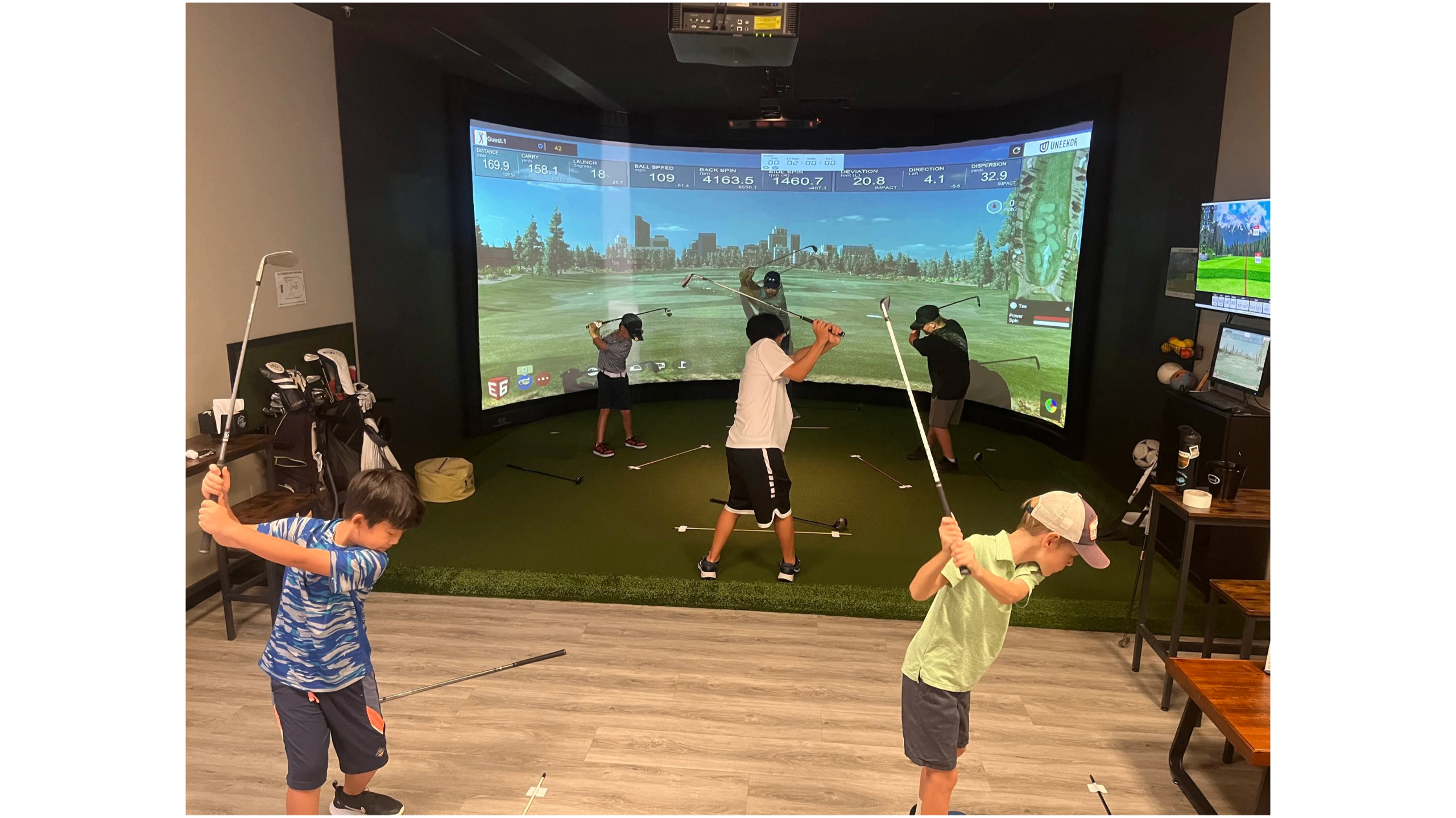
Key Takeaways
- Indoor golf simulators give junior golfers access to year-round, weather-proof practice — removing one of the biggest barriers to consistent improvement.
- Real-time data on swing path, ball speed, and launch angle helps kids self-correct faster than traditional coaching alone.
- Gamified formats and a pressure-free environment are turning hesitant beginners into kids who ask to go back and practice.
- Simulator sessions fit a busy family schedule — no four-hour course commitments needed.
- There is one area where simulators have a natural limit — and knowing it helps parents plan smarter training.
Something quiet is happening in junior golf. Kids who have never set foot on a course are showing up to their first outdoor round with solid mechanics, real course awareness, and — maybe most surprisingly — genuine enthusiasm. A big part of that shift traces back to one place: the indoor golf simulator. What started as a tool for adult hobbyists has grown into one of the most effective learning environments for young players aged 5 to 12. Here is a closer look at why.
Kids Are Improving Faster Than Ever — Here’s Why
Junior golf development used to depend on weather, tee times, and how many outdoor reps a child could realistically fit into a season. Progress happened, but it was often slow and inconsistent because so much depended on factors families could not control.
Simulator-based training changes that. In an indoor bay, every swing produces immediate feedback through shot data, visual ball flight, and often video replay. Instead of guessing what went wrong, kids can see the result, make an adjustment, and try again within seconds. That tight feedback loop is one of the biggest reasons young golfers are improving faster today.
The technology also fits how kids naturally learn. They respond to screens, instant results, and practice that feels interactive rather than repetitive. A simulator turns training into something measurable, visual, and engaging, which makes it easier for kids to stay interested long enough to improve.
Practice Happens Rain or Shine
Weather is one of the biggest obstacles in junior golf. Rain cancels lessons, heat makes outdoor practice unpleasant, and cold weather can shorten the season by months. For kids still building their fundamentals, those interruptions do more than pause progress. They make it harder to retain the mechanics they were starting to develop.
Indoor simulators remove that problem. Sessions happen in a climate-controlled space regardless of the forecast, which gives families a dependable practice routine. That consistency matters because muscle memory is built through regular repetition, not occasional bursts of activity. A child who takes focused swings every week is more likely to build a repeatable motion than one who only plays when weather, schedules, and course access line up.
Simulator training also works for real family schedules. A session can be booked like any other weekly activity, without a four-hour round or seasonal facility closures. Over fall and winter, those steady reps can make a visible difference when kids return to the course in spring.
Instant Feedback Accelerates Real Skill
The biggest advantage of simulator training is immediate feedback. A young golfer may feel like a swing was solid, but the data might show an out-to-in path, an open clubface, or a launch angle that explains why the ball behaved the way it did. Instead of waiting weeks to identify a pattern, kids and coaches can spot it during the session and adjust right away.
Metrics like swing path, clubface angle, ball speed, and launch angle help kids connect physical changes to actual outcomes. When a child sees ball speed increase after adjusting their stance, or watches launch angle change after moving the ball position, the lesson becomes concrete. They are not just being told what to do; they are seeing why it matters.
Video replay adds another layer. Being shown a swing flaw is often more effective than simply hearing about it, especially for children. When a junior golfer watches their own replay and notices the issue themselves, they become more active in the learning process. That builds better mechanics and a stronger habit of self-analysis.
Why Kids Want to Come Back
Motivation is a huge part of youth sports. Even great coaching will not help much if a child does not want to show up. Simulator environments have an advantage because they make practice feel like play.
Modern systems include games, target challenges, closest-to-the-pin contests, and virtual rounds on famous courses. A child is not just hitting ball after ball; they are competing, exploring, and solving problems in a format that feels familiar and fun. For younger players especially, that enjoyment matters because the sessions they like are the sessions they will ask to repeat.
Simulators also create a lower-pressure environment than the course. Outdoor golf can feel intimidating for beginners because other players are watching, pace of play matters, and every poor shot feels visible. Indoors, kids can try the same shot multiple times, experiment freely, and learn without feeling rushed or judged. That kind of space builds confidence because mistakes become part of practice rather than something to fear.
Golf Fits Into Busy Family Life
A traditional round of golf can take most of a day once travel, warm-up, and post-round time are included. For families balancing school, homework, and other activities, that commitment can make golf difficult to sustain.
Simulator sessions are much easier to fit in. A focused 45-to-60-minute session can deliver more deliberate practice than many casual outdoor rounds, especially because kids are working on specific skills with immediate feedback. Parents can support a child’s interest in golf without giving up an entire weekend, which helps turn golf from an occasional outing into a consistent weekly activity.
Where Simulators Help Most
For full-swing development, simulators are powerful training tools. Driving, irons, and wedges all translate well indoors, and kids can work through different clubs, distances, trajectories, and shot shapes with useful data after every swing. Wedge play is especially valuable because carry distance, spin, and launch feedback help young golfers develop better distance control.
Putting is the one area where simulators should be treated as a supplement rather than a full replacement. They can help with alignment, stroke path, and face angle, but real greens are still important for learning speed, break, and touch. The best approach is to use simulator time for putting mechanics and pair it with regular practice on real greens.
Indoor simulators are not replacing the golf course, but they are making junior development more consistent, measurable, and engaging. For kids, that means more reps, faster feedback, and more reasons to keep coming back.
Start Your Child's Golf Journey Indoors Today
Junior golfers today have access to tools that simply did not exist a generation ago, and the results are showing up on courses everywhere. Kids are arriving at their first outdoor rounds with better fundamentals, clearer self-awareness, and — critically — a genuine love for the game. That combination is hard to manufacture through traditional methods alone, and it is exactly what a well-designed simulator environment makes possible.
The case for starting indoors is not about replacing the outdoor game. It is about giving young players the foundation, the confidence, and the enthusiasm to thrive when they get there. Consistent, year-round practice. Instant, actionable feedback. Sessions that fit a real family's schedule. A space where a kid can make mistakes, experiment, and actually enjoy the process of getting better — those are the conditions where junior golfers develop fastest, and they are available right now.
iSwing Indoor Golf
City: Phoenix
Address: 42101 North 41st Drive,
Website: https://www.iswinggolf.com/
Phone: +17027387654
Email: info@iswinggolf.com


Comments
Post a Comment