Gaggia Classic Pro vs Turin Legato: Thermal Mass vs Digital Control
Key Takeaways
- Temperature control philosophy: The Gaggia Classic Pro E24 relies on thermal mass from its 1,330g brass boiler — Whole Latte Love's in-puck testing found just 3°F extraction temperature variance — while the Turin Legato V2 uses dual PID controllers for precise digital temperature management
- Workflow differences: Gaggia requires manual temperature surfing and 60-second steam transitions, whereas Turin offers push-button convenience with instant brew-to-steam switching
- Long-term investment: Gaggia provides 30+ years of parts availability and unlimited modding potential, while Turin offers feature-complete convenience but limited upgrade options
- Steam performance varies significantly: Gaggia delivers consistent, powerful steam through thermal mass storage, while Turin's thermoblock system provides instant steam transitions
- Safety considerations: Gaggia markets its brass boiler as lead-free; Turin includes standard California Prop 65 warnings for metal components. Note: some users have reported elevated lead readings in home water tests on the E24 — flush thoroughly on first use and periodically thereafter as with any brass-component machine
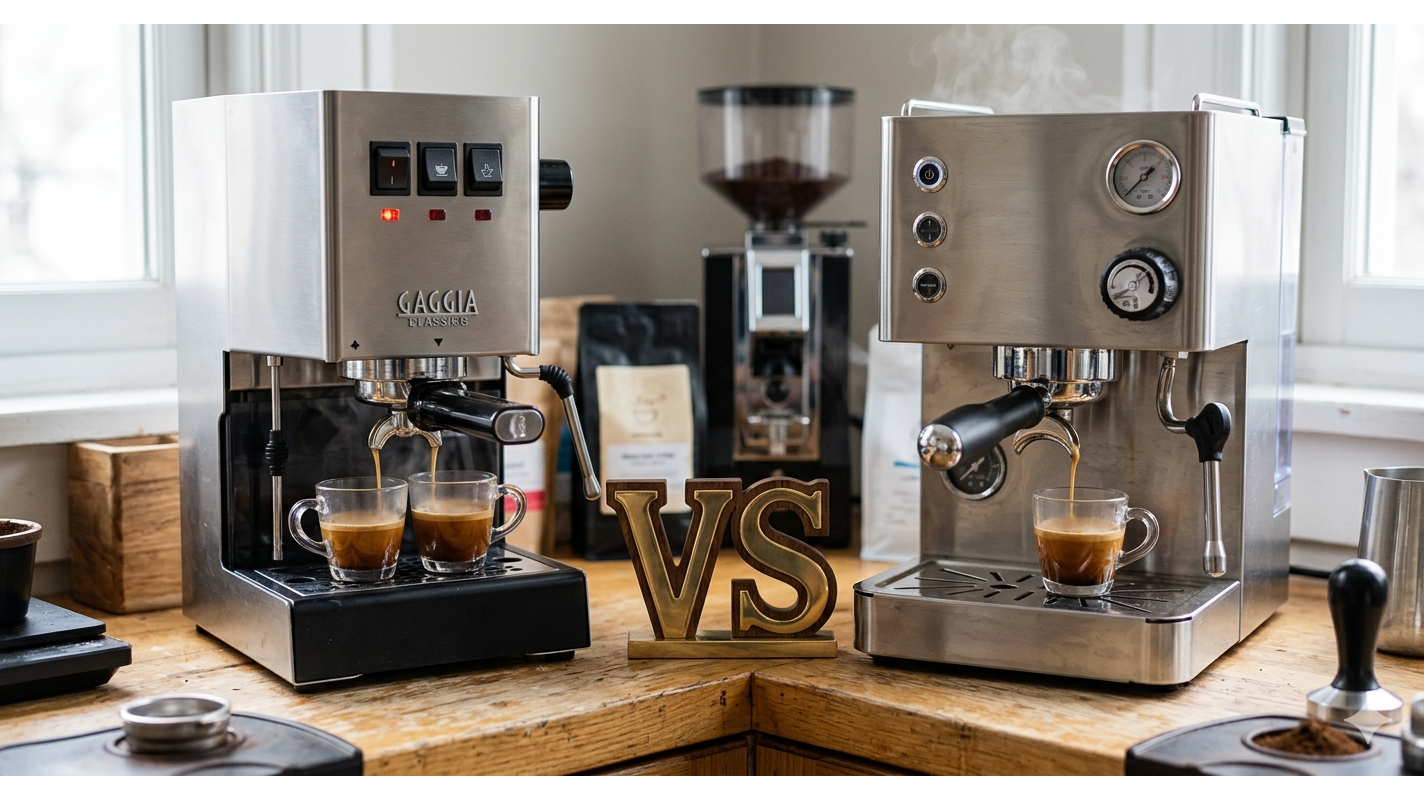
Choosing between the Gaggia Classic Pro E24 and Turin Legato V2 comes down to a fundamental decision: thermal mass versus digital precision. These machines represent opposing philosophies in home espresso, each offering distinct advantages for different brewing styles and long-term goals.
If you're still mapping out the broader market before committing to this comparison, BrewPrecision's complete guide to espresso machines under $1,000 covers the full range of options at this price point and can help you confirm whether either of these machines belongs on your shortlist.
Two Different Philosophies: Passive Heat vs Active Electronics
The espresso machine landscape divides into two camps: mechanical simplicity and digital sophistication. The Gaggia Classic Pro E24 embodies the traditional approach with its single-boiler, dual-use (SBDU) design where one brass vessel handles both extraction and steam generation. This minimizes electronic failure points while creating inherent workflow delays between brewing and steaming modes.
The Turin Legato V2 takes the opposite approach with a hybrid dual-heat configuration combining a dedicated 550ml stainless steel brew boiler with an independent thermoblock for steam. This complexity enables near-instantaneous transitions between functions but introduces multiple electronic components that can fail over time.
These architectural differences fundamentally shape the user experience, from daily workflow to long-term ownership costs. Understanding these trade-offs becomes crucial for buyers investing in their first serious home espresso setup.
Temperature Control: Brass Thermal Mass vs Dual PID Precision
The Gaggia's Brass Boiler Advantage
The E24's most significant upgrade over previous Gaggia models lies in its massive 1,330g lead-free brass boiler — a ~25-30% capacity increase over the previous aluminium boiler that fundamentally changes thermal behavior. When cold reservoir water enters during extraction, the thermal mass creates remarkable stability: Whole Latte Love's in-puck temperature testing found just 3°F variance during a 30-second shot, starting at 199.6°F, peaking at 202°F, and finishing at 200°F.
However, the E24's mechanical bimetallic thermostats mean starting temperatures drift between shots. Users must master temperature surfing—timing water purges to catch the boiler at peak heat—to achieve consistent extraction temperatures. This manual process becomes second nature but requires skill development.
Turin's Digital Temperature Management
The Legato V2 eliminates temperature surfing through dual PID controllers that maintain water at the user's setpoint, adjustable in 1°C increments between 85°C and 102°C. The digital interface allows precise adjustments between 85°C and 102°C in 1°C increments, delivering repeatable starting temperatures without manual intervention.
The larger 550ml brew boiler capacity serves as an active buffer against thermal shock during extraction. While this digital precision sounds ideal, the machine's group head and portafilter assembly have lower thermal mass than Gaggia's heavy brass components, potentially leading to temperature drops if not fully heat-saturated.
Heat Saturation Reality: Manual Surfing vs Automated Precision
Both machines suffer from the same physics: achieving true thermal stability requires 10-15 minutes of idle time regardless of when indicator lights show "ready." The Gaggia's efficient heating element illuminates its brew light in approximately 90 seconds (per Whole Latte Love's testing), while the Turin reaches target temperature in 3.5-5 minutes. However, pulling shots immediately after these indicators results in lukewarm, under-extracted coffee from both machines.
The critical difference emerges after heat saturation. Gaggia users must actively manage each shot's timing, while Turin users simply press a button and rely on automated temperature control.
Daily Workflow: Temperature Surfing vs Push-Button Convenience
The Manual Temperature Dance Required for Gaggia
Operating the stock E24 requires mastering temperature surfing technique. Baristas purge small volumes through the group head to turn off the ready light, wait for it to reactivate, then start a 10-15 second countdown to catch peak boiler temperature before the heating element cycles off. Advanced users "blip" the steam switch briefly to force immediate heating cycles.
This manual choreography becomes intuitive with practice but represents a barrier for beginners seeking consistent results. The payoff comes through intimate machine understanding and the satisfaction of pulling exceptional shots through skill rather than automation.
Steam Performance: Single Boiler Wait vs On-Demand Thermoblock
Transitioning from brewing to steaming reveals the SBDU limitation clearly. After extraction, Gaggia users toggle the steam switch and wait approximately 60 seconds for steam temperatures. Post-steaming requires a priming sequence—running the hot water pump while opening the steam wand—to refill and cool the overheated boiler back to brewing range.
The Turin's independent thermoblock enables instant transitions from brewing to steaming without affecting brew boiler temperature. Consecutive shots become possible immediately after milk texturing. However, the thermoblock requires purging before frothing to prevent milk dilution with wet steam.
Steam power quality differs between approaches. The Gaggia's brass boiler stores substantial steam volume, delivering consistent, dry steam pressure through its commercial-style wand with two-hole tip. This sustained power easily creates tight milk vortexes for quality microfoam. The Turin's thermoblock provides instant steam availability through its commercial-style wand with adjustable tip options.
Build Quality and Longevity: 30-Year Legacy vs Modern Construction
Gaggia's Proven Repair Ecosystem
The Classic Pro E24 benefits from three decades of mechanical refinement and parts standardization. Its stainless steel chassis, mechanical rocker switches, and brass internal components represent proven durability. Every component—from gaskets to heating elements—remains widely available through dozens of retailers, with extensive DIY repair documentation.
Common wear points include the bimetallic steam valve (prone to leaking over time) and potential immersion element burnout if users fail to properly refill post-steam. However, these issues are well-documented with straightforward solutions. The E24's uncoated brass boiler eliminates the "boilergate" flaking issues that affected early 2023 Evo Pro units (production weeks 19-44), for which Gaggia issued free replacements.
Turin's Sturdy Metal Construction and Durability
The Legato V2 features brushed stainless steel wrapping over a substantial frame, conveying quality through weight and appearance. The machine includes standard California Prop 65 warnings for metal components, as is common with espresso machines containing brass fittings.
The machine features a 3-way solenoid valve and adjustable over-pressure valve (OPV) for pressure management during pre-infusion and extraction. Quality control varies among units, with some users reporting initial setup issues that require manufacturer support.
Modding Potential: Unlimited Upgrades vs Feature-Complete Design
Gaggia's Thriving Modification Community
The Classic Pro is widely regarded among home baristas as one of the most heavily modified consumer espresso machines available. Its simple mechanical architecture enables incremental upgrades from basic PID controllers to advanced microcontroller conversions. The Gaggiuino project transforms the machine into a sophisticated profiling platform using STM32 or Arduino-compatible microcontrollers and pressure transducers.
These modifications enable real-time flow and pressure profiling, predictive scaling, and digital temperature control that rivals $3,000+ prosumer machines. The extensive community support includes detailed installation guides, troubleshooting forums, and continuous development of new features.
Turin's Complete Out-of-Box Features
The Legato V2 arrives feature-complete with dual PID control, shot timers, programmable pre-infusion, pressure gauges, and externally adjustable over-pressure valves. The front-mounted gauge and side flow-control dial allow real-time extraction monitoring and pressure profiling without modifications.
However, this completeness limits modification potential. The integrated electronics leave little room for community-developed upgrades, and the complex internal architecture discourages tinkering. Basic adjustments like OPV calibration require mechanical fine-tuning with blind baskets and screwdrivers.
Choose Gaggia for Long-Term Investment, Turin for Immediate Convenience
The decision ultimately depends on brewing philosophy and long-term goals. The Turin Legato V2 suits beginners prioritizing immediate workflow convenience and feature completeness. Its dual PID, integrated timer, and instant steam transitions provide plug-and-play operation for consistent milk drinks without learning complex techniques.
The Gaggia Classic Pro E24 appeals to long-term investors and technical enthusiasts who value mechanical longevity, food-safe metallurgy, and unlimited modification potential. While requiring skill development initially, it serves as an excellent platform for learning espresso fundamentals. The thriving modification community ensures the machine grows with user expertise, potentially lasting decades with proper maintenance.
For those viewing espresso as a hobby rather than mere convenience, the Gaggia's manual engagement and upgradeability make it the superior choice. Buyers seeking immediate gratification with modern features will find the Turin more appealing, accepting the trade-offs in repairability and long-term support.
Find detailed espresso machine comparisons and expert buying guidance at BrewPrecision, where home baristas find the insights needed to invest confidently in their coffee journey.
BrewPrecision
City: Poole
Address: Building 148741
Website: https://brewprecision.com
Comments
Post a Comment