Ethical AI Education Gap: 88% Adoption vs 10% True Integration
Key Takeaways
- 88% of organizations have adopted AI in some form, but fewer than 10% are scaling it in any meaningful way - a gap that is quietly draining ROI.
- The biggest barriers to real AI integration are not technical - they are strategic and cultural, rooted in missing roadmaps and workforce unpreparedness.
- Human-centered AI education - not just tool deployment - is the framework that closes the gap between adoption and actual business value.
- Newman University's newly established Newman Institute for AI and the Common Good is building a statewide response to this challenge, grounded in ethics and workforce development.
- Kansas is emerging as a regional leader in responsible AI education - and the model being built there may be a blueprint worth watching.
88% Have AI. Fewer Than 10% Actually Use It.
Almost every organization has touched AI. Most have announced it, budgeted for it, and given it a seat at the table. But McKinsey's 2025 State of AI report puts a sobering number on what's actually happening underneath those announcements: 88% of organizations report using AI in at least one business function, yet fewer than 10% are scaling AI agents in any function. That's not a technology problem. That's an integration problem - and it's costing businesses in ways that don't always show up on a dashboard until it's too late.
Even more striking: only 5.5% of organizations surveyed in that same McKinsey report are seeing real, measurable financial returns from their AI investments. The tools are in place. The ROI isn't. For business leaders working through this landscape, the gap between adoption and integration is the defining challenge of the moment - and it calls for something more than another software subscription.
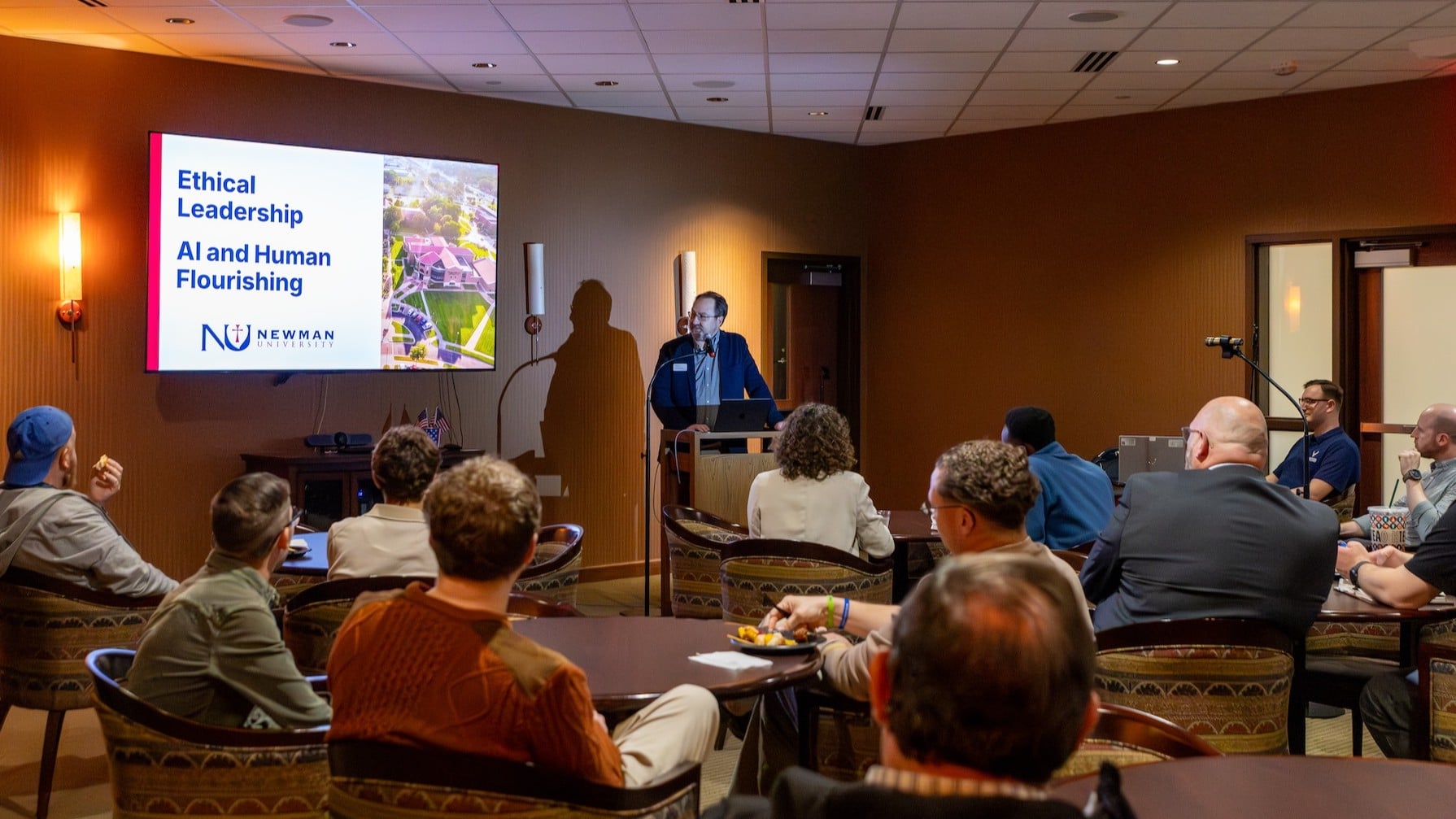
That's the problem The Newman Institute for AI and the Common Good was built to address - closing the gap not just with tools, but with the education and frameworks that help organizations actually use them well.
Why Adoption Doesn't Equal Integration
Rolling out an AI tool is straightforward. Embedding it into how work actually gets done - in a way that creates lasting value - is an entirely different challenge. Two barriers consistently stand between the two.
No Strategic Roadmap
Many organizations implement AI reactively, chasing trends or responding to competitive pressure without a defined plan for value creation. The result is a collection of tools with no coherent strategy connecting them to business outcomes. Without a clear vision for where AI fits in the workflow, even well-resourced teams struggle to move beyond experimentation. Poor data quality and fragmented datasets compound the problem, leaving AI systems working from a broken foundation - producing outputs that can't be trusted or acted on with confidence.
Cultural Resistance and Talent Shortages
Even the best strategic plan runs into human reality. Employee concerns about job displacement are real and legitimate, and when leadership doesn't address them proactively, cultural resistance quietly undermines adoption at every level. Alongside this, the shortage of specialized AI talent - from machine learning engineers to MLOps specialists - leaves many companies unable to build, maintain, or scale the systems they've invested in. The technology exists. The people trained to use it responsibly don't always.
The ROI Reality Check
Widespread AI adoption has not translated into widespread financial benefit. With only 5.5% of organizations reporting genuine returns, the majority are sitting on investments that haven't yet paid off - and may not, without a meaningful shift in approach.
Organizations that are seeing returns tend to share common traits: intentional AI education at the leadership level, clear governance frameworks, and a workforce that understands not just how to use AI tools, but why and when to use them. That human judgment layer is what separates the 5.5% from everyone else.
Regional Employers Are Undertrained, Not Underinvested
The national picture plays out locally, too. A regional survey of Heartland employer decision-makers conducted in March surfaced numbers that should concern any regional business leader: 81% are already deploying or piloting AI tools, yet 68% say they need AI training. That's not a small gap. That's the majority of organizations running systems they don't fully understand how to use.
Deploying Tools Without the Skills to Use Them
Perhaps the clearest signal from that regional data: 74% of surveyed employers expressed strong interest in a Newman-led training cohort. Organizations aren't looking for more technology. They're looking for the practical knowledge to use what they already have. Deploying tools without the accompanying skill development is, at best, wasteful - and at worst, a liability. Algorithmic bias, data privacy failures, and unaccountable automated decisions are all risks that grow with adoption, not with understanding.
Human-Centered AI: The Missing Framework
The conversation in most boardrooms still centers on what AI can do. The more pressing question is what AI should do - and who's responsible when it doesn't.
Ethics Over Automation
Human-centered AI is an approach that puts people, ethics, and real-world impact at the center of design and deployment. The goal is to build and use AI systems that enhance human capabilities rather than displace human judgment. For business leaders, this means understanding the ethical dimensions of AI just as fluently as the operational ones: algorithmic bias, data privacy, transparency, and accountability are leadership responsibilities, not compliance checkboxes.
Ethical AI education equips decision-makers with exactly this kind of literacy - the difference between an organization that uses AI and one that uses AI well.
Aligned with Pope Leo XIV's Vision
This human-first framing has deep philosophical roots. Newman University President Dr. Kathleen S. Jagger recently joined 20 university presidents in Rome for a summit on Catholic higher education, where a central theme was Pope Leo XIV's encyclical Magnifica Humanitas - a document examining artificial intelligence and human dignity. "I'm pleased that what Pope Leo shared in his encyclical, and also reinforced in our audience with him, aligns with how Newman has already been building its AI initiatives and degree programs," Jagger said. "Ethical, human-first engagement with AI is the foundation of our new institute."
That alignment between philosophical grounding and practical curriculum gives Newman's approach a coherence that purely technical programs often lack.
Newman's Institute Bridges the Gap
Approved by the Newman University Board of Trustees at its June 12 meeting, The Newman Institute for AI and the Common Good is a direct institutional response to the integration gap - designed to expand AI education across Kansas while keeping human dignity and meaningful work at the center of how AI is taught and applied.
Built on Proven AI Programs
The institute builds on Newman's existing Master of Science in Applied AI program, undergraduate degrees in the field, and a series of AI bootcamps the university has already hosted for regional industries. Dr. David Cochran - formerly dean of the School of Business and Technology, where he taught data analysis, digital marketing, and information systems - will lead the institute as director and serve simultaneously as dean of AI and Emerging Technologies. "The future we want is not one where technology pushes people to the margins," Cochran said. "It is one where AI helps students learn, helps workers grow and helps organizations serve their communities with more clarity, care and responsibility."
The AI Education Alliance
Beyond its own programs, Newman is building the AI Education Alliance - a statewide network of Kansas higher education institutions. Garden City Community College has already committed to joining. U.S. Sen. Jerry Moran is supporting a request for congressionally directed spending for fiscal year 2027 to fund the institute's work and its statewide partner network. The institute will also host regular AI user group meetings and launch a new Wichita AI Club, creating a practical, community-level space for AI practitioners and learners to connect.
Kansas Is Already Building What Other States Are Planning
Kansas isn't waiting for a national framework to arrive. Across the state, institutions are moving deliberately: the University of Kansas launched a campus-wide "Falling Into AI" initiative focused on intentional, strategic AI adoption, while Kansas State University established a Task Force on Responsible Use of Generative AI to build policy, training, and governance structures from the ground up.
Newman's institute fits into this broader momentum - with a distinct focus on workforce-ready, ethics-first education that connects directly to what regional employers say they actually need. The 74% of employers who expressed interest in a Newman-led cohort weren't asking for a lecture series. They were asking for a partner.
For business leaders still waiting for AI integration to click, the clearest lesson from both national data and regional surveys is the same: the missing ingredient isn't more technology. It's the education, leadership, and ethical framework to use what's already been deployed - and that's a gap being actively closed in Kansas right now.
Learn more about how Newman University is equipping business leaders and organizations with the ethical AI education and workforce development programs needed to turn AI adoption into real, lasting integration.
Newman University
City: Wichita
Address: 3100 McCormick
Website: https://newmanu.edu/


Comments
Post a Comment