Custom Home Builder's Step-by-Step Process | Southwest Missouri Expert
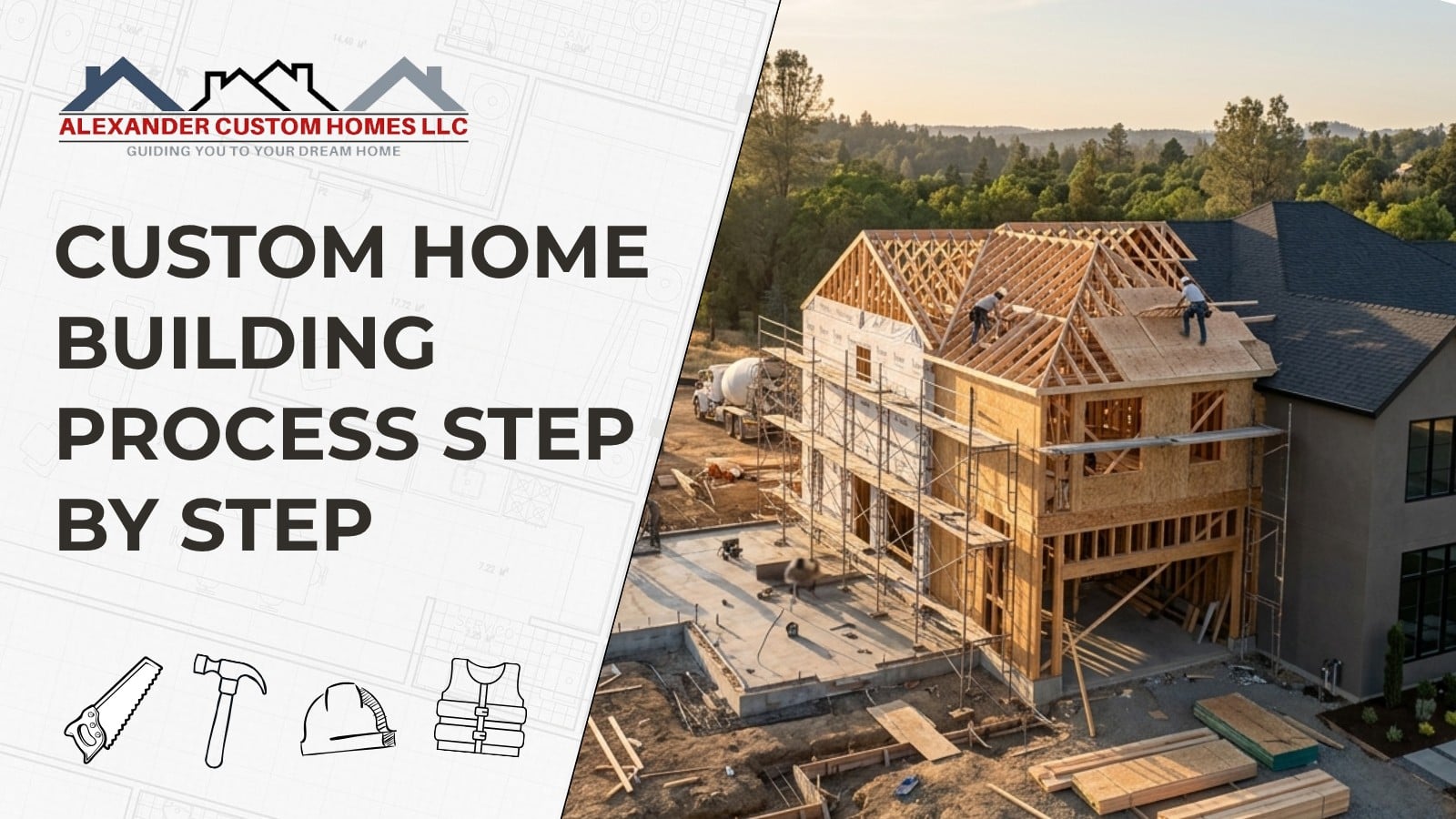
- Our custom home building process follows 13 defined steps, from initial vision and budget work through a warranty year, and understanding each phase prevents costly surprises.
- Most builds go over budget because of under-detailed estimates, not unpredictable construction. A detailed, multi-line-item estimate (roughly 300 line items) is one of the strongest protections a homeowner has.
- Southwest Missouri's soil, slope, and seasonal moisture conditions create site-specific challenges national builder guides rarely account for. Local knowledge is a genuine advantage, not a marketing line.
- The design-build model keeps cost and timeline far more predictable than the traditional hire-an-architect-then-shop-for-a-builder sequence.
- Moisture control (vapor barriers, flashing, proper grading) is critical to long-term durability in Missouri's humid climate, and those decisions are made during construction, not after.
Building a custom home is one of the largest financial decisions most families make, and it can be either rewarding or stressful depending on how the process is managed. The chaos is largely preventable: when every phase is mapped out ahead of time, an overwhelming maze starts to look like a straightforward sequence of manageable milestones.
Our 13-Step Process Turns Complex Builds Into Clear Milestones
A custom home build is not one big project. It's a chain of interdependent decisions, approvals, and construction phases, each affecting the next. Design choices interact with cost, schedule constraints interact with permit timelines, and material selections interact with subcontractor availability. There are genuine highs when concrete gets poured and walls go up, and real lows when permits are pending and nothing visible seems to be happening.
What separates a smooth build from a painful one is almost never luck, it's whether the process was structured clearly enough to manage those moving parts before they became crises. As Alexander Custom Homes LLC, a 5th-generation custom builder based in Pierce City, MO, we've organized our approach around exactly that idea: a 13-step framework that converts the complexity of a custom build into predictable, clearly communicated milestones, reflecting Josh Alexander's 27 years of building experience in Southwest Missouri, including site conditions, seasonal challenges, and jurisdictional quirks that generic national guides don't cover.
Why Custom Home Builds So Often Go Over Budget
How under-detailed estimates create costly surprises mid-build
The most common reason custom home budgets blow up isn't bad luck, it's low-resolution estimates. When a builder quotes using broad categories rather than itemized line items, there's no mechanism to catch the gaps between what was assumed and what construction actually requires, and those gaps show up as change orders that homeowners feel blindsided by.
Based on our own experience working alongside construction bank loan managers, most contractor-financed builds go over budget, often significantly, because a contractor quoted low upfront to win the relationship and dealt with overages once the client was already committed. A detailed, multi-line-item estimate, roughly 300 line items pricing out every category from excavation to appliance packages, is the most direct way to prevent that pattern, forcing hard conversations early, when adjustments are still cheap.
Decision overload and the emotional roller coaster
Budget surprises aren't the only thing that derails a build. Decision fatigue is real: over a custom home project, owners make hundreds of choices, floor plans, ceiling heights, window styles, cabinet finishes, tile, lighting, many months before the space exists to evaluate them. Without a structured, staged selections process, that volume becomes overwhelming fast.
The emotional arc of a custom build is predictable once you know to look for it: excitement early, creative energy mixed with cost anxiety during design, stagnation during permitting, a rush of "I can finally see it" at framing followed by second-guessing, then decision fatigue during finishes. Knowing these swings are coming makes them manageable.
Southwest Missouri construction realities: drainage, slopes, and rural site costs
National cost guides and TV-style build timelines are essentially useless for Southwest Missouri. The Ozarks terrain introduces variables that dramatically affect budget and schedule. Sloped land, common among desirable rural parcels here, can swing foundation cost by $35,000 to $75,000 compared to a flat site, based on our direct project experience. Rock near the surface requires specialized excavation. Rural parcels that seem affordable often require long driveway runs, well drilling, septic installation, and extended utility lines, costs that inflate the total investment well beyond what "house dollars" alone suggest.
Custom home construction in the Springfield, MO area currently runs roughly $200-$400 per square foot, with high-end builds at the upper end. A practical planning figure for the rural Southwest Missouri build area, based on our project history, is around $215 per square foot of conditioned space, already accounting for rural infrastructure costs most builders price separately or omit from early estimates.
The Full 13-Step Process, Explained
1. Vision, budget, and feasibility
Every successful build starts here, and most troubled ones skipped this step. Vision work translates "dream home" ideas into real constraints: square footage, quality level, style, and a budget band tied to actual construction costs and financing capacity. Feasibility pressure-tests those constraints against site conditions, soft costs, and local realities like basements versus slab, well/septic needs, and storm resilience.
First-time clients almost universally underestimate soft costs like utility hookups, driveways, and septic systems. Catching that misunderstanding in the first conversation keeps a budget from becoming a moving target.
2-3. Land evaluation and assembling the right team
Land that looks perfect is sometimes anything but. A thorough site evaluation before purchase confirms zoning, setbacks, building envelopes, and easements; assesses utility access; and often includes surveys and geotechnical or soil tests. In rural Missouri, that also means floodplain status, septic suitability, and tree-clearing scope.
Team assembly follows: a traditional architect-first model, or a design-build firm integrating design, estimating, and construction under one roof. Design-build compresses the feedback loop between what's drawn and what it costs, and concentrates accountability so one team owns the outcome instead of design and budget decisions happening separately.
4. Design and preconstruction
This is where the final investment figure takes shape, or quietly falls apart. Preconstruction includes programming, schematic design, structural engineering, MEP coordination, and detailed specs from window grades to plumbing fixtures, plus rounds of cost-estimating that iterate between drawings and budget until aligned. For Missouri builds, it should also encode structural decisions for the local climate: roof design for snow and wind loads, HVAC sizing for humid summers, and drainage details that govern moisture performance for decades, engineering choices best made here, not during rough-ins when changes are expensive.
5-6. Permits, site prep, and the waiting stage
Once construction documents are complete, they go to the relevant local authority, plus separate applications for electrical, plumbing, mechanical, septic, stormwater, and driveway permits depending on jurisdiction. Missouri's building codes are adopted and enforced locally, so requirements and timelines vary by municipality.
This is reliably the lowest-energy phase emotionally: nothing visible is happening while loan interest or interim housing costs may already be running. Site preparation follows: tree clearing, rough grading, temporary power and water, and access-road work. On sloped or complex rural sites, this phase can surface unexpected soil or drainage conditions, which is why thorough site evaluation in step 2 matters.
7-8. Foundation, framing, and rough-ins
Missouri foundations must be engineered for the state's expansive clay soils, freeze-thaw cycling, and site-specific drainage demands. Exterior footings typically extend 30-36 inches below grade for frost depth. Foundation waterproofing and drainage detailing here directly determine whether a basement or crawlspace stays dry over 30 years.
Framing brings a genuine emotional high as the structure rises fast. Rough-ins follow: electrical, plumbing, HVAC, and low-voltage systems run before insulation and drywall close the walls, the last chance to adjust outlet locations or prewiring at minimal cost. HVAC sizing deserves attention in Missouri's humid climate: an undersized system creates comfort and moisture problems that are hard to correct later.
9-10. Exterior and interior finishes
Exterior finishes close out the building envelope: roofing, siding or masonry, trim, housewrap and flashing. Choices here, brick color, siding profile, window grids, roof line, are permanent and publicly visible; renderings help, but light, topography, and neighbors affect how finishes read in person.
Interior finishes are where decision fatigue peaks: insulation, drywall, trim, cabinets, countertops, tile, paint, flooring, fixtures, lighting, hardware, dozens of identity-level selections. Keeping selections anchored to how the family actually lives, durable flooring for Missouri mud and pets, functional mudroom storage, a kitchen that matches how they cook, reduces regret more than finish-catalog browsing.
11-13. Final sitework, handover, and the warranty year
Final sitework, driveways, walks, patios, grading, drainage, landscaping, is most commonly underbudgeted early and most tempting to cut when costs run high. That's a mistake: grading that doesn't carry water away from the foundation creates exactly the moisture problems that compromise structural longevity.
Handover includes final code inspections, certificate of occupancy, a punch-list walkthrough, and transfer of warranty documentation and manuals. Missouri law includes implied warranties covering major structural defects, and many builders layer express warranties on top, often a 1-2-10 model: one year workmanship, two years mechanical, ten years structural. The warranty year typically brings minor seasonal movement, small drywall cracks, nail pops, doors slightly out of square, normal if the builder explained them at move-in.
"Water Is Enemy Number One" in Missouri Homes
How Missouri's humid summers and heavy spring rains create moisture risk
Missouri's climate creates a persistent moisture threat. Humid summers, heavy rainfall, seasonal swings, and freeze-thaw cycles push moisture into building assemblies at once: ground vapor through foundations, bulk water at the envelope, and condensation inside wall cavities in winter.
Inadequate moisture management compounds over time: mold in wall cavities and crawlspaces, rot in framing and sheathing, structural deterioration invisible until it's serious, and conditions that attract wood-destroying insects.
What proper moisture control actually involves
Effective moisture management is a system of coordinated details spanning the entire build, not a single product. Missouri's official site preparation guidelines call for grading that directs water away from the foundation, crowning under the home, and a 6-mil polyethylene vapor barrier as a baseline, just the starting point.
Full moisture control includes foundation waterproofing and exterior drainage; crawlspace encapsulation or basement waterproofing; vapor barriers under slabs; window and door flashing; housewrap with lapped seams integrated with flashing; roof drainage directed away from the foundation; and HVAC sized to manage interior humidity. Each, if skipped or done cheaply, creates a failure mode that shows up years later.
Comprehensive Estimates: The Cost Certainty Difference
Why detailed line-item estimates prevent mid-build budget shock
A vague estimate, broad categories with allowances standing in for actual selections, looks affordable until real costs land, by which point the homeowner is emotionally committed and in a poor negotiating position.
A detailed line-item estimate forces every significant cost assumption into the open before construction begins. At roughly 300 line items, it converts vague categories into specific, priced decisions, aiming for close to 99% cost certainty before equipment rolls onto the site, protecting both parties from mid-build friction.
What honest per-square-foot pricing looks like in Southwest Missouri
Per-square-foot pricing here currently runs approximately $200-$400, depending on finish level and site conditions. A practical planning number for rural builds, based on our project experience, is around $215 per square foot of conditioned space, already including rural infrastructure costs (well, septic, electric service, driveway, tree clearing) that cheaper estimates often omit.
Interior finish selections are the single largest lever on final cost. Site slope is the second largest variable: a steep lot versus a flat one can shift foundation cost alone by $35,000-$75,000. A realistic early conversation about both, before design work begins, keeps a budget from becoming a moving target.
Three Paths to Your Custom Home
Ready-to-Build Plans: faster entry, curated series
For homeowners who want a high-quality custom-built home without the timeline and complexity of ground-up design, our pre-designed plan series offer a meaningful advantage, spanning value-focused, everyday-living homes to premium builds with a fully custom feel.
The Homestead Series starts at $250,404 for a 1,075 sq ft plan and scales to $458,396 for a 2,248 sq ft, 4-bed/3-bath home, all on slab-on-grade foundations with custom knotty alder cabinetry, vaulted ceilings, and energy-efficient windows. The Legacy Series steps up to insulated crawlspace foundations, masonry accents, and granite or quartz countertops, starting at $379,962. The Monogram Series suits buyers who want the character of a fully custom home, basement foundations, hardwood flooring, custom tile, premium HVAC, while primarily choosing finishes rather than redesigning the structure.
Design Your Own: full custom design-build from scratch
For buyers with a specific vision no existing plan captures, this path starts with a Concept Consultation and New Home Design Worksheet, moves through drafted floor plans, one included major revision round, 3D renderings, and a detailed cost estimate and budget review meeting before any construction commitment. Design fees start at $4,950, plus $2.75 per square foot for conditioned space over 1,800 square feet.
The value of this sequence is the budget review meeting at the end, when the actual construction cost is transparently on the table before the homeowner commits. The common alternative, design first, price later, is where costly surprises are born.
Major Renovation: every project treated as fully custom
Renovation work can't be standardized: every existing home has its own structural reality, history, and scope of what "renovation" means, so treating it as anything less than fully custom is how failure modes get missed.
Our renovation design path mirrors the new-build process: a Renovation Design Worksheet, drafted plans, 3D renderings where applicable, and a detailed cost estimate before construction begins. Design fees start at $2,475, applying the same rigor to a renovation as a new custom home, because the stakes are just as real.
Design-Build Keeps Cost and Timeline Predictable
The traditional model separates design from construction: hire an architect, get drawings, then shop those drawings to multiple builders for bids. Design-build integrates both under a single contract and team, with real practical consequences.
When design and construction are separated, cost feedback comes late, often after a design the homeowner loves is fully developed, at which point "value engineering" means cutting things they care about. Under design-build, cost estimates run in parallel with design decisions, so changes are made at pencil cost, not construction cost, and the blame-shifting between separate architects and builders disappears. Where material prices and subcontractor availability fluctuate, as they reliably do here, that accountability is a practical protection, not just a cleaner org chart.
Building in Southwest Missouri Requires Local Knowledge
Missouri's climate, soil conditions, and freeze-thaw cycles affect every foundation
Missouri's clay-heavy soils expand when wet and contract when dry, creating movement that acts on foundations over time. Freeze-thaw cycles demand exterior footings extend at least 30-36 inches below grade to sit below the frost line. Get either detail wrong and foundation performance degrades measurably over a decade or two.
The Ozarks terrain adds complexity: rock near the surface requires specialized excavation and changes foundation design; slope variation changes drainage management and affects cost. A builder who has worked this terrain for decades brings calibrated expectations a first-time custom homeowner can't replicate through research alone.
Navigating permit and code requirements that vary by jurisdiction
Missouri doesn't have a single statewide residential building code. Codes are adopted and enforced at the municipal and county level, typically referencing the International Residential Code (IRC) with local amendments, so requirements for a build in Greene County may differ from Lawrence County or a rural parcel in Barry County.
Permit timelines vary by jurisdiction, and rural areas don't always move faster than urban ones. Separate applications may be required for building, electrical, plumbing, mechanical, septic, driveways, and stormwater management, each on its own approval track. A builder with active relationships and recent project history across the nine-county Southwest Missouri service area moves through that process with far fewer surprises.
A Warranty Is Only as Good as the Builder Behind It
Missouri law provides implied warranties covering major defects from faulty workmanship or materials. Most reputable builders layer express warranties on top, often a 1-2-10 model: one year workmanship, two years mechanical, ten years structural. On paper, those look similar builder to builder.
In practice, the difference is in how a builder responds when something needs attention. Minor issues during the warranty year, seasonal drywall movement, nail pops, doors settling slightly out of square, are predictable and normal, not alarming if explained at move-in. What determines whether the warranty year builds trust or frustration is whether the builder is genuinely reachable, owns issues cleanly, and communicates clearly. A proactive check-in six months after move-in signals the relationship doesn't end when construction does.
Front-Load the Clarity, Protect the Entire Build
Almost every painful custom home experience traces back to the same root cause: important decisions made too late, when their cost and consequences were already locked in. Unclear budgets, skipped site evaluations, vague estimates, and deferred material selections are all far cheaper to solve in the planning stage than the construction stage.
Thorough feasibility work in step one prevents budget shock later. Detailed site evaluation in step two prevents change-order surprises. A 300-line-item estimate in preconstruction prevents a homeowner discovering mid-build that their budget was never realistic. A structured, staged selections process prevents backorders and schedule ripples during finishes. Honest communication about the warranty year prevents a minor nail pop from becoming a broken relationship.
The complexity of a custom build doesn't disappear when the process is well-managed, but it becomes predictable, and predictable complexity is manageable complexity, the difference between a build that feels like a crisis and one that feels, in hindsight, like it went exactly as planned.
To review home series options, get real pricing for Southwest Missouri, or start a conversation about a build, visit Alexander Custom Homes LLC, a 5th-generation custom home builder serving families across Southwest Missouri.
Alexander Custom Homes LLC
City: Pierce City
Address: 409 N Myrtle St
Website: https://alexandercustomhomesllc.com/
Phone: +1 417 318 5545


Comments
Post a Comment