AI Accelerated Software Development. It Did Not Accelerate Engineering Judgment
AI Accelerated Software Development. It Did Not Accelerate Engineering Judgment.
If you have used Claude Code, Codex, or GitHub Copilot recently, you have probably experienced something that would have felt impossible two years ago.
A feature that used to take a week can now appear in minutes.
A CRUD API? Generated.
An authentication flow? Generated.
A React frontend connected to a database? Generated.
AI has fundamentally changed the cost of writing software.
But it has not changed the cost of deciding whether that software should be trusted.
That distinction is becoming one of the biggest hidden risks in healthcare engineering.
The New Bottleneck
Traditional software development looked like this:
Write code → Review code → Ship
AI-native development increasingly looks like this:
Generate code instantly → Review everything manually → Ship
The first step became 10-100x faster.
The second step barely changed.
Security reviews still take time.
Architecture reviews still take time.
HIPAA technical reviews still take time.
Engineering judgment has become the new bottleneck.
And unlike code generation, judgment is not something you can simply autocomplete.
Why This Matters More in Healthcare
In a typical SaaS application, a bug may create downtime or data corruption.
In a healthcare application, the same bug may expose protected health information (PHI), violate HIPAA safeguards, break auditability requirements, or create patient safety and regulatory risk.
The problem is not that AI-generated code is inherently bad.
The problem is that AI-generated code is often context-blind.
An AI coding assistant may correctly implement a database query while still creating a PHI exposure path.
It may generate working authentication code while missing role-based authorization requirements.
It may encrypt data at rest while forgetting audit logging obligations.
All of that code can be syntactically correct, pass unit tests, and still be unacceptable for a regulated healthcare environment.
Traditional Security Tools Were Not Built for This
Static analysis tools are excellent at finding known security weaknesses.
They can identify hardcoded secrets, SQL injection patterns, unsafe deserialization, vulnerable dependencies, and hundreds of other deterministic issues.
We use those tools ourselves.
But healthcare engineering often requires answering a different class of questions:
- Does this service process PHI?
- Is access to that PHI properly authorized?
- Is access auditable?
- Is encryption applied consistently across the data lifecycle?
- Are healthcare-specific safeguards implemented in the right architectural layer?
- Does the system design create an unintended PHI exposure path?
Those are not purely pattern-matching problems.
They are architecture and governance problems.
The Category We Think Is Emerging
When Docker appeared, people first talked about containers.
When Kubernetes emerged, people talked about orchestration.
The winning companies did not merely ship products. They gave the industry new language for a transition that was already happening.
We believe software engineering is entering a similar transition.
The first generation of AI helped developers write software.
The next generation will help organizations determine whether that software deserves to reach production.
We call that shift AI Engineering Governance.
What Is AI Engineering Governance?
AI Engineering Governance is the discipline of using specialized AI systems to evaluate software architecture, security, compliance, and engineering quality before software reaches production.
Think of it as the layer that sits between AI-generated code and production deployment.
Its job is not to replace developers.
Its job is to provide evidence-based engineering judgment at machine speed.
That means evaluating:
- PHI handling
- Authorization models
- Encryption practices
- Audit logging
- Data lifecycle management
- Healthcare-specific engineering patterns
- AI-generated implementation decisions
In other words: not just “Is this code vulnerable?” but “Can this software safely handle patient data?”
Why We Built ClearMap
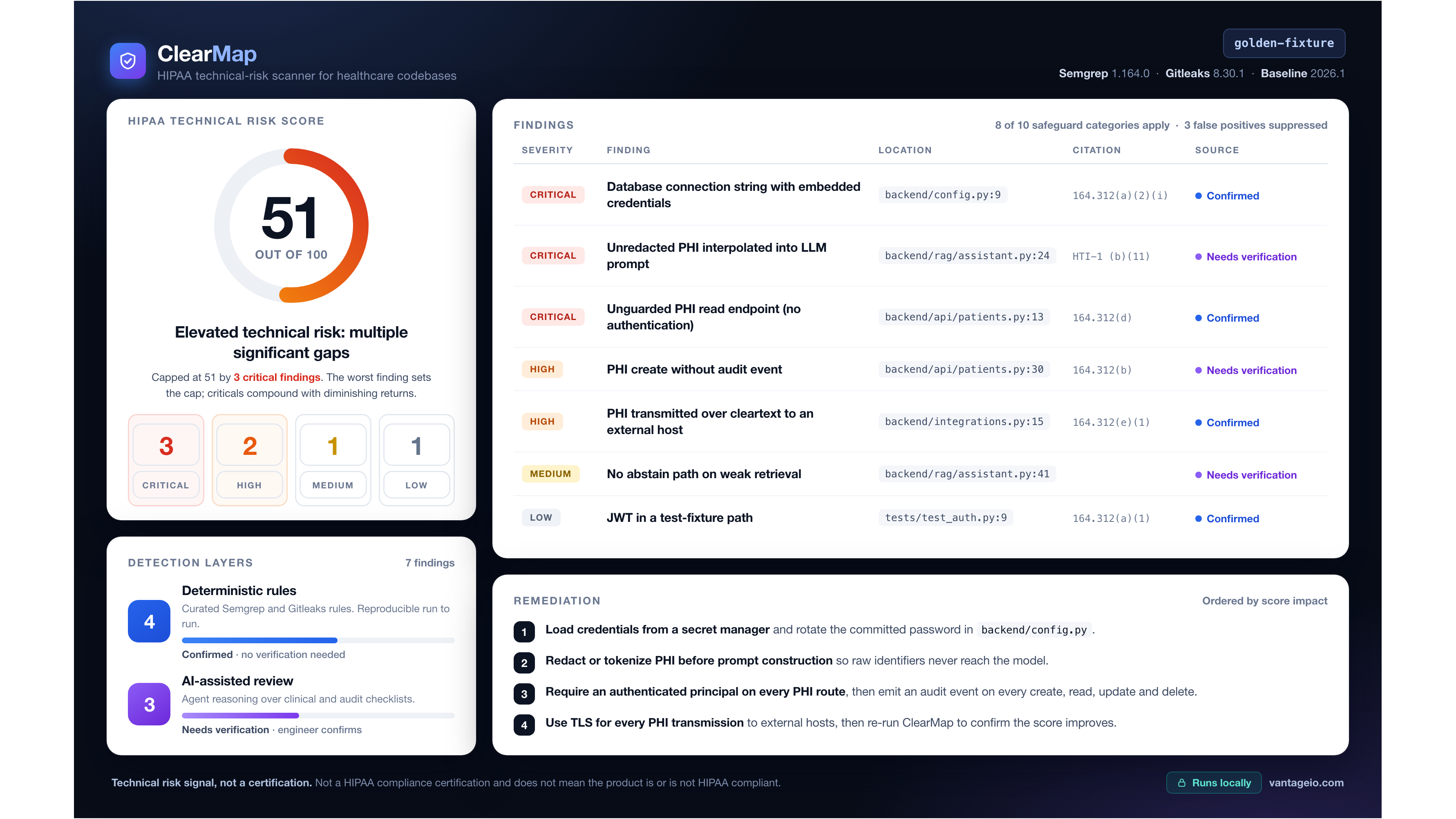
This is the problem that led us to build ClearMap.
ClearMap is an open source platform designed specifically for healthcare AI-native development workflows.
Under the hood, it combines:
- Deterministic security analysis using proven tools such as Semgrep and Gitleaks
- Healthcare-specific compliance knowledge focused on HIPAA technical safeguards and PHI handling
- AI-assisted architectural reasoning for questions that require system-level context
One design decision was especially important to us:
Deterministic findings remain separate from AI-derived conclusions.
If a secret is committed to a repository, that is a deterministic fact.
If an authorization model appears insufficient for a PHI workflow, that is an architectural conclusion that requires reasoning.
Engineering teams should be able to see the difference clearly.
Transparency matters, especially in regulated environments.
This Is Not a Replacement for Security or Compliance
A common misconception is that AI governance tools are trying to replace penetration testing, HIPAA risk analyses, or compliance audits.
That is not our view.
ClearMap is designed to complement existing security and compliance programs.
The goal is earlier evidence.
Finding a PHI handling issue during architecture review is dramatically cheaper than finding it after deployment.
Finding an insecure authorization pattern during development is dramatically cheaper than finding it during an audit.
The earlier a healthcare team can identify risk, the less expensive that risk becomes.
The Open Source Decision
We chose to release ClearMap as open source for a simple reason: trust.
Healthcare organizations should be able to inspect the rules, understand the reasoning, extend the platform for their own environments, and integrate it directly into their CI/CD and AI coding workflows.
Black-box governance is a difficult sell in a regulated industry.
Transparent governance is a much stronger foundation.
Where This Is Going
I do not think the long-term question is whether AI will write production software.
That has already happened.
The real question is whether organizations will continue reviewing that software with processes designed for a world where humans wrote every line by hand.
My prediction is that within a few years, every company building regulated software will have some form of AI Engineering Governance, just as every engineering team today relies on version control, automated testing, and CI/CD.
The tooling will evolve.
The specific vendors will evolve.
But the need for machine-assisted engineering judgment will not go away.
AI accelerated software development.
It did not accelerate engineering judgment.
That is the gap we are trying to close.
ClearMap is available today as an open source project.
Explore the project: https://github.com/Vantage-IO/clear-map
Learn more about Vantage IO: https://vantageio.com
VantageIO
City: Hallandale Beach
Address: 1025 E Hallandale Beach Blvd
Website: https://vantageio.com/
Phone: +13059127567
Email: sales@vantageio.com


Comments
Post a Comment