Affordable Dumpster Rental? Peoria Company Reveals Weight Allowance Traps
Key Takeaways
- A low base price on a dumpster rental quote almost never tells the full story — the weight allowance and overage rate determine what the final invoice actually looks like.
- Dense materials like concrete, roofing shingles, and wet soil can push a dumpster past its weight limit long before the container looks even halfway full.
- Hidden fees — including overage charges, extended rental fees, and prohibited item penalties — can quietly add hundreds of dollars to what seemed like a budget-friendly booking.
- Zap Dumpsters Peoria has published a practical breakdown of how to identify the true total cost of a dumpster rental before signing anything — worth reviewing before getting any quote.
- The sections below unpack exactly which fees to watch for, what a solid written quote should include, and why Illinois disposal rules can turn an overlooked item into a serious penalty.
A dumpster rental looks straightforward on the surface: pay a flat rate, fill the container, have it hauled away. For many Peoria homeowners tackling a renovation or cleanout, that is exactly how it goes — until the final invoice arrives. What seemed like a $299 deal can quietly balloon into a $500-plus bill, and the gap almost always traces back to one overlooked number buried in the fine print: the weight allowance.
That $299 Dumpster Quote Will Cost You More
A $299 quote for a standard roll-off container in the Peoria, IL market is an eye-catching number. It is also almost certainly structured to generate additional charges. Dumpster rental costs in the Peoria area typically range from $200 to $800, with common mid-sized options like a 15-yard dumpster starting around $385 for a short rental window. Anything advertised significantly below that range is not a bargain — it is a signal that something in the pricing structure has been shifted out of the base price and into the fine print.
The mechanics are simple. Providers who compete on headline price often do so by shrinking the included weight allowance to as little as 1 ton, then recouping margin through overage fees once the load is weighed at the disposal facility. A homeowner who fills a 20-yard container with old drywall, flooring, and mixed renovation debris is almost guaranteed to exceed a 1-ton cap — and at $55 to $150 per ton in overage charges, those extra tons add up faster than most people expect.
Understanding how this works before booking is the difference between a project that stays on budget and one that does not. Zap Dumpsters Peoria has published a guide on finding the best-value dumpster rental in Peoria, IL that walks through how to compare quotes line by line — not just headline price — so the true total cost is visible before any deposit changes hands.
Weight Allowance: The Number That Determines Your Real Cost
What a weight allowance actually is
A weight allowance is the maximum amount of debris — measured in tons — included in the quoted rental price. Exceed it, and the overage is billed separately, typically after the container has been hauled to the disposal facility and weighed. For most standard residential containers, weight allowances range from 1 to 5 tons, with a 20-yard dumpster — one of the most popular sizes for home renovation and cleanout projects — typically carrying a limit of 2 to 3 tons.
The weight allowance is the single most important number in any dumpster rental quote, yet it is also the one most likely to be absent from a low-price advertised rate. A quote that lists a base price without explicitly naming the included tonnage is incomplete — and in practice, an unnamed weight allowance almost always means a low one. Before accepting any quote, confirm the exact included weight in writing and the exact per-ton charge that applies once that limit is crossed.
Why dense materials hit the limit before the dumpster looks full
Visual fullness and weight are two very different things. A 20-yard dumpster filled with old carpet and light wood framing might weigh under a ton. That same container filled with concrete, brick, roofing shingles, or wet soil can easily hit 3 to 5 tons before it is anywhere close to full by volume. This is the trap that catches the most homeowners off guard — especially on projects involving demolition, roof tear-off, or excavation work.
Dense materials compress poorly and weigh disproportionately more than their volume suggests. A single layer of roofing shingles across the bottom of a 20-yard container can represent more than a ton of material. Mixed loads — part light debris, part heavy materials — are harder to estimate and the most common source of unexpected overages. Knowing the types of debris going into the container before booking gives a provider the information needed to recommend the right weight allowance for the job, rather than the lowest one that produces a compelling headline price.
How Hidden Fees Stack Up Fast
1. Weight overage charges ($55-$150 per ton)
Weight overage fees are the most common and most expensive hidden cost in dumpster rentals. The typical range runs $55 to $150 per ton above the included allowance. On a job that runs 2 tons over a 1-ton cap, that is a potential $110 to $300 in additional charges — billed after the fact, once the truck has left the disposal facility. The overage rate is rarely prominently disclosed in a low-price quote, which is precisely why it does so much damage to final invoices.
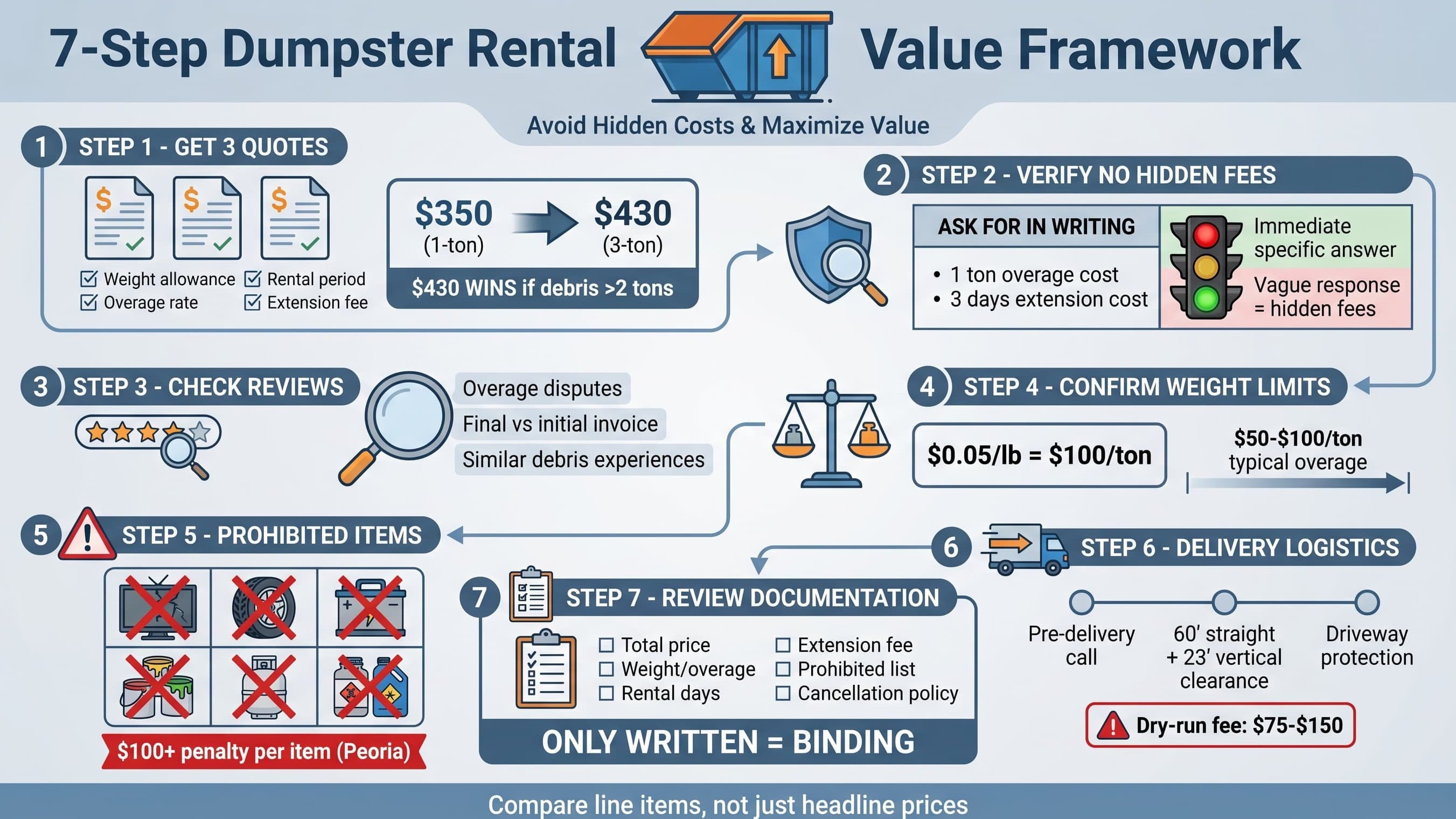
To put it in real terms: a $299 base quote with a 1-ton allowance and a $100-per-ton overage rate will cost $499 on a job that generates just 3 tons of debris. A transparent quote at $430 with a 3-ton allowance and a $60-per-ton overage rate covers the same job for $430 — $69 less, despite the higher headline price. The math is straightforward, but only visible when the line items are laid out side by side.
2. Extended rental day fees ($15-$50 per day)
Most dumpster rental quotes include a set number of rental days — commonly 3 to 7 — in the base price. Projects that run long, whether due to weather, contractor delays, or simply more work than anticipated, can push the container into extended territory. Extended day rates typically run $15 to $50 per day, depending on the provider and container size. A project that runs a week over schedule at $40 per day adds $280 to the invoice without any additional debris or service — just time.
The fix is simple: ask before booking how many rental days are included and what the per-day rate is beyond that window. Factor a realistic project timeline into the comparison rather than assuming the base rental period will be sufficient. Renovation timelines have a way of stretching, and a provider with a low per-day extension rate is worth more than one with a rock-bottom base price and a steep daily overage.
3. Fuel and environmental surcharges
Fuel and environmental surcharges are common line items that rarely appear in advertised base prices. These charges — typically a flat fee ranging from $25 to $100, or a percentage of the total cost (roughly 5-35%) — cover the provider's fuel costs for delivery and pickup, as well as mandated environmental compliance fees tied to the disposal facility. In some quotes, landfill or tipping fees — what the facility charges based on the weight of the load, which in Illinois generally ranges from $40 to $75 per ton and can average higher — are included in the base rate. In others, they are billed separately after the fact.
The distinction matters because a quote that excludes the disposal fee is essentially an incomplete price. A $350 quote that does not include disposal can easily become a $450-plus invoice once the tipping fee is added post-delivery. Always ask whether the disposal or tipping fee is included in the quoted total, and get the answer in writing before confirming the booking.
4. Prohibited item contamination penalties
Prohibited item penalties are among the most avoidable fees in dumpster rental — and among the most expensive when they are not avoided. Penalties for placing restricted items in a container typically range from $100 to $2,000, depending on the item type and how it complicates disposal. Common prohibited items include motor oil, lead-acid batteries, electronics, liquid paint, tires, appliances containing refrigerant, propane tanks, and hazardous chemicals.
These restrictions exist because Illinois state law governs how these materials can legally be handled at the disposal facility level — not just as a contractor preference. Requesting the prohibited items list before the container arrives takes about 30 seconds and can prevent a $200 or $300 penalty for something as easy to overlook as a few cans of old paint or a car battery from the garage shelf.
Low Base Price vs. Low True Total Cost
The comparison that actually matters
The only price that matters at the end of a dumpster rental is the one on the final invoice. Base prices are marketing tools; true total cost is the real measure of value. The gap between the two can be significant — and it is consistently widest for quotes that lead with an unusually low headline number.
Consider a side-by-side example using realistic Peoria market numbers. A 20-yard dumpster quoted at $310 with a 1-ton weight allowance and a $100-per-ton overage rate produces a final invoice of $460 on a 2.5-ton load — $150 in overages on top of the base. A competing quote at $430 with a 3-ton allowance and a $60-per-ton overage rate covers that same 2.5-ton load entirely within the included allowance, for a final cost of $430. The lower-headline quote cost $30 more. That is the comparison that matters — and it is only visible when weight allowance and overage rate are part of the evaluation.
Warning signs a quote is structured to generate overages
A few patterns reliably signal that a low-price quote is built around overage revenue rather than genuine value. Watch for these specifically:
- Weight allowance not mentioned — Any quote that does not name the included tonnage upfront is almost certainly hiding a low one.
- Disposal fee listed separately — A base price that excludes the tipping or disposal fee is structurally incomplete; the real cost is higher than it appears.
- Vague overage language — Phrases like overage depends on weight without a specific per-ton rate are a red flag; the rate should be stated clearly before booking.
- Base price significantly below the Peoria market range — Quotes below $300 for any standard container in the local market almost always involve a minimal weight allowance designed to generate additional charges.
- Payment via app only — Requests for untraceable payment through Venmo, Zelle, or Cash App, particularly paired with unusually low prices, are consistent with scam structures flagged in consumer warnings.
What Every Written Quote Should Spell Out
Key terms your booking confirmation should include
A verbal quote is not an agreement. The written booking confirmation — received before the container is dispatched — is the only document that determines what was actually agreed to. Before confirming any dumpster rental in Peoria, verify that the written confirmation explicitly includes all of the following:
- Total price with all fees included — delivery, pickup, disposal, and any standard surcharges rolled into one number
- The included weight allowance — stated in tons, not ranges or approximations
- The exact per-ton overage rate — so there is no ambiguity about what excess weight costs
- Number of rental days included — and whether the clock starts at delivery or at booking
- The per-day extension fee — the daily rate that applies if the project runs longer than expected
- The prohibited items list — or a direct reference to where it can be found in writing
If any of these elements is missing from the written confirmation, request it before the truck rolls. A provider who answers all six points specifically and in writing is one that has thought through its pricing transparently. One who deflects or says the details are standard without specifying them is signaling that the fine print may not be in the customer's favor. A verbal assurance that the weight allowance is around 3 tons is not a contractual commitment — only the written version is enforceable.
Illinois Prohibited Items Can Trigger Serious Penalties
Illinois state law sets strict rules about what can and cannot go into a landfill — and those rules flow directly down to what is allowed in a roll-off dumpster. Used motor oil and lead-acid batteries are explicitly prohibited from landfill disposal under Illinois law, requiring separate handling through certified collection sites or recycling centers. General construction and demolition debris must also be routed to facilities that meet state environmental compliance standards; improper disposal can carry substantial penalties that may fall on the generator of the waste, not just the hauler.
For homeowners, the practical implication is this: the prohibited items list is not just a contractor policy — it reflects what is legally permissible at the disposal facility. Items that seem minor, like a half-empty can of paint thinner, an old car battery, or a broken window AC unit, can trigger contamination fees and, in more serious cases, broader legal liability. The Illinois EPA maintains guidance on household hazardous waste collection events and permanent drop-off locations across Central Illinois for items that need a separate disposal channel.
The most common prohibited items to plan around before a Peoria area project include: liquid paint in any form, motor oil, lead-acid batteries, electronics, tires, appliances containing refrigerant such as fridges and AC units, propane tanks, and hazardous chemicals. Knowing this list before the container arrives — and arranging separate disposal for any of these items in advance — eliminates the risk entirely.
Transparent Pricing Protects Peoria Homeowners From Surprise Invoices
The pattern behind most surprise dumpster rental invoices is consistent: a low headline price attracts the booking, a minimal weight allowance generates the overage, and the customer sees the real cost only after the container has been picked up and the load weighed. By the time the invoice arrives, there is little recourse. The debris is gone, the project is done, and the terms — however buried — were technically disclosed somewhere in the paperwork.
The protection is not complicated. It comes down to asking the right four questions before any quote is accepted: What is the included weight allowance? What is the exact per-ton overage rate? What does the rental period include, and what does an extra day cost? Is disposal included in the quoted total? A provider who answers all four specifically, in writing, and without hesitation is operating transparently. One who hedges or provides vague answers on any of them is worth passing on — regardless of how attractive the base price looks.
Peoria homeowners planning a renovation or cleanout project deserve to know what a dumpster rental will actually cost before committing — not after the truck leaves. Transparent pricing is not a premium feature; it is a baseline expectation that any reputable provider should meet without being asked twice. Knowing the right questions to ask, what a complete written quote looks like, and which fee structures are designed to generate overages puts that control back where it belongs: with the homeowner, before the container ever hits the driveway.
For homeowners in the Peoria area who want straightforward pricing and no invoice surprises, Zap Dumpsters Peoria states it offers roll-off dumpster rentals with fully transparent flat-rate quotes.
Zap Dumpsters Peoria
City: Peoria
Address: 208 SW Center St
Website: https://zapdumpsterspeoria.com
Phone: +1 309 650 8954


Comments
Post a Comment