3 Government-Backed Loan Types: Which Remain Assumable & Why
Key Takeaways
- FHA, VA, and USDA loans are the three government-backed mortgage types that are legally assumable - conventional loans almost never are.
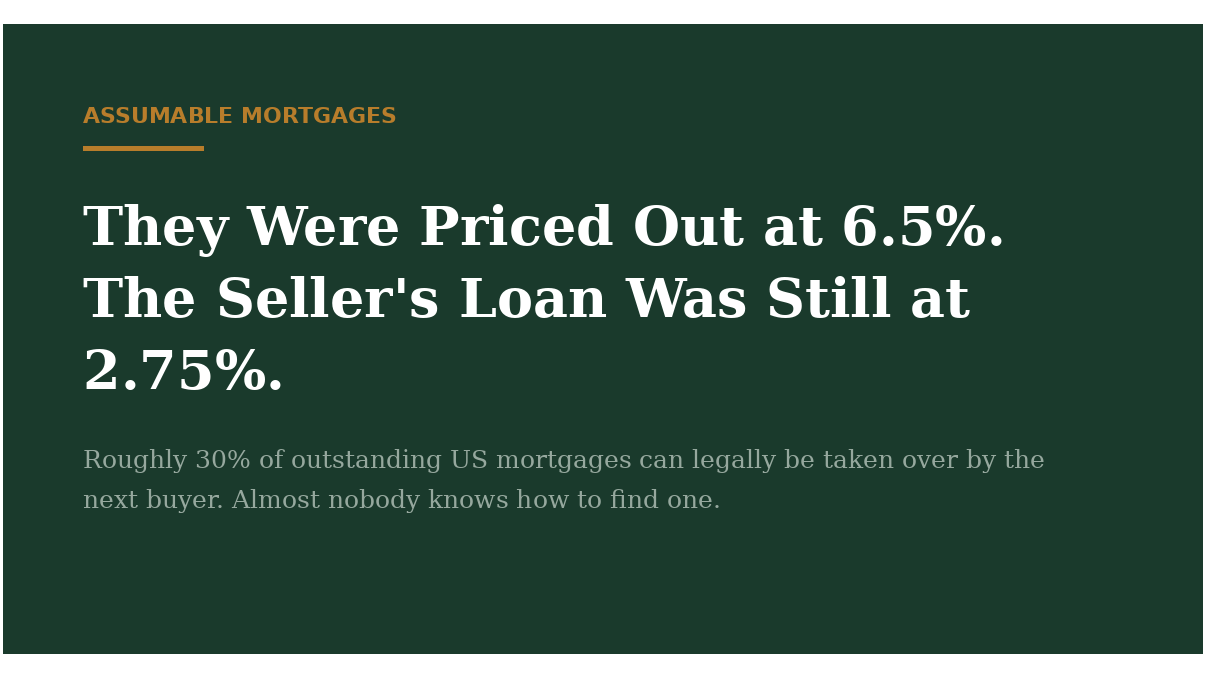
- Buyers who assume a loan from the 2020-2022 era can lock in rates as low as 2.5%-3.5% in a market where current rates hover around 6.5%-6.75%, potentially saving over $1,000 per month on larger loan amounts with significant rate differentials.
- VA loan sellers face a critical risk most agents never mention: if the buyer is not an eligible veteran, the seller's VA entitlement stays tied to that loan until it is fully paid off.
- The biggest obstacles are not eligibility - they are the equity gap, slow servicer timelines, and a shortage of professionals who actually know how to close these deals.
- There is no central registry for assumable loans, which means finding one requires knowing exactly where and how to look - covered in detail below.
Assumable mortgages have existed for decades. Most buyers never think to ask about them. Right now, in a market where a half-per cent difference in rate can shift a monthly payment by hundreds of dollars, that question is worth asking every single time.
Government-Backed Loans Are Assumable - Most Buyers Never Ask
A mortgage assumption lets a buyer step into a seller's existing loan - same lender, same rate, same remaining balance - instead of taking out a brand-new mortgage at today's rates. For FHA, VA, and USDA loans, this is legally permitted. Yet the vast majority of buyers never bring it up, and most real estate agents don't either.
That's not entirely anyone's fault. Assumable loans represent a small slice of active listings, and the process is more involved than a standard purchase. FHA, VA, and USDA mortgages account for a meaningful share of outstanding U.S. mortgages - and millions of those were written between 2020 and 2022, when rates sat between 2.5% and 3.5%. That's a large pool of loans worth asking about. This knowledge gap is evident, as most buyers often discover assumable loans only after encountering a listing that explicitly mentions one - by which point opportunities may already have passed.
Why Low Rates From 2020-2022 Still Matter Today
The Rate Gap Buyers Are Chasing
The core appeal is straightforward: rates today are roughly double what they were during the 2020-2022 era. A buyer taking out a new $350,000 mortgage at 6.5%-6.75% faces a very different monthly payment than a buyer assuming an existing loan at 3%. That gap - the rate differential - is what makes assumption worth the extra effort right now. This window won't stay open indefinitely. If and when market rates fall, the advantage of a 2020-era loan narrows.
Real Savings: What Assuming a 3% Loan Looks Like Today
An FHA loan assumption can result in significant savings. For example, a buyer taking over a 3.25% loan in a market where new mortgages were closing around 6.5%-6.75% could see a payment reduction of over $1,000 per month on a sufficiently large loan amount. Over a 30-year term, that compounds into tens of thousands - often six figures - in total interest savings. The closing takes longer than a conventional purchase, but for a four-figure monthly difference, most buyers who understand the math consider it worth it.
FHA Loans: One of the Most Common Assumable Options
FHA loans are the most frequently encountered assumable mortgage in the market, largely because FHA-backed financing has been widely used by first-time and moderate-income buyers for years. Any qualified buyer can assume an FHA loan - they don't need to be a first-time buyer, and they don't need to have an existing FHA loan themselves.
Who Qualifies and What the Lender Checks
The buyer must qualify through the seller's existing loan servicer - not a lender of their choosing. That servicer will review credit score and history, debt-to-income ratio, and employment and income documentation. It's a full underwrite, just run through a different channel. The buyer has no ability to shop lenders or negotiate terms - the servicer controls the process entirely.
Primary Residence Requirement
FHA rules require that the property being assumed become the buyer's primary residence. This isn't a technicality - it's actively enforced. Investors looking to assume FHA loans for rental use don't qualify. The program is designed to benefit owner-occupants, and that restriction holds at assumption just as it does at origination.
VA Loans: The Entitlement Risk Sellers Often Miss
VA loans can be assumed by both veterans and non-veterans, which sounds like a broad advantage - and it is, for buyers. For sellers, though, there's a risk hiding inside that flexibility that most agents never flag.
Non-Veteran Buyers and Frozen Entitlement
When a non-veteran assumes a VA loan, the original veteran seller's entitlement stays attached to that loan until the loan is paid off - not until closing, but until the mortgage is fully retired. On a 30-year term assumed by a stranger, that could be decades away. During that entire period, the portion of the seller's VA benefit tied to the old property is unavailable for a new purchase. The seller can still buy again, but likely not with the full VA benefit they earned. This catches sellers off guard constantly, and listing a VA loan as assumable without understanding this detail has real financial consequences.
The Veteran-to-Veteran Substitution Fix
There is a solution, but it requires a specific buyer: an eligible veteran with their own VA entitlement. In that scenario, the buyer can substitute their entitlement for the seller's, releasing the seller's benefit entirely at closing. That single distinction - veteran buyer or not - is the difference between a clean exit and a benefit frozen for the better part of a working life. Any experienced mortgage professional handling VA assumptions knows to raise this in the very first conversation.
USDA Loans: Assumable With Strict Eligibility Gates
USDA loans are assumable through what the agency calls a transfer and assumption process. The mechanics are similar to FHA - the incoming buyer must qualify through the existing servicer - but the eligibility requirements are more layered.
Income Limits and Rural Property Rules Still Apply
USDA eligibility doesn't disappear just because a loan already exists. The new borrower must still meet USDA income limits for their household size and the property's county, and the home must still qualify as rural under USDA guidelines at the time of assumption. This is the narrowest eligibility window of the three loan types. A buyer who qualifies for an FHA or VA assumption might not qualify for a USDA one simply because their income exceeds the county threshold. Verify both the buyer's eligibility and the property's current USDA designation before going too far down this path.
The Real Obstacles Every Buyer Faces
The Equity Gap: Cash or a Second Mortgage
Here's the practical problem most buyers hit immediately: the assumable loan balance and the home's sale price are rarely the same number. If a seller bought at $300,000 with a $280,000 loan and the home is now worth $420,000, the buyer assumes roughly $265,000 after paydown - but needs to cover roughly $155,000 to bridge the gap. That difference must be paid in cash at closing or financed through a second mortgage, which carries its own interest rate and terms. The second mortgage option requires a lender willing to write a subordinate loan on a property with an assumed first - not all lenders are set up for this, and the combined rate calculation changes the savings math.
Timelines, Fees, and Servicer Control
Assumptions don't close in 30 days. The process commonly runs 45 to 90 days, and some servicers stretch to 120. Servicer systems are built for new loan originations, not assumption processing, and staffing for assumption departments is often minimal. For FHA and USDA loans, assumption fees can range from a few hundred dollars and may go up to 1% of the remaining loan balance, depending on the servicer. For VA loans specifically, there is a funding fee of 0.5% of the remaining balance, plus a separate processing fee that servicers may cap at a few hundred dollars - confirm the exact figures with the servicer. None of this is a dealbreaker, but buyers need to plan for it - and sellers need to know their listing may sit under contract longer than a conventional deal.
No Registry, No Shortcut - Here's How to Find One
There is no central database of assumable loans. MLS records don't carry loan type in any standardized field, so the word "assumable" surfaces only when an agent writes it into a description - and sometimes that claim hasn't been verified. A handful of third-party platforms have started aggregating assumption-eligible listings, but coverage varies significantly by market.
In practice, finding an assumable loan means searching listing descriptions for terms like "assumable," "FHA loan," "VA loan," or "USDA loan" and verifying with the seller's agent; asking directly on any government-backed listing even if assumption isn't advertised; and working with a mortgage professional who has actually closed assumptions before. That last point matters most. Most loan officers have never handled one. The few who have know which servicers cooperate, where deals typically stall, and how to structure the equity gap - knowledge that rarely makes it into a listing description but makes or breaks the transaction.
Rates Are Elevated Now - Assumable Loans Offer a Concrete Advantage While They Are
The case for assumption is real, and it's time-sensitive. Every 2020-era FHA, VA, or USDA loan still outstanding represents a potential $1,000-per-month swing for the right buyer on the right loan amount. That gap narrows as market rates fall - and it disappears entirely if rates return to pre-2022 lows. Buyers who understand assumption and know how to pursue it are operating with an edge that most of the market is leaving on the table.
The process is more involved than a conventional purchase. It takes longer, requires a specific type of professional help, and involves a gap that most people have to get creative to fill. Three government-backed loan programs explicitly permit assumption, millions of eligible loans exist, and the financial math at current rates is hard to argue with. For buyers feeling priced out by today's rates - and sellers looking for a genuine differentiator in a competitive market - assumption deserves a serious look, not just a passing mention in a listing description.
Autonomous Growth helps loan officers and local service professionals build the digital visibility that puts them in front of buyers asking these exact questions - visitautonomousgrowth.ioto see how they make it happen.
Autonomous Growth ( part of RReputatioNN )
City: Rijkevorsel
Address: 109 Sint-Lenaartsesteenweg #1
Website: https://autonomousgrowth.io


Comments
Post a Comment