11 Questions on Crawl Space Mold Removal? Tampa Bay Inspection Pros Answer
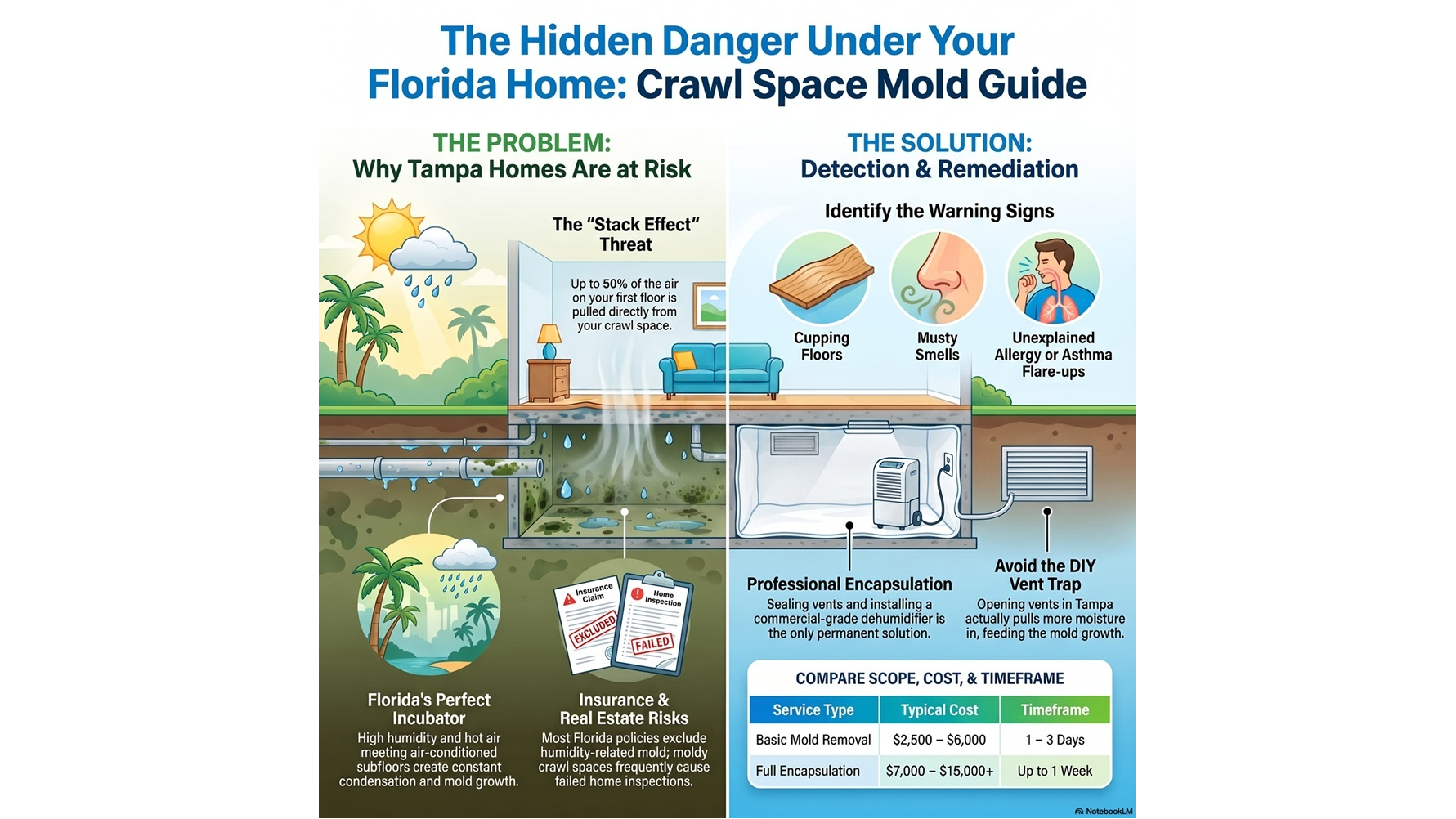
- Tampa Bay's subtropical humidity makes crawl space mold one of the most common - and costly - home problems in the region.
- Professional remediation typically runs $2,500-$6,000, but severe cases can push well past $10,000 depending on structural damage and moisture control needs.
- Most Florida homeowners insurance policies do not cover mold from long-term humidity - a detail that catches many homeowners off guard.
- Up to 50% of the air on your first floor is pulled up from the crawl space, meaning a mold problem below directly affects the air your family breathes.
- Opening crawl space vents in Tampa's climate actually worsens moisture - one of several counterintuitive facts covered below.
Crawl space mold is the kind of problem that hides out of sight until it becomes expensive. For homeowners across the Tampa Bay area, the local climate turns a manageable risk into an almost unavoidable one. The questions below are the ones Tampa Bay homeowners ask most often - answered with the specifics this region actually demands.
Tampa's Climate Makes Crawl Space Mold Almost Inevitable
Florida ranks second in the nation for homes most prone to mold, with an estimated 264,000 mold-related insurance claims filed in 2022 alone. That number makes sense once you understand what's happening under the average Tampa Bay home. Humidity levels regularly exceed 75% year-round, summer rains are heavy and frequent, and the region's high water table keeps the ground persistently damp. Mold needs only three things to thrive: moisture, organic material like wood, and warmth. Tampa Bay supplies all three in abundance for most of the year.
This is the challenge that TampaBayMold.net's crawl space mold removal specialists work with daily - not a generic moisture problem, but one shaped by a specific regional climate that standard remediation advice often underestimates.
What Does Crawl Space Mold Removal Cost in Tampa Bay?
Cost is usually the first question, and the range is wide enough that a single number doesn't tell the full story.
Typical Range: $2,500-$6,000
For most crawl space mold jobs in Tampa Bay, the remediation itself - cleaning, treating, and removing contaminated material - runs between $2,500 and $6,000. Mold remediation in Tampa already runs approximately 7.5% above the national average, reflecting both the prevalence of the problem locally and the labor intensity of working in tight, humid crawl spaces. The final number depends on the crawl space's square footage, how deep the mold has penetrated into the wood, and whether vapor barrier work is included.
When Costs Escalate to $10,000-$20,000+
Costs climb significantly when structural wood has rotted and requires replacement, or when the job includes full encapsulation, drainage systems, or sump pump installation. In those scenarios, total project costs can reach $10,000 to $20,000 or more. The jump reflects real scope: wood rot means load-bearing joists or beams may need replacing, which shifts the work from mold remediation into structural repair. Catching the problem early is the most reliable way to keep costs in the lower range.
Why Mold Spreads So Fast Under Florida Homes
Humidity, Rain, and a High Water Table
Tampa's summer months bring near-daily afternoon storms and persistent humidity that never fully dries out between events. The ground beneath most Tampa Bay homes holds moisture close to the surface year-round due to the region's naturally high water table. That combination keeps the soil under the house damp and the air trapped in the crawl space saturated - a condition mold exploits rapidly on any available wood surface.
Condensation on Cool Subfloors Feeds Growth
There's a physics problem working against Tampa homeowners: the subfloor above the crawl space is cooled by the home's air conditioning, while the air entering the crawl space is warm and humid. When that warm, moist air contacts the cooler subfloor surface, it condenses - depositing water directly onto the wood. This cycle repeats daily during cooling season, which in Tampa Bay runs from roughly April through October. That's six months of continuous moisture accumulating on the exact surfaces mold needs to grow.
Signs You Have Mold Without Going Under the House
Most homeowners discover crawl space mold indirectly - through symptoms in the living space above rather than by inspecting it themselves. The most telling signs include:
- A persistent musty odor, especially noticeable when the AC starts up
- Cupping or buckling hardwood floors, which signals moisture in the subfloor
- Elevated indoor humidity that doesn't respond normally to air conditioning
- Unexplained spikes in allergy or asthma symptoms among people in the home
- Visible efflorescence (white mineral deposits) on foundation walls or piers
None of these signs alone confirms mold, but two or more together - especially in an older Tampa Bay home - should prompt a professional inspection rather than a wait-and-see approach.
Does Homeowners Insurance Cover This?
This is where many Tampa Bay homeowners get an unwelcome surprise.
Covered Perils vs. Maintenance Neglect
Florida homeowners insurance policies typically cover mold only when it results directly from a covered peril - a sudden burst pipe, an appliance failure, or storm-driven water intrusion. Mold that developed gradually from Tampa's ambient humidity, poor ventilation, or a slowly rising water table is classified as a maintenance issue, not an insurable event. That distinction matters enormously when a remediation bill arrives.
Sub-Limits That May Leave You Short
Even when a policy does cover mold, the coverage is often capped by a sub-limit - sometimes as low as $10,000. Given that severe crawl space mold jobs in Tampa Bay can exceed that figure, a homeowner assuming full coverage may still face a significant out-of-pocket cost. Reviewing the mold sub-limit on the policy declarations page before a problem develops is far easier than disputing it after remediation has already started.
Your Indoor Air Is Already Affected
The Stack Effect: Up to 50% of First-Floor Air
The stack effect describes how air moves through a home like a chimney - rising from the lowest point to the highest. In a home with a crawl space, air is continuously drawn up from below the floor into the living area. Research indicates that up to 50% of the air on a home's first floor originates from the crawl space. When that space contains active mold colonies, elevated humidity, and stagnant air, those conditions travel directly into the rooms above - carrying musty odors, elevated spore counts, and airborne moisture along with them.
Post-remediation air quality verification is a meaningful step for this reason. Even after professional mold removal, spores can persist in HVAC systems, making follow-up testing a worthwhile part of any complete remediation plan.
Opening Vents Makes Things Worse, Not Better
More airflow seems like it should mean less moisture. In most of the country, that logic holds. In Tampa Bay, it backfires. The outdoor air is almost always more humid than the air inside a crawl space, so opening foundation vents pulls that humid air in. It then contacts the cooler surfaces of the floor joists and condenses - adding moisture rather than removing it. Sealed, conditioned crawl spaces consistently outperform vented ones in humid Florida climates, which is the core reason encapsulation has become the preferred long-term solution here.
Is Crawl Space Encapsulation Worth It in Tampa?
What Encapsulation Actually Involves
Crawl space encapsulation seals the space off from ground moisture and outside air entirely. The process typically includes:
- Closing and sealing all foundation vents
- Installing a heavy-duty vapor barrier (usually 8-20-mil polyethylene) across the ground and up the walls
- Sealing penetrations around pipes and piers
- Installing a high-capacity dehumidifier sized appropriately for the sealed environment
The dehumidifier component is non-negotiable. A sealed crawl space without active moisture control can trap humidity rather than eliminate it. Standard residential dehumidifiers often lack the capacity for the continuous moisture load a Florida crawl space produces, so a high-capacity unit properly sized for the space is required for effective moisture control.
Cost vs. Long-Term Value: $5,000-$15,000
Encapsulation in Tampa Bay typically runs $5,000 to $15,000, depending on crawl space size, accessibility, and whether drainage improvements are also needed. Against that cost, consider what repeated mold treatments, wood rot repairs, elevated energy bills from moisture-laden air fighting the AC, and a failed home inspection at the worst possible moment would add up to. For homes with chronic moisture problems, encapsulation tends to be the last remediation cost rather than one in a recurring series.
Get a Professional Inspection - Before a Home Sale Forces You To
Mold, standing water, or rotting joists in a crawl space are among the most common deal-killers in Tampa Bay real estate transactions. Buyers and their inspectors look specifically at crawl spaces in Florida, and visible mold or structural damage typically triggers a demand for full remediation before closing - or a walk-away. Sellers who discover the problem mid-transaction face both time pressure and reduced negotiating leverage.
A proactive inspection resets that dynamic entirely. Addressing a crawl space mold issue on a planned timeline, rather than under contract pressure, allows for proper remediation, proper verification, and proper documentation - all of which translate directly to a cleaner sale and fewer surprises.
The signs are often already present inside the home. The musty smell, the buckling floor, the allergy flare-ups - they're worth taking seriously well before a home inspector puts them in a report. For Tampa Bay homeowners ready to get a clear picture of what's actually happening under their home, TampaBayMold.net provides professional crawl space mold inspections and remediation services across the Tampa Bay area.
TampaBayMold.net
City: Tampa
Address: 550 N. Reo St. Suite #300
Website: https://www.tampabaymold.net


Comments
Post a Comment