What Kind of Outdoor Kitchen Suits You? Port St Lucie Designer's Quiz
Key Takeaways
- No two outdoor kitchens are the same — the right design depends on how you cook, how you entertain, and how your home is built.
- Florida's heat, humidity, and salt air make material selection one of the most critical decisions in any outdoor kitchen build.
- Functional zones — hot, cold, wet, and dry — are the backbone of a well-planned outdoor kitchen layout.
- Custom Outdoor Kitchen Port St Lucie offers a free Designer's Quiz that helps homeowners pinpoint the right style and features before a single stone is laid.
- A 3D design consultation bridges the gap between inspiration and a finished outdoor space that actually works for your lifestyle.
Outdoor kitchens have become one of the most sought-after home upgrades in South Florida — and for good reason. Port St Lucie's warm climate practically begs for year-round outdoor living. But walking into the planning process without a clear direction makes it easy to end up with a space that looks beautiful in a showroom photo and falls short in real life. This guide breaks down what professional designers actually think about when building a custom outdoor kitchen, and how homeowners in Port St Lucie can use those same principles to find a setup that genuinely fits their lifestyle.
There's No One-Size-Fits-All Outdoor Kitchen
Scroll through any home design feed and it's tempting to point at a stunning outdoor kitchen and say, "I want that." The problem? That kitchen was built for someone else's backyard, someone else's cooking habits, and someone else's aesthetic. What works beautifully in a modern waterfront property may feel completely out of place on a cozy suburban lot surrounded by mature tropical landscaping.
The truth is, outdoor kitchen design is deeply personal. Two homeowners on the same street in Port St Lucie can end up with wildly different kitchens — and both can be exactly right. One might be a weekend grillmaster who hosts large family gatherings and needs serious cooking power. Another might want a calm, low-maintenance setup for evening cocktails and light entertaining. Both deserve a kitchen designed around their life, not a floor model.
That's the whole premise behind personalized design tools and consultations. Custom Outdoor Kitchen Port St Lucie built their Designer's Quiz specifically to help local homeowners cut through the noise — answering a few focused questions to get matched with a style and feature set that actually suits how they live. It's a practical first step before diving into materials, layouts, or appliance selections.
What a Designer Considers for Your Custom Build
Your Cooking Habits and Hosting Style
The most important question any outdoor kitchen designer asks isn't about aesthetics — it's about behavior. How do you actually use your outdoor space? A homeowner who smokes brisket low-and-slow every Sunday has completely different needs than someone who hosts corporate cocktail parties twice a year.
Cooking habits shape everything: the number and type of appliances, the amount of prep space, whether a dedicated pizza oven or a flat-top griddle makes more sense, and how much cold storage is needed nearby. Hosting style, meanwhile, dictates flow. Large gatherings need open layouts with multiple access points so guests aren't crowding around one station. Intimate dinners call for a more enclosed, cozy arrangement that keeps the host connected to the conversation.
Getting honest about these habits upfront prevents the most common outdoor kitchen regret — building something that looked great on paper but doesn't match how the space actually gets used.
Your Home's Architecture and Available Outdoor Space
An outdoor kitchen doesn't exist in isolation. It sits in relationship with the home behind it, the patio or deck beneath it, and the yard stretching out around it. A well-designed build respects those relationships rather than fighting them.
A Mediterranean-style stucco home in Port St Lucie calls for different finishes than a modern concrete-and-glass build. The roofline, exterior color palette, window trim, and even the driveway pavers all send design signals that the outdoor kitchen should respond to. Beyond aesthetics, the physical footprint of the outdoor space determines how large the kitchen can realistically be and whether features like a bar overhang, pergola, or separate dining zone are feasible.
Designers measure, photograph, and assess the site before recommending anything — because a layout that ignores the architecture or squeezes into an awkward corner will always feel like an afterthought.
Your Ideal Functional Zones: Hot, Cold, Wet, and Dry
Every well-planned outdoor kitchen is organized around four functional zones. Understanding these zones is the clearest way to evaluate whether a design will actually work in practice:
- Hot zone: The cooking core — grills, smokers, burners, pizza ovens, or griddles. This area needs proper ventilation clearance and should be positioned so smoke flows away from seating areas.
- Cold zone: Refrigeration, beverage coolers, and ice makers. Proximity to the bar or serving area matters here. No one wants to walk across the patio to grab a drink.
- Wet zone: The sink and any plumbing-connected features. Placement relative to prep surfaces and the grill determines how smoothly the cooking workflow runs.
- Dry zone: Counter space for prep, landing zones next to appliances, and storage for tools and supplies. This is often underestimated — experienced outdoor cooks know you can never have too much counter space.
A thoughtful layout sequences these zones so the cook moves efficiently without backtracking, and guests can serve themselves without getting in the way.
Outdoor Kitchen Styles Popular with Port St Lucie Homeowners
Sleek and Modern with Stainless Steel Finishes
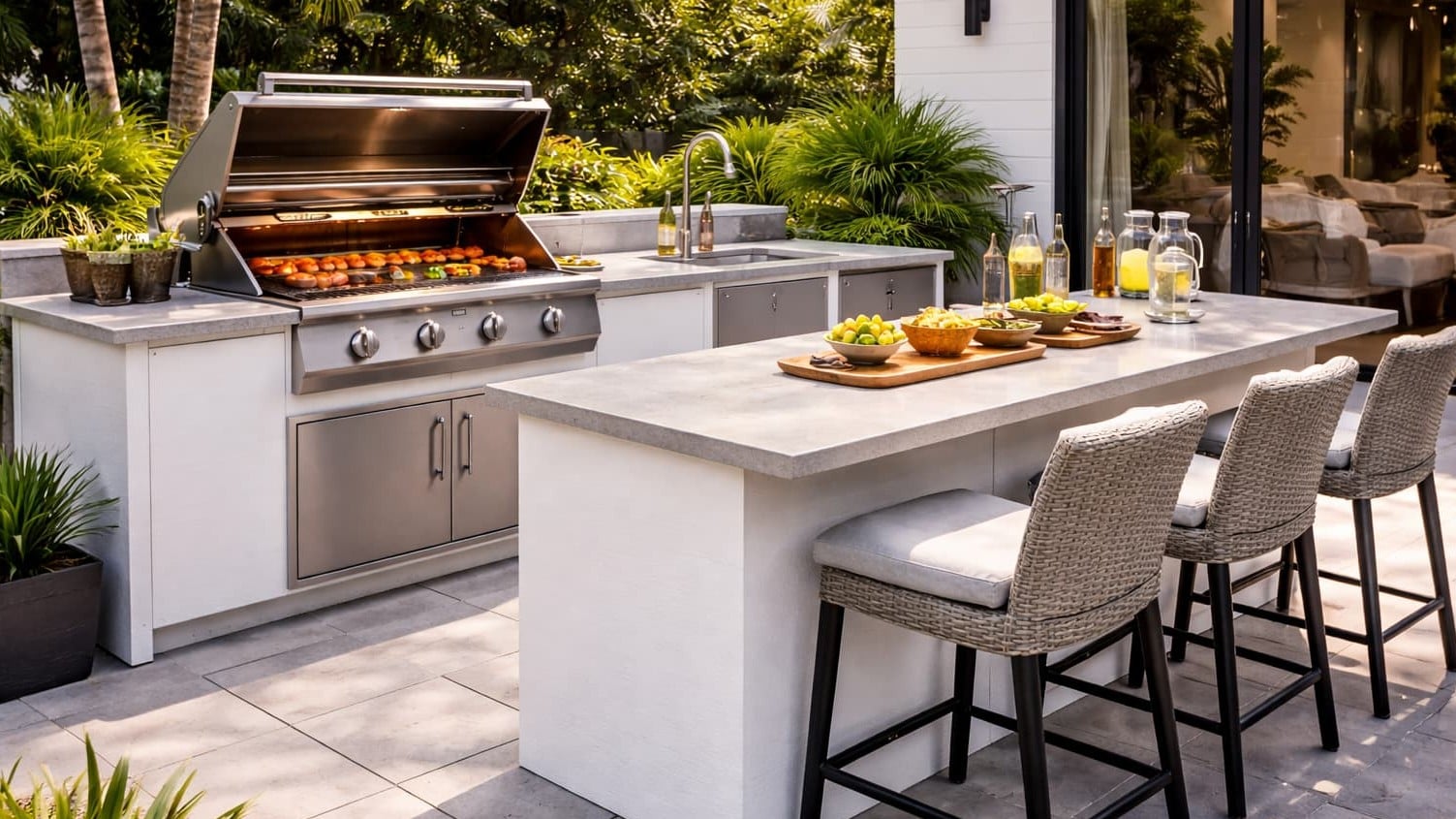
The modern outdoor kitchen is built on clean lines, minimal ornamentation, and a commitment to materials that look sharp and age well. Stainless steel is the signature element — used for appliance faces, cabinet doors, countertop edges, and even structural framing. It pairs naturally with polished concrete countertops, large-format porcelain tile, and integrated LED lighting strips that define the space at night.
This style works especially well with newer construction homes that have a contemporary architectural profile. It's also the most appliance-forward aesthetic — the kitchen gear is meant to be visible and celebrated, not hidden behind decorative panels. For homeowners who take outdoor cooking seriously and want the space to reflect that, a stainless steel-forward build communicates exactly the right message.
Warm and Rustic with Natural Stone and Weather-Resistant Accents
Not every Port St Lucie homeowner wants their backyard to feel like a commercial kitchen. The rustic approach prioritizes warmth, texture, and a sense of permanence — as if the kitchen has always been part of the landscape.
Natural stone veneers, travertine countertops, rough-hewn wood-look porcelain, and wrought iron hardware all contribute to this aesthetic. The palette leans toward earth tones: warm tans, terracotta, deep browns, and mossy greens. This style integrates beautifully with mature landscaping and works especially well for homes with traditional or craftsman-style architecture.
From a practical standpoint, natural stone veneers and quality porcelain tile hold up remarkably well in Florida's climate — offering the look of organic materials with durability that matches or exceeds synthetic alternatives. The key is choosing materials that are rated for outdoor use and sealed appropriately for the Florida heat cycle.
Tropical and Relaxed for Florida Outdoor Living
There's a third aesthetic that feels uniquely at home in South Florida: the tropical outdoor kitchen. This style leans into the setting rather than trying to import a design language from somewhere else. Think thatched-roof tiki structures, bamboo-inspired accents, concrete block construction with stucco finishes, and lush plantings that blur the line between kitchen and garden.
Color plays a bigger role here — ocean blues, coral, sandy neutrals, and tropical greens all make appearances. The atmosphere is relaxed and inviting by design. Seating is generous, there's often a dedicated bar area with bar stools, and the layout prioritizes a laid-back flow over tight kitchen efficiency.
For homeowners in Port St Lucie who entertain frequently and want their outdoor space to feel like a vacation destination, the tropical style delivers an experience that's hard to replicate with any other aesthetic.
Florida's Climate Changes Everything
Materials That Hold Up to Heat, Humidity, and Salt Air
Florida isn't kind to outdoor materials that weren't designed with its climate in mind. High UV exposure, intense summer heat, near-constant humidity, and — for homeowners within a few miles of the coast — salt air corrosion are realities that every outdoor kitchen build in Port St Lucie has to account for.
The materials that perform best in this environment share a few key traits: they don't absorb moisture, they resist UV-related fading and brittleness, and they hold up against the oxidizing effects of salt exposure. Here's how the most common options break down:
- Marine-grade stainless steel (304 or 316 grade): Resists corrosion significantly better than standard stainless. Grade 316 is the preferred choice for coastal properties.
- Natural stone and porcelain tile: Excellent thermal performance and long-term durability when properly sealed. Porcelain in particular offers very low water absorption rates.
- Marine-grade polymer (HDPE): A synthetic cabinet material that doesn't warp, splinter, or absorb moisture — purpose-built for humid outdoor environments.
- Concrete block (CBS) construction: A tried-and-true structural approach in Florida; heavy, stable, and immune to the pest and moisture issues that plague wood framing outdoors.
Choosing materials based on Florida performance rather than showroom appeal is one of the clearest differentiators between an outdoor kitchen that lasts decades and one that starts showing wear within a few years.
Layout Choices That Work Year-Round Outdoors
Port St Lucie's climate means outdoor kitchens can be used in every month of the year — but it also means they'll face summer rainstorms, intense afternoon sun, and occasional cold snaps in winter. A layout that accounts for these conditions stays functional and comfortable regardless of what the weather is doing.
Covered structures — pergolas, solid-roof pavilions, or CBS-framed overhead structures — extend usable hours significantly by blocking direct sun and keeping cooking areas dry during brief afternoon storms. Strategic orientation of the grill and cooking stations keeps prevailing breezes from pushing smoke toward seating areas. Shade placement matters most in the mid-afternoon window when western sun exposure peaks.
Drainage is another often-overlooked layout factor. Flat surfaces that trap water after rain become safety hazards and accelerate material wear. A properly graded patio surface and covered countertops direct water away efficiently. These aren't glamorous design decisions, but they're what separates a kitchen that performs well from one that creates headaches year after year.
From Consultation to a Custom 3D Design
One of the most useful shifts in outdoor kitchen design over the past decade is the move toward 3D visualization before any construction begins. It solves a problem that has plagued home improvement projects forever: the gap between what a homeowner imagines and what actually gets built.
The process typically starts with a detailed consultation — either in-home or through a structured discovery process — where a designer gathers information about the site, the homeowner's lifestyle, their style preferences, and their budget range. From there, a 3D rendering is built that shows the finished kitchen in context with the actual outdoor space. Homeowners can see how the layout flows, how the finishes look together, and whether the proportions feel right — all before committing to materials or breaking ground.
This stage is also where practical refinements happen. A design that looked good on a mood board might reveal an awkward workflow when rendered in three dimensions. The grill might be too close to the seating area. The bar might block the view of the yard. The 3D model surfaces these issues when they're easy and inexpensive to fix, rather than after the concrete is poured.
For homeowners who aren't sure where to start, beginning with a structured questionnaire — like a designer's quiz — gives the design team the foundation they need to build an accurate first draft. It shortens the consultation process and ensures the 3D design is already calibrated to the homeowner's actual preferences rather than starting from scratch.
Schedule a Consultation and Get Your Perfect Outdoor Kitchen
The gap between "I want an outdoor kitchen" and "I know exactly what I want" is where most projects stall. Homeowners browse Pinterest boards, collect inspiration photos, and still feel unsure about what style fits their home, what materials make sense for Florida, or how to translate a wish list into a workable layout.
The most efficient way to close that gap is a structured conversation with someone who designs these spaces every day. A good consultation doesn't just collect preferences — it asks the right questions to surface priorities the homeowner might not have thought to articulate. How much shade is needed? Is the kitchen cooking for two or twenty? Should the kitchen disappear into the landscape or make a statement?
Answering those questions upfront is exactly what the Custom Outdoor Kitchen Port St Lucie Designer's Quiz is designed to do. It's a practical starting point — a few focused questions that help clarify style direction, feature priorities, and functional needs before stepping into a full consultation. From there, a custom 3D design brings the vision to life with real dimensions and real materials, so there are no surprises when construction begins.
An outdoor kitchen built around a homeowner's actual life — how they cook, how they entertain, and where they live — is one that gets used and loved for years. That's the standard every design should be measured against.
For homeowners in Port St Lucie ready to turn outdoor potential into a finished, functional space, Custom Outdoor Kitchen Port St Lucie brings the expertise and local knowledge to make it happen right.
Custom Outdoor Kitchen Port St Lucie
City: Port St. Lucie
Address: 1602 SE South Niemeyer Cir
Website: https://outdoorkitchenportstlucie.com


Comments
Post a Comment