What Is TradeComplianceRecords.com And Who Should Use It?
Introduction: From PDFs To Proof
Trade compliance records are the documents and data that prove a shipment complies with customs, export control, sanctions, product safety and environmental regulations. In most organizations, those records live across email inboxes, shared drives and siloed systems, which makes them hard to verify when customs, regulators or customers ask for proof.
TradeComplianceRecords.com exists to solve that problem by turning static trade documents into hash-verified records that can be checked through a public URL or a QR code. Instead of asking outside parties to trust a PDF attachment, the platform gives them a direct way to confirm that the document they are looking at matches the version stored in the registry.
What Trade Compliance Records Are
Trade compliance records include the paper trail and digital evidence that show a company is following international trade rules. They commonly include commercial invoices, packing lists, bills of lading, import permits, export declarations, licenses, certificates of origin, certificates of conformity, sanctions screening logs, KYC files, internal audits and corrective action records.
These records matter because businesses are often required to retain them for years and produce them during audits, inspections and disputes. For customs brokers, freight forwarders and warehouse operators, the challenge is not only keeping the records, but also proving that the version being presented is the correct and unchanged version.
What TradeComplianceRecords.com Is
TradeComplianceRecords.com is a hash-verified registry where businesses upload trade compliance documents and convert them into verifiable records. Each uploaded record can be linked to a SHA-256 cryptographic hash, a permanent public URL and a QR code that can be scanned by customs officers, regulators, customers or auditors.
That means a final certificate, passport, declaration or attestation no longer has to live only as a private file in someone’s inbox or folder. It can exist as a tamper-evident record that is easy to retrieve and verify through the public Verify page.
Who Should Use It
Customs brokers and freight forwarders can use Trade Compliance Records to register customer documents once and share a single QR code or verification link instead of forwarding attachments every time someone asks for proof. This reduces confusion, helps with post-clearance reviews and creates a cleaner audit trail.
Bonded warehouses and 3PLs can use the platform to connect stored goods or outbound shipments to a verified compliance record. A QR code on a pallet, label or shipment file can point to the canonical record without exposing internal warehouse systems.
Enterprise importers, exporters and manufacturers can use higher-volume registration workflows to manage large portfolios of compliance documents. Instead of exposing internal repositories, they can share only the public verification URLs and QR codes linked to approved records.
How It Fits With Existing Systems
Trade Compliance Records is not designed to replace ERP systems, customs filing software or screening tools. Companies can continue using those systems for classification, duty calculation, export controls, sanctions screening and filing workflows, while using Trade Compliance Records as the external registry of record for final approved documents.
In practical terms, the workflow looks like this: the company creates or receives the final compliance document in its normal systems, uploads that final version to the registry, receives a hash, URL and QR code, and then shares those verification tools externally. The result is a separate layer of trust that sits above the operational workflow.
Use Cases: DPP, CBAM, CoC And More
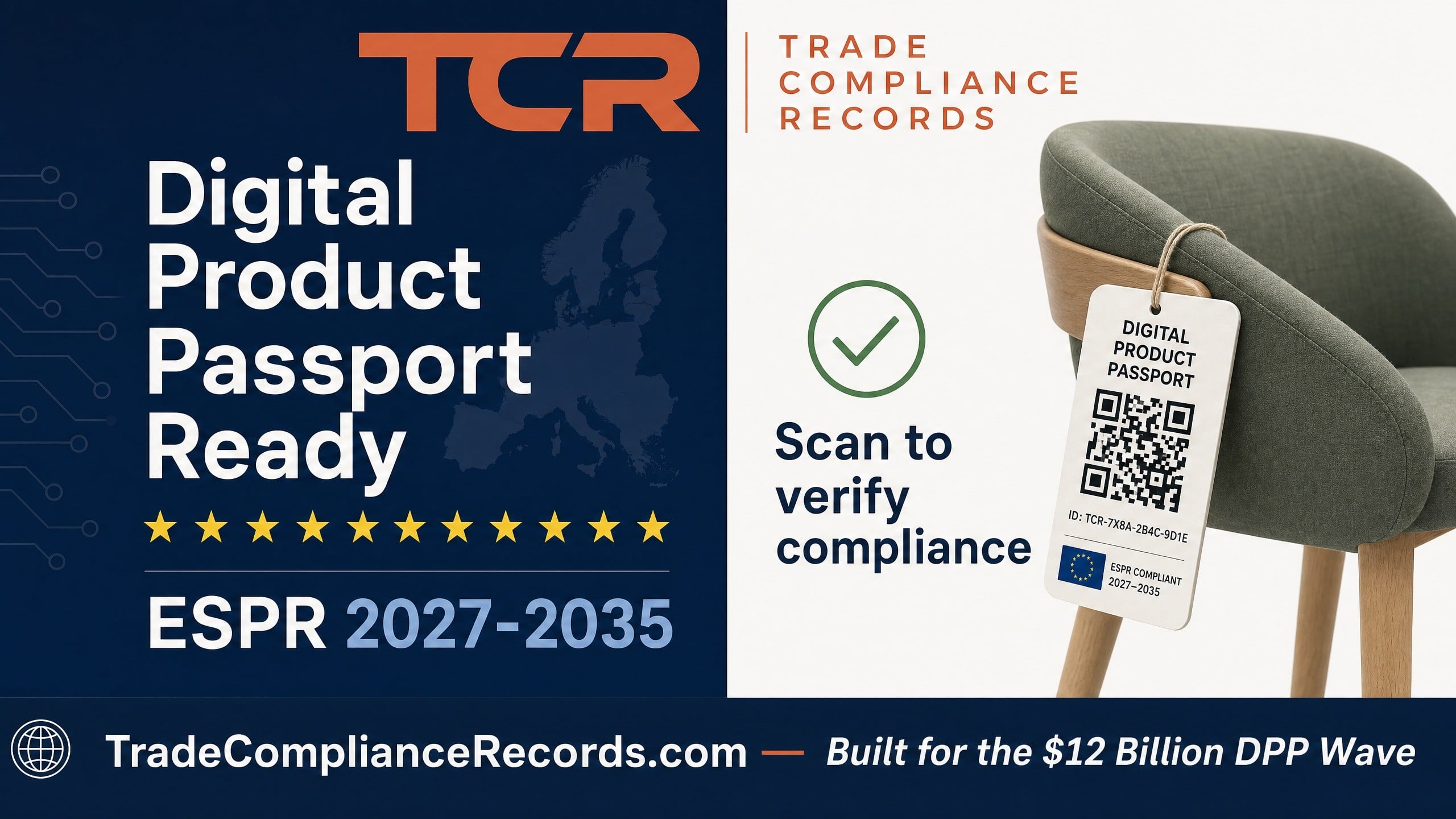
One of the clearest applications is the management of Digital Product Passport records. Companies preparing for product traceability obligations can register passport files and supporting documentation so that a customs official or importer can access a verifiable digital record instead of a loose file set.
Another important use case is CBAM documentation. Importers and brokers handling embedded emissions reports, supplier attestations and supporting evidence can organize those files in a dedicated hub and give reviewers a single verification path rather than a collection of email attachments.
Trade Compliance Records can also be used for certificates of conformity, pre-export verification records, sanctions evidence, KYC documents and broader due-diligence files. Through its public regulation record structure, the platform also helps connect documents to the underlying regulatory obligations that make them necessary.
How Verification Works
Verification is simple. A customs officer, customer, regulator or auditor can scan the QR code on a label, certificate or shipment file, or they can go directly to the public verification page and enter the record ID or hash.
They are then shown the canonical record stored in the registry, which makes it easier to confirm whether the document in hand is the same one that was originally registered. This reduces the reliance on self-attestation alone and creates a more defensible proof trail.
Why This Matters Now
Trade compliance is moving toward more documentation, more traceability and more public accountability. Requirements linked to Digital Product Passports, carbon reporting, conformity assessment and supply-chain due diligence all increase the need for records that are not just stored, but verifiable.
That is where TradeComplianceRecords.com fits in. It turns private compliance files into trusted signals that customs, regulators, business partners and AI systems can reference with more confidence.
Getting Started
Businesses can begin by identifying the documents that create the most friction during audits, customs checks or customer onboarding. Those records can then be uploaded to Trade Compliance Records, assigned verification URLs and paired with QR codes for external use.
Over time, that can expand into a broader registry strategy covering DPP files, CBAM records, certificates of conformity, sanctions evidence and other trade compliance records that need a stronger proof layer.
LinkDaddy LLC
City: Clearwater
Address: 509 N Prescott Avenue
Website: https://linkdaddy.com
Phone: +1-727-350-8520
Email: tony@linkdaddy.com


Comments
Post a Comment