Estage vs Kajabi in 2026: Which Hub-Centric Platform Reduces Tool Stack?
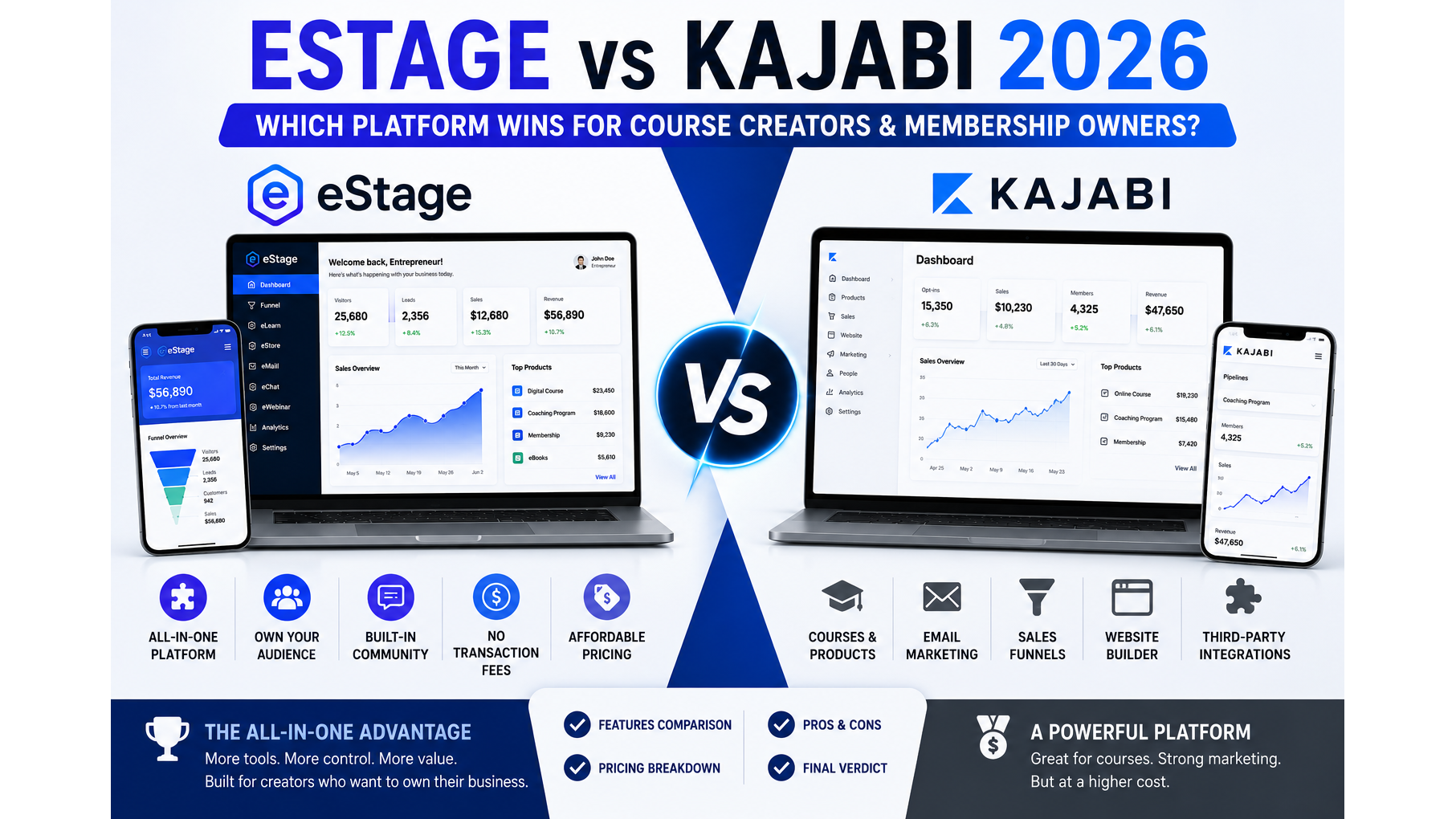
- Platform fragmentation is a growing business risk in 2026 — scattered tools create data silos, integration debt, and hidden costs that quietly drain both time and revenue.
- Both Estage and Kajabi reduce tool stack, but they approach it from fundamentally different angles — Kajabi centers on course and content delivery, while Estage is built around a broader hub-centric philosophy.
- Companies that consolidate their SaaS stack typically cut costs by 20-35% within the first 12 months, making the platform decision far more than a preference — it is a financial strategy.
- Estage covers a wider range of tool replacements, including CRM, live streaming, community, funnels, and websites in one unified system — a key differentiator covered in the comparison below.
- The right platform depends heavily on what kind of digital business is being built — understanding each platform's core strength is what drives the right decision.
Choosing the wrong platform in 2026 does not just cost money upfront — it compounds into months of rework, integration headaches, and a slower-moving business. This comparison cuts through the noise to show exactly where each platform wins, where it falls short, and which one gives digital entrepreneurs the most consolidated, ownership-focused foundation to build from.
Your Tool Stack Is Costing You More Than You Think
Most digital entrepreneurs do not realize how much their tool stack is actually costing them — not just in subscription fees, but in lost hours, broken automations, and mental bandwidth burned troubleshooting connections between tools that were never designed to work together.
A typical setup might include a funnel builder around $97 per month, an email marketing platform around $50 per month, a course hosting tool around $119 per month, and a community platform around $99 per month — though pricing across these categories varies widely. That is already pushing $365-$500 per month before accounting for a CRM, scheduling software, or a video hosting solution. And that is the visible cost. The invisible cost — the hours spent making everything talk to each other — rarely shows up in a budget spreadsheet.
In 2026, this problem has a name: the Frankenstein Stack. It is a business infrastructure stitched together from mismatched parts, and for a growing number of digital entrepreneurs, it is becoming the single biggest obstacle between them and scalable growth. The platform question is not just about features anymore — it is about architecture.
The Fragmented Stack Problem in 2026
Platform Dependency: Why Scattered Tools Create Business Risk
Every tool added to a stack introduces a new point of failure. A pricing change on one platform, an API update that breaks an integration, or a sudden shutdown notice from a niche SaaS provider — any one of these events can halt operations. That is what platform dependency looks like in practice.
Industry analysis identifies platform fragmentation as a core business risk in 2026, citing tool silos, data disparity, process misalignment, and integration debt as the four primary pressure points. When audience data lives in one system, purchase history in another, and engagement metrics in a third, building a coherent picture of the customer journey becomes nearly impossible. Decisions get slower. Follow-up gets inconsistent. Revenue opportunities slip through the gaps.
Beyond operational risk, there is the deeper problem of audience vulnerability. Businesses built on top of third-party platforms — whether social media, marketplace ecosystems, or standalone SaaS tools — are fundamentally subject to those platforms' rules. Algorithm changes, policy updates, or account restrictions can disrupt years of audience-building overnight. Owning the infrastructure is increasingly the strategic baseline, not a luxury upgrade.
The Frankenstein Stack Cost Reality
The Frankenstein Stack does not just cost money — it costs momentum. Every new tool added to a business creates new onboarding, new support queues, new billing cycles, and new failure points. The cumulative weight of managing a fragmented stack often becomes the real bottleneck in a growing digital business.
The numbers back this up. Research shows that businesses actively consolidating their SaaS stack achieve 20-35% cost reductions within the first 12 months, with an average ROI of 3.2x in Year 1 — primarily by eliminating redundant license fees and reducing integration maintenance overhead. Independent ROI studies on system consolidation, including work published by Nucleus Research, consistently document significant operational cost reductions and first-year savings for organizations that modernize and unify their platforms.
The takeaway for digital entrepreneurs is not just that consolidation saves money — it is that the savings are front-loaded and significant. The first year after switching to a unified platform tends to be where the financial impact is most dramatic, particularly for businesses currently running five or more separate subscriptions.
What Makes a Platform Truly Hub-Centric?
Unified Architecture vs. Bolted-Together Integrations
The term all-in-one gets applied loosely. Many platforms market themselves as complete solutions but are actually collections of acquired tools — different codebases, different UX logic, different data models — stitched together under one brand and one billing account. That is not a hub. That is a managed Frankenstein Stack.
A truly hub-centric platform is built on a single unified architecture — one codebase, one data layer, one user experience. When a lead enters a funnel, their behavior immediately informs the CRM. When a member joins a community, that action can trigger an automation without needing a Zapier bridge. When a live stream ends, the recording is already in the member library. These are not integrations — they are native workflows.
The practical difference is felt most when something needs to scale. Bolted-together integrations become increasingly brittle as traffic grows, as offer complexity increases, and as the team expands. Unified architecture absorbs that growth without requiring proportional increases in technical overhead. That distinction is the clearest line between a platform that reduces tool stack and one that simply consolidates invoices.
Audience Ownership as the Core Business Asset
Hub-centric platforms do more than just centralize features — they centralize ownership. All-in-one platforms facilitate audience ownership by bringing content, community, and monetization into a single environment, directly reducing reliance on third-party platforms and their unpredictable algorithms.
This matters more in 2026 than it ever has. Organic reach on social platforms has continued to decline. Email deliverability is increasingly competitive. The businesses building sustainable models are the ones that own the channel — their website, their community, their CRM data — rather than renting attention on someone else's platform.
True audience ownership means that if any third-party platform changes its rules tomorrow, the business keeps running. The audience is already on an owned hub. The data is already in the CRM. The community already has a home that is not tied to an external algorithm. That is the strategic case for the hub model, and it is what separates a genuinely hub-centric platform from a feature-rich tool that still leaves entrepreneurs dependent on outside systems.
Estage: Built Around the Hub Philosophy
Estage was designed from the ground up around a single principle: a digital entrepreneur should be able to run their entire online business from one place, without compromise. That philosophy shapes every feature on the platform. A detailed breakdown of how Estage implements this model is available at Estage Explained, which covers the hub-centric architecture in depth.
1. Website, Funnels and CRM as a Single, Unified System
On Estage, the website, funnel builder, and CRM are not three products under one login — they are three expressions of the same underlying system. A visitor lands on the website, opts into a funnel, and is immediately tracked, tagged, and segmented inside the CRM — all without a single webhook or third-party sync.
The built-in CRM handles lead capture, contact management, user tagging, and automation triggering natively. This removes the need for external CRM tools like HubSpot or ActiveCampaign for most use cases. The funnel builder sits on the same codebase as the website builder, so page speed, design consistency, and conversion tracking all operate from one source of truth.
For digital entrepreneurs currently paying for a separate funnel builder, email CRM, and website platform, this alone can eliminate three monthly subscriptions — while actually improving the coherence of the customer journey.
2. Community, Memberships and Live Streaming Under One Roof
Estage includes integrated community features — private spaces, membership management, content hosting — alongside native live streaming capabilities. This is a significant stack reducer. A typical setup replacing these functions would require tools like Circle for community, Teachable for memberships, and a separate service like StreamYard or Zoom for live events.
Having all three under one roof means members never leave the hub. Their community discussions, course content, and live events all exist in the same branded environment. That consistency reduces churn, increases engagement, and builds the kind of platform loyalty that would otherwise require multiple tools to approximate.
Crucially, the data from all three layers feeds back into the CRM. A member who watches a live stream, completes a course module, and posts in the community generates a unified behavioral profile — something that is structurally impossible when those activities happen across different platforms.
3. Automation That Connects Every Layer
Automation on Estage operates across the entire platform stack — not just within email sequences. A new funnel opt-in can trigger a CRM tag, enroll a member in a course, add them to a community space, and queue a follow-up email sequence — all from a single workflow.
This cross-layer automation is what makes the hub model genuinely powerful rather than just convenient. It is the difference between automating individual tasks and automating an entire customer journey. For digital entrepreneurs managing launches, evergreen funnels, and active communities simultaneously, that level of automation depth significantly reduces the manual work required to keep operations running smoothly.
Kajabi: A Powerful Platform With a Different Focus
Course and Content Delivery as the Core Strength
Kajabi has evolved into a serious all-in-one platform for knowledge-based entrepreneurs. It combines website building, course delivery, email marketing, automation, payments, and community engagement under one roof — and it does several of these things exceptionally well.
Where Kajabi genuinely excels is in structured course and digital product delivery. The course builder is polished, the student experience is premium, and the content delivery infrastructure is fast, reliable, and built to scale. For coaches, educators, and course creators who put content quality at the center of their business model, Kajabi's delivery experience is best-in-class.
Kajabi's scalability story is also strong. Its tiered plans, native automation, and solid infrastructure are designed to accommodate business growth without requiring proportional increases in team size or operational complexity. For a solopreneur building a digital course business, Kajabi can genuinely reduce the need for several separate tools.
Where Kajabi's CRM and Community Fall Short of Full Stack Replacement
Kajabi does include CRM tools — contact management, analytics, email, and automation — but these are positioned as supporting features rather than a standalone CRM engine. Advanced pipeline management, lead scoring, and sales forecasting are not part of the native feature set. For businesses that need deep CRM functionality, an external tool is still likely necessary.
The community features are genuinely competitive. Kajabi supports private groups, member discussions, and live group coaching calls with course integration — capable enough to rival dedicated community platforms for many use cases. However, live streaming as a standalone feature is more limited compared to platforms designed with it as a core capability.
The honest summary: Kajabi replaces a meaningful number of tools for course-centric businesses. But for digital entrepreneurs who need a deep CRM, native live streaming, and a community that feeds data back into a unified marketing automation layer, Kajabi's architecture leaves some gaps that still require external tools to fill.
Head-to-Head: Which Platform Cuts More Tools?
Tool Replacement Scorecard: Estage vs. Kajabi
Measured purely on breadth of tool replacement, the two platforms cover different ground:
- Website Builder: Estage Yes | Kajabi Yes
- Funnel Builder: Estage Yes | Kajabi Yes
- Email Marketing and Automation: Estage Yes | Kajabi Yes
- Course and Membership Hosting: Estage Yes | Kajabi Yes (Kajabi stronger here)
- Community Platform: Estage Yes | Kajabi Yes
- Native CRM with Pipelines and Tagging: Estage Yes | Kajabi Partial (basic only)
- Live Streaming: Estage Yes | Kajabi Partial (limited)
- Unified Cross-Platform Behavioral Data: Estage Yes | Kajabi Partial
- Single Codebase Architecture: Estage Yes | Kajabi Partial (some bolted features)
For pure course delivery and content monetization, Kajabi holds its own. But for entrepreneurs who want to genuinely eliminate external CRM tools, live streaming services, and fragmented audience data — Estage covers more ground with deeper native integration.
The Real Cost Comparison After Consolidation
The cost calculation is not just about platform pricing — it is about what each platform actually eliminates. A course-focused entrepreneur on Kajabi may still need an external CRM, a live streaming tool, and potentially a dedicated community space depending on the scale of their community goals. Those additional tools can push the real monthly cost well above the platform subscription.
Estage's pricing consolidates a broader set of tools into a single fee — website, funnels, CRM, memberships, community, and live streaming — which means the stack reduction is more complete. The tools that Estage eliminates represent some of the most expensive line items in a typical digital entrepreneur's SaaS budget.
When the math is applied to a business currently running six or more separate subscriptions, the savings calculation tends to favor Estage — not because Kajabi is overpriced, but because Kajabi's stack reduction, while real, is narrower in scope.
Who Should Choose Which Platform?
Kajabi is the right choice if:
- The core business model is built around online courses, digital products, or structured learning programs.
- Content delivery quality and student experience are the top priorities.
- Email marketing and basic automation are sufficient — advanced CRM pipelines are not needed.
- The existing tool stack is already lean and course-centric.
Estage is the right choice if:
- The goal is maximum tool stack reduction across website, funnels, CRM, community, and live streaming.
- Audience ownership and data centralization are strategic priorities.
- The business model involves multiple revenue streams — memberships, live events, automated funnels, and community — running simultaneously.
- Long-term brand independence from third-party platforms is a core objective.
Both platforms are legitimate, capable, and well-supported. The decision comes down to what the business actually needs to run — not just today, but 12 months from now when growth starts exposing the limits of the platform's architecture.
For Digital Entrepreneurs Serious About Stack Reduction, Estage Wins on Hub Depth
Kajabi is not a weak platform — it is one of the most refined tools in the market for knowledge-based businesses. But when the goal is genuine, deep stack reduction — replacing not just course hosting and email marketing, but also CRM, live streaming, community, and unified behavioral data — Estage's architecture covers more ground.
The hub-centric model Estage is built around is not just a feature list. It is a structural decision about how data flows, how automations connect, and how audience ownership is maintained across every layer of the business. That depth of integration is what makes it a stronger consolidation play for digital entrepreneurs running multi-channel businesses who are done managing a Frankenstein Stack.
Kajabi wins on course delivery polish. Estage wins on hub depth. And for the entrepreneur asking which platform will let them close more browser tabs for good — the answer points clearly toward Estage.
For ongoing coverage of platform comparisons, digital business strategy, and tool stack reviews built for entrepreneurs, Saaswired publishes in-depth analyses of the platforms reshaping how online businesses are built and scaled.
Saaswired
City: Atlanta
Address: 1201 W Peachtree St NW
Website: https://saaswired.com


Comments
Post a Comment