Employee-to-CEO Business Formation System: Step-by-Step & Compliance-Ready
- Half of all new businesses fail within five years, and poor planning — not bad luck — is usually the culprit.
- A structured, step-by-step business formation system dramatically reduces the risk of costly mistakes, legal missteps, and wasted time during launch.
- Transitioning from employee to CEO requires more than a business idea — it demands a mindset shift, legal compliance, tax strategy, and a clear path to revenue.
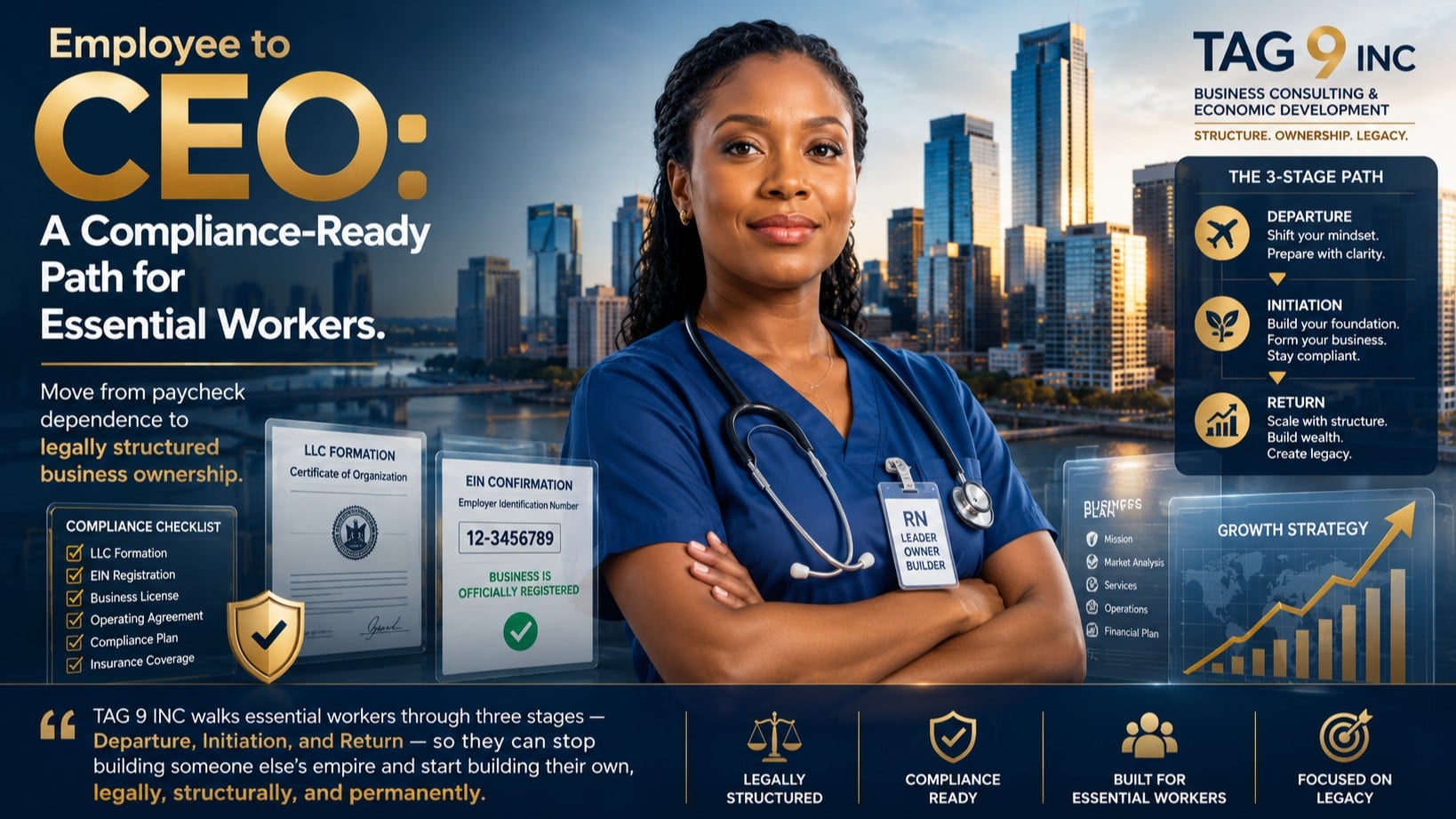
- TAG 9 INC's Employee-to-CEO system is built specifically around the compliance, funding, and growth stages that trip up most first-time business owners.
- Keep reading to find out how the "Fear-to-Freedom" framework and a sequential 7-step growth roadmap can change how a new business gets off the ground.
Starting a business while still holding down a job is one of the most common — and most mismanaged — transitions in entrepreneurship. The idea is exciting. The execution? That's where most people stall. Between choosing a legal structure, handling taxes, defining a market, and actually generating revenue, the process can feel like assembling furniture without instructions.
That's exactly the gap a structured business formation system is designed to close.
Half of New Businesses Fail Within 5 Years — Poor Planning Is Usually Why
According to the U.S. Bureau of Labor Statistics, approximately 50% of new businesses don't survive past their fifth year. The reasons are rarely dramatic — no single catastrophic event brings most of them down. Instead, it's the accumulation of small, avoidable problems: launching without validating a market, skipping proper legal formation, mismanaging early cash flow, or failing to meet tax obligations from the start.
Poor planning doesn't always look like chaos. Sometimes it looks like someone working incredibly hard in entirely the wrong direction — building a product nobody wants, operating under the wrong legal structure, or missing compliance deadlines that result in penalties. These aren't failures of passion or effort. They're failures of process.
The encouraging flip side? Most of these failure points are preventable when the right framework is in place before launch day.
Why a Structured System Beats Going It Alone
The Hidden Costs of an Unstructured Launch
Going it alone isn't just stressful — it's expensive. Entrepreneurs who skip structured guidance often pay for it later through legal fees to fix improperly formed entities, tax penalties from misclassified income, or wasted marketing spend on audiences that were never validated. These aren't hypothetical risks; they're consistent patterns that business advisors and formation professionals see repeatedly.
There's also a less visible cost: time lost to rework. When foundational steps are done out of order — or skipped entirely — downstream problems force entrepreneurs to circle back and rebuild. Restructuring a business entity after the fact, for example, is far more complex and costly than forming it correctly from day one.
- Legal restructuring costs can run into the thousands if the wrong entity type was originally chosen
- Back taxes and penalties accumulate quickly when quarterly obligations aren't understood at launch
- Lost funding opportunities arise when business credit hasn't been established early in the process
How Sequential Steps Reduce Risk and Rework
A sequential approach to business formation works because each step builds on the last. Legal structure informs tax strategy. Tax strategy informs funding eligibility. Funding eligibility informs growth planning. When these stages are handled in the right order, the entire process becomes more efficient — and more defensible if questions arise later.
Structured entrepreneurship training programs consistently show stronger outcomes than self-directed approaches precisely because they enforce this sequence. Participants gain practical knowledge in finance, marketing, operations, and legal compliance — not as isolated topics, but as an integrated system. The result is a business that's not just launched, but launched correctly.
TAG 9 INC has built its Employee-to-CEO system around this sequential logic — addressing business formation, funding preparation, and compliance in a deliberate order that mirrors how successful businesses are actually built.
The Mindset Shift: Employee to CEO
Accepting Risk Without Abandoning Stability
One of the most underestimated challenges of transitioning from employee to entrepreneur is the internal one. As an employee, success is largely defined by others — hit the targets, follow the process, collect the paycheck. As a CEO, success is self-defined, self-directed, and entirely self-accountable.
That shift doesn't happen automatically. It requires a deliberate recalibration of how risk is perceived. Risk in entrepreneurship isn't the enemy — it's the environment. The goal isn't to eliminate it, but to make informed decisions within it. Many successful entrepreneurs begin this transition gradually, through side ventures that build confidence and market insight without requiring an immediate income sacrifice.
Readiness for this transition spans three dimensions:
- Personal mindset — the willingness to take ownership and redefine success on personal terms
- Financial stability — having enough runway to sustain the transition period
- A validated business idea — not just a good concept, but one with evidence of real demand
The Fear-to-Freedom Framework in Practice
Fear is almost universal at the employee-to-CEO transition point. Fear of failure, fear of financial insecurity, fear of judgment. What separates those who move forward from those who stay stuck isn't the absence of fear — it's having a framework that makes the next step feel manageable.
TAG 9 INC's "Fear-to-Freedom Mindset" framework is built around this exact dynamic. Rather than glossing over the emotional weight of the transition, it acknowledges it and offers a structured path through it. Personal and spiritual development are woven into the system alongside the business mechanics — because a CEO who hasn't done the internal work is likely to undermine the external one.
Building a Compliance-Ready Business Entity
Compliance isn't bureaucratic red tape — it's the foundation that protects a business and its owner from serious legal and financial consequences. Getting it right from the start means making three key decisions correctly, in sequence.
1. Choose the Right Legal Structure (LLC vs. Corporation)
The legal structure chosen at formation has long-lasting consequences across liability, taxation, and the ability to raise investment. It's one of the most consequential early decisions a new business owner makes — and one of the most commonly misunderstood.
- LLC (Limited Liability Company): Offers personal liability protection with flexible pass-through taxation. Generally simpler to manage and well-suited for most small businesses and solo founders.
- S-Corporation: Allows for potential self-employment tax savings by splitting income between salary and distributions, but comes with stricter eligibility requirements and shareholder limits.
- C-Corporation: The preferred structure for businesses seeking venture investment or planning to issue multiple classes of stock, but subject to double taxation at the corporate and individual levels.
The right choice depends on the business model, projected growth, and personal tax situation. Getting this wrong isn't just inconvenient — it can mean paying more in taxes than necessary or losing personal asset protection entirely.
2. File Correctly to Protect Personal Assets
Choosing a structure is only half the battle. Proper state filing, registered agent designation, operating agreements, and corporate formalities are what actually activate the liability protection that makes an LLC or corporation worth forming in the first place. Many new entrepreneurs skip these steps or file incomplete paperwork, creating what's known as a "piercing of the corporate veil" — where courts hold owners personally liable despite the legal entity existing on paper.
Professional business formation guidance handles state filing requirements, document preparation, and ongoing compliance tasks like annual reports — the exact details that fall through the cracks in a do-it-yourself approach.
3. Meet Tax Obligations from Day One
Tax obligations don't begin when a business turns profitable — they begin when it forms. Employer Identification Numbers (EINs), quarterly estimated tax payments, sales tax registrations, and payroll taxes all have their own timelines and requirements. Missing early deadlines can trigger penalties that compound over time.
Building a tax-compliant foundation from launch is far less costly than correcting a problematic tax history later. This means understanding which entity structure optimizes for the owner's specific tax situation, and setting up systems to track and report accurately from the very first transaction.
Legal Power Moves: Taxes, Assets & Funding
Minimizing Tax Exposure Legally
Strategic tax planning isn't reserved for large corporations. Even in the earliest stages, new business owners have access to legitimate tax reduction strategies that employees simply don't. Business deductions, retirement account contributions through the business, home office deductions, vehicle use, and healthcare costs can all reduce taxable income — when structured correctly.
The key word is correctly. The IRS scrutinizes new business deductions closely, and poorly documented claims can trigger audits. TAG 9 INC frames this as "Legal Power Moves" — a deliberate approach to minimizing tax exposure within the bounds of the law, rather than aggressive or risky strategies.
Accessing Capital and Building Business Credit
One of the biggest misconceptions new business owners carry is that funding comes later — after proving the business works. In reality, building the financial infrastructure that makes a business fundable starts at formation.
Business credit is established separately from personal credit, and it begins accumulating only after a business has:
- A registered legal entity with an EIN
- A dedicated business bank account
- Trade lines and vendor relationships reporting to business credit bureaus
Entrepreneurs who skip these early steps often find themselves locked out of financing options when growth demands capital. A structured formation system builds this financial foundation in parallel with legal and tax setup — ensuring funding readiness isn't an afterthought.
A Sequential Growth Roadmap: From Market Definition to Revenue
Legal formation and compliance create the structure. What actually drives business success is what happens next — finding customers, delivering value, and building sustainable revenue. TAG 9 INC's "7 Steps to $360K in 36 Months" program is built to walk new business owners through exactly this progression.
Validating Your Market and Value Proposition First
Before any marketing dollar is spent or any product is built, the foundational question must be answered: Is there a real, accessible market for this? Market validation involves identifying a specific target audience, understanding their problem in their own language, and confirming they're willing to pay for a solution.
This step comes first for a reason. Building a value proposition without market validation is one of the most common — and costly — mistakes in entrepreneurship. The most refined product in the world can't generate revenue if it's solving a problem nobody cares about, or if it's being offered to the wrong audience.
Key activities at this stage include:
- Conducting primary and secondary market research
- Defining the ideal customer profile with specificity
- Testing the core value proposition before full product development
- Identifying the competitive landscape and differentiation angle
Building Marketing, Sales Funnels, and Ongoing Optimization
Once the market is validated and the value proposition is clear, the next phases focus on building the systems that reliably turn strangers into customers. This means developing a marketing strategy that reaches the right audience, building sales funnels that move prospects through awareness, consideration, and purchase — and then optimizing based on data.
"Optimize based on data" isn't a vague directive. It means establishing baseline metrics from the start, identifying which parts of the funnel are underperforming, and making evidence-based changes. A business that tracks this data from month one has a significant advantage over one that starts measuring only after problems emerge.
This growth roadmap — from market definition through funnel optimization — transforms the idea of "building a business" from an overwhelming abstraction into a series of concrete, sequenced actions.
Community, Mentorship & Government Contracts
The Strong CEO Community Advantage
Entrepreneurship can be isolating, particularly for someone making the transition out of a team-oriented employment environment. The loss of built-in collaboration, peer accountability, and institutional support is one of the underappreciated challenges of going out on one's own.
Structured entrepreneurship programs address this through community — peer networks of people working through the same transition, mentors who have already solved the problems ahead, and access to advisors with specialized expertise. TAG 9 INC's "Strong CEO Community" is built around this principle, offering not just knowledge but belonging to a network of growth-oriented business owners.
Beyond peer support, TAG 9 INC also includes government contract advisory services as part of its system. Government contracts represent a significant and often underutilized revenue source for small businesses — particularly those owned by socially and economically disadvantaged entrepreneurs, including minority-owned businesses that qualify for set-aside programs. Navigating the procurement process, certifications, and contract requirements is complex, but it's also one of the most consistent paths to stable, large-scale revenue for qualifying businesses.
Combining community accountability, mentorship access, and government contract guidance gives new business owners a support structure that goes well beyond what any solo launch attempt can replicate.
TAG 9 INC Aims to Give Aspiring CEOs a Structured, Compliant Path to Business Ownership
The journey from employee to CEO is genuinely hard. The odds aren't automatically in a new entrepreneur's favor — but they shift significantly when the process is structured, sequenced, and compliance-ready from the start. The most common failure points in new businesses are also among the most preventable: wrong legal structure, missed tax obligations, undefined markets, and no financial infrastructure for funding.
What TAG 9 INC has built addresses these failure points not as isolated checkboxes, but as an integrated system. Business formation connects to tax strategy. Tax strategy connects to funding readiness. Funding readiness connects to growth. Throughout that entire sequence, mindset development and community support keep the entrepreneur moving forward instead of retreating to the perceived safety of a paycheck.
This kind of structured approach doesn't eliminate the difficulty of building a business — but it does ensure that the difficulty is spent on the right problems at the right time, rather than on costly, avoidable mistakes made in the wrong order.
For those serious about making the employee-to-CEO transition with clarity and confidence, visit TAG 9 INC, where step-by-step business formation guidance and compliance-ready resources are built specifically for aspiring business owners.
TAG 9 INC
City: MIAMI
Address: 1501 Biscayne Blvd
Website: https://tag9inc.com/
Phone: +1-888-639-9287


Comments
Post a Comment