Does Humidity Cause Mold? Tampa Inspection Specialist Explains 48-Hr Window
Key Takeaways
- Yes — humidity directly causes mold growth. When indoor relative humidity climbs above 60%, most common mold species have everything they need to begin colonizing surfaces, even without a single drop of standing water.
- After any water intrusion event, mold can begin growing within 24 to 48 hours, according to the CDC — and Tampa's heat compresses that window even further.
- Crawl spaces and HVAC systems are Tampa Bay's two biggest mold blind spots, and one contaminated air handler can push spores into every room of the home simultaneously.
- The EPA recommends keeping indoor humidity between 30% and 50% — a target that takes deliberate, year-round effort in Tampa's subtropical climate.
- There are proven prevention strategies that Tampa homeowners can put into practice today, and knowing when to call in professional testing can be the difference between a minor fix and a major remediation project.
Tampa's humidity is the kind that hits you the moment you step outside — thick, heavy, and relentless. But what's happening inside the walls of Tampa Bay homes is a bigger story. That constant ambient moisture doesn't just make summer afternoons miserable; it creates near-perfect conditions for mold to grow year-round, often in places that go completely unnoticed until the damage is already done.
Tampa's Humidity Doesn't Just Make You Sweat — It Feeds Mold Year-Round
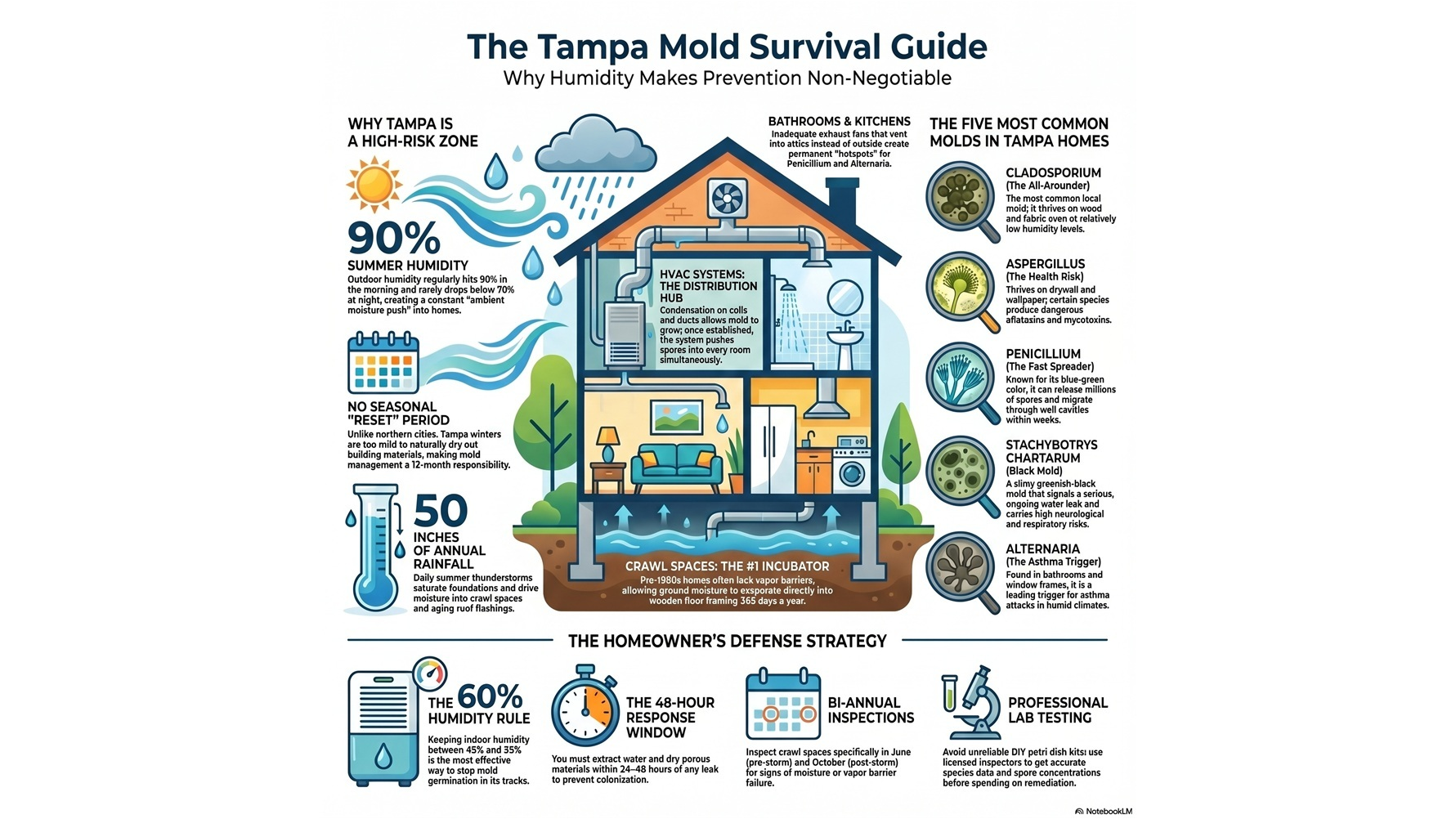
Tampa sits sandwiched between Tampa Bay and the Gulf of Mexico, and that geography keeps moisture levels elevated around the clock. Even on clear days, outdoor relative humidity in Tampa regularly sits between 80% and 90% by morning — only dipping into the 60s or 70s during peak afternoon heat. That ambient moisture pushes into homes every time a door opens, every time the AC cycles off, and every time a crawl space sits uninspected.
Add Tampa's rainfall into the equation — the city averages 46 to 50+ inches per year, with near-daily thunderstorms concentrated between June and September — and the moisture load becomes significant. Rain saturates soil around foundations, drives moisture up through crawl spaces, works through aging roof flashing, and overwhelms drainage systems. Every one of those pathways is a potential mold trigger inside the home.
What makes Tampa's climate particularly problematic isn't just the rain or the humidity in isolation. It's the combination with heat. When warm, saturated outdoor air meets the cooler interior surfaces of an air-conditioned home, condensation forms — on drywall, wood framing, insulation, and HVAC components. That thin film of moisture is all mold spores need to start germinating. Tampa Bay homeowners looking for a local specialist who understands exactly how these conditions interact can find TampaBayMold.net on Google Maps — their team has documented how consistently these climate patterns translate into active indoor mold problems across Hillsborough, Pinellas, and Pasco counties.
Unlike cities such as Boston or Philadelphia — where cold winters cause outdoor mold spore counts to drop significantly and building materials lose moisture seasonally — Tampa offers no comparable dry period. Indoor mold can persist year-round in any climate given the right conditions, but Tampa removes the seasonal pressure relief that colder regions experience. Mold management here is a 12-month responsibility, not a warm-weather concern.
Why the 48-Hour Window Is a Critical Line of Defense Against Mold
The 48-hour window isn't a rule of thumb — it's backed by the Centers for Disease Control and Prevention (CDC), which states that mold can begin growing on a damp surface within 24 to 48 hours of moisture exposure. In Tampa's climate, that clock starts the moment water touches a susceptible surface, and it moves fast.
Mold Spores Are Always Present — But Need the Right Conditions to Activate
Mold spores are everywhere. They float through outdoor air, hitch rides through open windows, and exist in virtually every indoor environment at low background levels. Under normal, dry conditions, those spores are essentially dormant — present but inactive. The moment moisture levels rise above the threshold those spores need to germinate, they activate. No flooding required. No burst pipe needed. Persistent condensation on a window frame or a slow drip under a sink can be enough.
This is what makes high humidity so problematic even on days with no rain event: humidity alone can supply the moisture film that activates spores already living on organic materials — drywall paper facing, wood framing, carpet backing, ceiling tile. The American Society of Heating, Refrigerating and Air-Conditioning Engineers (ASHRAE) has emphasized that moisture and humidity control is the single most critical factor in preventing mold in buildings. Controlling it isn't optional in Tampa — it's foundational.
Tampa's Heat Accelerates the Clock After Any Water Event
A wet patch of drywall that might take four or five days to develop visible mold in a cool, dry climate can produce active colonies in two days or less in Tampa's conditions. Heat accelerates the metabolic processes of mold, shortening the germination window and increasing the rate at which spores spread from an initial growth site to surrounding materials. Restoration industry guides consistently emphasize that response time — not remediation scope — is the most important factor in preventing minor water events from becoming major mold problems in humid climates like Tampa's.
Even seemingly minor intrusions — a slow roof drip, persistent condensation on a poorly insulated pipe, a bathroom exhaust fan venting into the attic instead of outside — can provide sufficient moisture for colonization to begin within that same timeframe. The source doesn't have to be dramatic for the outcome to be serious.
How Humid Is Too Humid? The Numbers That Matter
Humidity levels aren't just a comfort metric. They're the primary variable homeowners can control in the fight against mold. Understanding the specific thresholds — and what Tampa's typical conditions look like against those thresholds — changes how seriously most homeowners treat their indoor air quality.
60% Humidity Is the Growth Threshold — Tampa Blows Past It Daily
Most common indoor mold species can begin growing when relative humidity at a surface level exceeds 60%. At 70% or above, germination can begin within 24 hours. In a Tampa home without active humidity control, indoor humidity routinely exceeds the 60% mark — particularly in rooms with limited airflow like closets, utility rooms, and bathrooms. During summer months, even well-maintained homes can see humidity spikes that push past the growth threshold during periods of heavy rainfall or AC downtime.
A calibrated digital hygrometer — available at most hardware stores for under $20 — placed in high-risk rooms gives real-time data rather than guesswork. That small investment can be the earliest warning system in the house.
The EPA Target: 30-50% — Why Staying Below 60% Is Both the Goal and the Challenge in Tampa
The Environmental Protection Agency (EPA) recommends maintaining indoor relative humidity between 30% and 50% for optimal indoor air quality and mold prevention. In Tampa, that target range requires deliberate, active effort. The practical interim goal for most Tampa homeowners is keeping humidity consistently below 60% — not because 55% is safe and 61% is dangerous, but because maintaining that buffer provides some margin against the humidity spikes that Tampa's climate produces regularly.
Achieving sub-60% humidity in Tampa typically requires more than just running the central AC. Whole-home dehumidifiers integrated into the HVAC system are the most effective solution for consistent control across the entire house. Standalone units work for single rooms but cannot keep pace with Tampa's ambient moisture load at a whole-home level. Structural improvements — sealing crawl space vents, installing vapor barriers under the home, ensuring exhaust fans vent directly outside — are what make those humidity targets achievable long-term rather than just temporary.
Tampa's Two Biggest Mold Blind Spots
Most homeowners check the obvious places — grout lines, under-sink cabinets, bathroom ceilings. But the two locations responsible for the most serious, most widespread, and most expensive mold problems in Tampa Bay homes are usually completely out of sight.
Crawl Spaces: Ground Moisture Never Stops Evaporating
Crawl spaces are the single highest-risk mold zone in Tampa Bay homes, and they're also the most consistently neglected. Many homes built before the 1990s in the Tampa area have little to no vapor barrier protection beneath the structure, leaving exposed soil directly under the wooden floor framing. Ground moisture evaporates upward constantly — saturating wood joists, subfloor decking, and insulation 24 hours a day, 365 days a year.
Combined with the limited airflow typical of enclosed crawl spaces, this creates a near-perfect mold incubator. Cladosporium and Penicillium dominate in these environments, and infestations here frequently go undetected for years — only surfacing when flooring begins to feel soft, a musty odor becomes noticeable inside the home, or a routine inspection uncovers extensive structural growth. Encapsulating crawl spaces and installing dehumidifiers in these areas are the two most effective interventions, according to building science professionals focused on high-humidity climates.
HVAC Systems: A Contaminated Coil Can Widely Distribute Spores Throughout the Home
A moldy HVAC system isn't an air quality problem in one room — it's a whole-home distribution system for mold spores. Tampa's climate means air conditioning runs nearly continuously from April through October, and that constant operation creates persistent condensation on evaporator coils and inside ductwork. When mold establishes itself on those coil surfaces or inside the duct lining, every cycle of the system pushes spores into every room of the house simultaneously.
Warning signs include a musty or earthy smell that appears the moment the system kicks on, dark streaking or discoloration around supply vents, and allergy or respiratory symptoms that worsen indoors but improve when occupants leave. Regular professional cleaning of evaporator coils — combined with periodic ductwork inspection — is the standard prevention protocol recommended by HVAC industry associations. The absence of visible signs doesn't mean the system is clean, particularly in Tampa's operating environment.
Where Else Mold Hides in Tampa Bay Homes
Beyond crawl spaces and HVAC systems, Tampa's humidity creates predictable hotspots throughout the home. Mold rarely announces itself early — by the time visible growth or a musty odor appears, a colony is almost always well-established and has been growing for weeks.
Bathrooms and Kitchens
Bathrooms and kitchens generate consistent moisture through showering, cooking, dishwashing, and general water use. In Tampa's already-humid environment, that additional load pushes these spaces into near-continuous mold-risk territory. Penicillium and Alternaria are the dominant species in these areas, appearing in grout lines, under sink cabinets, behind toilets, around window frames, and on the underside of bath mats.
The most common contributing factor in Tampa homes is inadequate exhaust fan performance. Many homes have fans that are undersized for the space, vented into the attic rather than directly outside, or simply not used consistently enough to make a meaningful difference. A fan venting into an attic trades one moisture problem for another.
Closets, Window Frames, and Under-Sink Cabinets
These spaces share a common trait: limited airflow. Closets — especially exterior-wall closets — trap humid air against surfaces that never fully dry. Window frames accumulate condensation where warm indoor air meets the cooler glass and frame surface, particularly in older single-pane installations. Under-sink cabinets experience intermittent moisture from pipe condensation and minor drips that go unnoticed for weeks.
Cladosporium is the most common species found in these locations — it can establish itself at relatively low humidity levels compared to other mold types, and its dark coloring makes it easy to mistake for dirt or general discoloration until the colony is well-entrenched. Periodic inspection of these spaces — not just the obviously wet areas — is part of effective mold prevention in Tampa's climate.
4 Proven Ways to Keep Tampa's Humidity From Winning
Mold prevention in Tampa isn't about one single action — it's a layered approach that addresses the specific vulnerabilities the climate creates. These four strategies, applied consistently, are what separate homeowners who manage mold risk successfully from those who face major remediation projects.
1. Keep Indoor Humidity Consistently Below 60%
This is the single most impactful thing a Tampa Bay homeowner can do. Maintaining indoor relative humidity consistently below 60% — ideally between 45% and 55% — removes the primary condition mold needs to grow, even when spores are present in the air (which in Tampa, they always are).
A calibrated digital hygrometer placed in high-risk rooms gives actionable real-time data. Whole-home dehumidifiers integrated into existing HVAC systems are the most effective long-term solution. Sealing crawl space vents, installing vapor barriers, and ensuring exhaust fans vent directly outside are the structural moves that make the humidity target sustainable in Tampa's environment — not just achievable on good days.
2. Act Within 48 Hours of Any Water Intrusion
After any water event — a roof leak, storm flooding, burst pipe, or appliance overflow — the priority is extraction and drying, immediately. Get standing water out first using a wet/dry vacuum or pump. Then deploy air movers and dehumidifiers to bring affected materials below safe moisture content as quickly as possible.
Any porous material — drywall, insulation, carpet padding — that cannot be dried within that 48-hour window should be removed rather than dried in place. In Tampa's ambient humidity, attempting to dry saturated porous materials in situ almost always results in mold growth, even when the surface appears dry. The internal moisture content is what matters, not the surface feel.
3. Inspect Crawl Spaces and HVAC Systems on a Recommended Schedule
Given that these are Tampa Bay's two highest-risk mold zones, both deserve scheduled inspections rather than reactive attention after a problem is visible.
- Crawl spaces: Physical inspection at minimum twice per year — once before summer storm season (June) and once after it ends (October). Look for visible mold on wood framing, deteriorating or absent vapor barriers, standing water, and pest damage to existing barriers.
- HVAC systems: Professional evaporator coil cleaning annually, with ductwork inspection every two to three years. Pay particular attention to flex duct sections where condensation accumulates and liner degradation creates mold-friendly surfaces.
These inspections cost a fraction of what remediation runs in Tampa Bay — and they consistently catch problems at the stage when they're still manageable.
4. Know When Professional Lab Testing Is Worth the Investment
DIY mold test kits sold at hardware stores — the petri dish type — are largely unreliable for making meaningful decisions. They confirm that spores are present (true in every indoor environment) but cannot provide accurate species identification, spore concentration data, or comparison to outdoor baseline levels.
Professional air quality testing by a licensed inspector using calibrated sampling equipment and accredited laboratory analysis gives actionable data: which species are present, at what concentrations, whether indoor levels are elevated compared to outdoor baseline, and where contamination is likely originating. That information determines whether any remediation is needed at all — and if so, what type. Getting the data first prevents both under-treatment and unnecessary over-treatment.
In Tampa, Mold Prevention Is a 12-Month Job — Not a Summer One
Tampa's mold risk doesn't pause in November. With winter lows that rarely drop below 50°F, there's no cold, dry season to naturally suppress mold activity the way northern climates experience. Building materials never get that annual reset. Ground moisture under crawl spaces never stops evaporating. HVAC systems run year-round. The conditions that create mold risk in Tampa Bay homes are present in every month of the calendar — which means prevention has to be too.
The homeowners who avoid serious mold problems in this climate aren't the ones who get lucky. They're the ones who treat humidity control as a maintenance priority, respond to water events with urgency, and inspect the spaces mold prefers before visible symptoms appear. The investment in prevention — a whole-home dehumidifier, a semi-annual crawl space check, an annual HVAC cleaning — costs a fraction of what a mid-sized mold remediation project runs in Tampa Bay. More importantly, it protects the air quality that every person in the home breathes every single day.
For homeowners who want a professional assessment of their home's specific risk factors, TampaBayMold.net provides expert mold inspection and testing services throughout the Tampa Bay area.
TampaBayMold.net
City: Tampa
Address: 550 N. Reo St. Suite #300
Website: https://www.tampabaymold.net


Comments
Post a Comment