Concierge Security Guards vs. Traditional Lobby Guards | Boston Provider
Key Takeaways
- Concierge security guards combine professional security expertise with hospitality-level service — something traditional lobby guards are not trained or equipped to deliver.
- Properties using an integrated concierge security approach report up to 60% fewer unauthorized access incidents compared to those relying on traditional security alone.
- Beyond access control, concierge officers handle package management, visitor coordination, and emergency first response — making them a multi-function asset for any property.
- High-end residential buildings, luxury hotels, and Class A office buildings benefit most from this model, where first impressions and resident satisfaction directly affect property value.
- The right concierge security program can reduce insurance premiums through proactive, documented risk management — a measurable financial return worth understanding in detail.
When a resident steps into the lobby of a luxury apartment building or a guest walks into a Class A office tower, the first face they see sets the tone for everything that follows. That moment — that first impression — is where concierge security fundamentally outperforms the traditional lobby guard model. It is not just about stopping threats. It is about managing them before they form, while making everyone in the building feel genuinely welcome.
Up to 60% Fewer Unauthorized Access Incidents — That's the Concierge Difference
The numbers tell a clear story. Properties that deploy an integrated concierge security model report up to 60% fewer unauthorized access incidents compared to those using traditional security measures alone. That is not a marginal improvement — it is a structural shift in how security risk is managed at the point of entry.
Traditional lobby guards are positioned to react. They respond to what is already happening. Concierge security officers, by contrast, are trained to prevent — using visitor management systems, access logs, real-time monitoring, and interpersonal awareness to identify and neutralize risks before they escalate. The result is a demonstrably safer property without the cold, transactional feel that reactive security tends to create.
This proactive orientation is the foundation of everything that sets the concierge model apart. It is also why property managers overseeing high-value assets in Boston are increasingly making the switch.
What Sets Concierge Security Apart
More Than a Gatekeeper: The Security Ambassador Role
The traditional security guard role was built around a simple premise: watch, deter, and respond. Concierge security officers operate from an entirely different framework. They are trained as security ambassadors — professionals who blend standard security procedures with customer service, communication, and conflict de-escalation skills.
In practice, this means a concierge officer is not just scanning badge access or watching a monitor. They are greeting residents by name, coordinating with building management, anticipating the needs of arriving guests, and maintaining a situational awareness that blends naturally into the environment. Their presence communicates both safety and sophistication simultaneously.
This dual capability is especially valuable in premium residential and mixed-use developments, where visible deterrence needs to coexist with a welcoming atmosphere. Security that feels aggressive or out of place erodes the very brand value high-end properties work hard to build. Security ambassadors preserve it.
Where Traditional Lobby Guards Fall Short
Traditional lobby guards serve a purpose — but in premium property environments, their limitations become hard to ignore. Their training centers on monitoring and patrol. Customer interaction, hospitality protocols, and proactive service are typically outside their scope. In a Class A office building or luxury residential tower, that gap shows.
Operationally, siloed security also creates problems. When a guard operates independently of building management, maintenance, and front-of-house staff, miscommunications happen — and security gaps follow. Concierge security officers integrate directly into the property's operational team, eliminating those silos and ensuring consistent, coordinated coverage across every touchpoint.
Core Duties That Go Beyond Monitoring
1. Access Control and Visitor Management
Access control is the backbone of any building security program, and concierge officers manage it with far greater precision than a standard lobby guard. Their responsibilities include:
- Managing guest sign-in and verifying visitor credentials
- Coordinating vendor and contractor access in real time
- Monitoring badge and key fob usage across all entry points
- Maintaining visible oversight of shared spaces — lobbies, elevators, parking structures
- Ensuring all access points are secured throughout the property at all times
Supported by technology — visitor management software, digital logbooks, and real-time incident reporting tools — concierge officers maintain a detailed, auditable record of everyone entering and exiting the property. This level of documentation is critical for both security and liability purposes.
2. Package and Mail Handling
Package management has become a significant operational challenge for high-density residential and commercial properties. Concierge security officers manage the entire delivery process professionally — tracking incoming parcels, logging deliveries, notifying residents, and securing items until pickup.
They are also trained to identify suspicious packages and intercept potential threats before they reach residents or staff. New England Security's concierge program uses advanced package and resident management systems that systematize this process — automating information flow so officers always know exactly what to do when a delivery arrives, reducing both operational friction and security risk.
3. Emergency Response as First Responder
In any emergency — a medical crisis, a fire, a security threat — the first few minutes are critical. Concierge security officers are trained to act as first responders, not observers waiting for outside help to arrive.
Their emergency preparedness covers:
- Medical emergencies — basic first aid and triage protocols
- Fire response — evacuation coordination and fire-life safety system interaction
- Security incidents — threat containment and coordination with law enforcement
- Communication — emergency notification systems and real-time updates to building management
This first-responder capability is a meaningful differentiator. By the time emergency services arrive, a trained concierge officer has already stabilized the situation, accounted for residents, and established a clear communication line with incoming responders.
The Hospitality-Security Blend High-End Properties Demand
Trained in Etiquette, Cultural Awareness, and Conflict Resolution
What separates a concierge security officer from a standard guard is not just what they do — it is how they do it. These professionals receive extensive training in etiquette, cultural awareness, and conflict de-escalation, preparing them for the nuanced social dynamics of luxury environments.
That training manifests in subtle but important ways: communicating clearly and courteously under pressure, reading situations before they escalate, providing proactive assistance without being intrusive, and maintaining composure in high-stakes moments. In environments where guests and residents include executives, high-net-worth individuals, and international visitors, that level of interpersonal polish is non-negotiable.
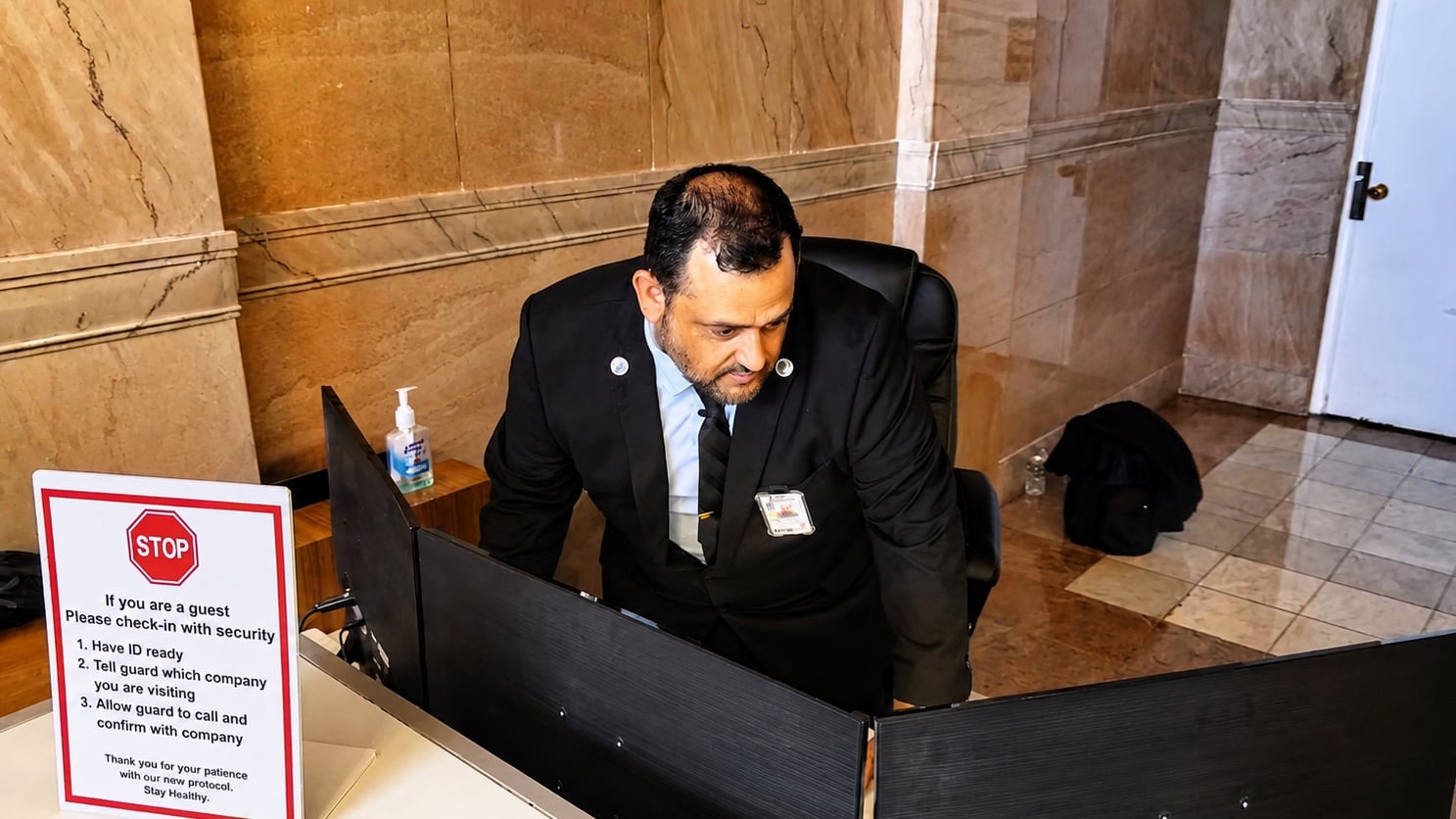
Many luxury properties also dress concierge security in professional attire — suits rather than traditional guard uniforms — reinforcing the brand aesthetic while maintaining a visible security presence that deters without intimidating.
Luxury-Level First Impressions That Protect Reputation
Reputation is an asset — and in the luxury property market, it is one of the most valuable ones on the balance sheet. A single incident mishandled at the front desk can generate resident complaints, negative reviews, or worse, liability exposure. Concierge security officers are specifically positioned to prevent that outcome.
Beyond managing threats, they manage perceptions — creating an immediate sense of both welcome and protection for everyone who enters the building. That experience of feeling safe and respected is what drives long-term resident retention and referral in high-end properties. It is a soft benefit with very real financial consequences.
Measurable Business Benefits for Property Managers
Reduced Insurance Premiums Through Proactive Risk Management
Insurance underwriters pay close attention to documented risk management programs. Concierge security — with its detailed access logs, incident reports, visitor records, and emergency response protocols — creates exactly the kind of paper trail that demonstrates a property is actively mitigating risk.
The result is often reduced insurance premiums. Thorough risk prevention strategies signal to insurers that a property is less likely to generate costly claims, which directly affects premium calculations. For large Class A properties, that reduction can be substantial over time — turning a security investment into a measurable line-item saving.
Higher Resident Satisfaction Through an Enhanced Experience
The connection between concierge security and resident satisfaction is well-documented. A case study from a high-end residential complex demonstrated a 95% increase in resident satisfaction within six months of implementing integrated concierge, security, and resident support services — along with 30% faster emergency response times.
Resident satisfaction is not just a feel-good metric. In high-end multifamily buildings, it directly affects lease renewals, referrals, and the ability to command premium rents. Front desk concierge services add a tangible layer of luxury and operational efficiency that residents notice — and pay for willingly.
Why Class A Properties Choose Purpose-Built Solutions
Not every property has the same security profile. A 40-story luxury residential tower in downtown Boston has fundamentally different needs than a boutique hotel in Back Bay or a Class A suburban office campus. What they share is an expectation of excellence — and a low tolerance for one-size-fits-all security programs that were not designed with their environment in mind.
Purpose-built concierge security solutions are structured around a property's specific risk profile, operational workflows, resident or tenant demographics, and brand standards. That means protocols developed for this building — not recycled from the last one. It also means security personnel trained on property-specific procedures — familiar faces who integrate into the community rather than rotating strangers treating every shift like a first day.
For property managers, this customization is not a luxury — it is a requirement. Generic security programs leave gaps. Custom programs close them, and they do it in a way that strengthens rather than disrupts the property experience.
New England Security Delivers Both — Contact Us for Boston Concierge Guard Services
For property managers in the Boston area overseeing high-end residential buildings, luxury hotels, or Class A office spaces, the choice between traditional lobby guards and concierge security is not just a staffing decision — it is a strategic one. The operational benefits, measurable risk reduction, and resident experience advantages of the concierge model are well-established, and the financial case is increasingly difficult to argue against.
New England Security has built its concierge guard program specifically for the demands of premium Boston-area properties. Their approach combines professional access control, advanced resident and package management technology, emergency first-response training, and hospitality-level service standards — all delivered by officers trained to function as an extension of the property management team, not as an outside vendor operating in isolation.
The result is a security presence that protects the property, strengthens the resident experience, and reflects the quality of the building itself. That is the standard high-end properties should be holding their security to — and it is the standard the concierge model is designed to meet.
Learn more about what a purpose-built concierge security program looks like in practice at New England Security, a Boston-based provider specializing in professional security solutions for premium properties.
New England Security
City: Malden
Address: 208 Broadway
Website: https://newenglandsecurity.com


Comments
Post a Comment