Can Black Mold Be Completely Removed? Tampa Bay Specialist Explains
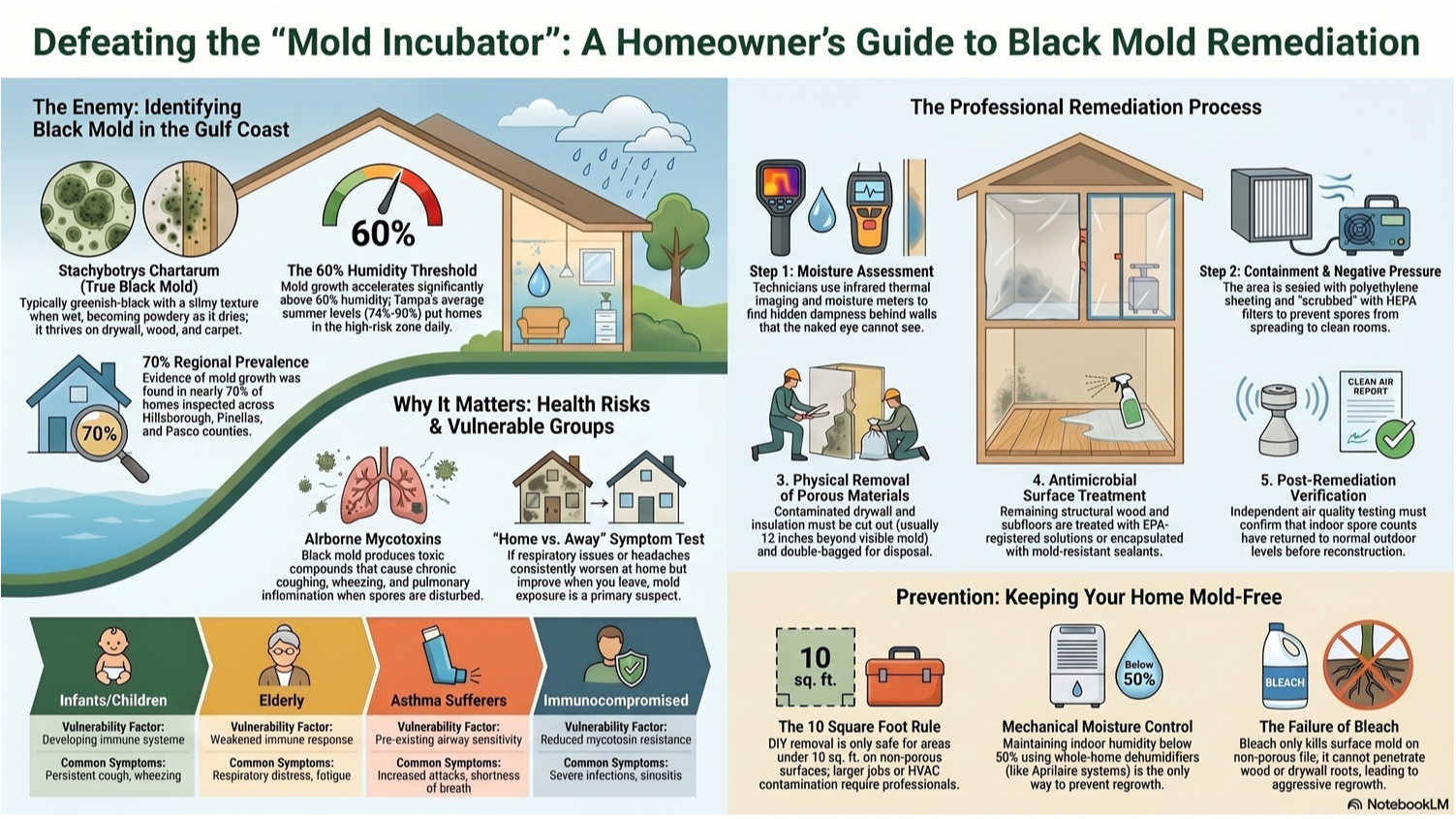
- Yes, black mold can be fully addressed — but only when active colonies are eliminated, contaminated materials are removed, and the moisture source is permanently fixed.
- Tampa Bay's summer humidity routinely hits 74%-90%, making it one of the most mold-prone environments in the country.
- There's a critical difference between mold removal and mold remediation — and confusing the two almost always leads to regrowth within weeks.
- Certain household members — infants, the elderly, asthma sufferers — face significantly higher health risks from black mold exposure than others.
- Keep reading to find out exactly when DIY cleanup is appropriate, and when it makes the problem measurably worse.
Dark patches on the bathroom ceiling. A musty smell that shows up every time the AC kicks on. A water stain that reappeared three weeks after you painted over it. These aren't minor cosmetic annoyances — in a Tampa Bay home, they're early warning signs of a problem that grows fast and goes deep. Understanding what black mold actually is, what it takes to get rid of it for good, and why Tampa's climate raises the stakes higher than most places is the foundation for making smart decisions about your home and your family's health.
Yes — But 'Complete Removal' Means More Than You Think
Black mold spores exist naturally in virtually every environment, including the outdoor air around your home right now. That's an important starting point, because it reframes what "complete removal" actually means. The goal of professional remediation isn't to produce a sterile, spore-free building — that's neither achievable nor necessary. The real target is eliminating the active mold growth inside your home and returning indoor spore concentrations to levels consistent with normal outdoor air.
When that standard is met — and verified through independent post-remediation air quality testing — the job is done correctly. Four conditions must all be true at the same time: active colonies are physically removed or the affected materials are disposed of entirely, airborne spore counts return to normal outdoor levels, the moisture source is identified and permanently corrected, and clearance testing confirms the results. Any remediation that skips even one of those steps is a temporary fix, not a complete one.
This distinction matters enormously in Tampa Bay, where ambient humidity means any residual moisture pathway gets exploited fast. TampaBayMold.net's mold remediation process is built specifically around Gulf Coast conditions — where the window between "addressed properly" and "back in six weeks" is much narrower than it would be in a drier climate.
Tampa Bay Makes Black Mold Worse Than Most Places
Most general mold advice is written for average climates. Tampa Bay is not an average climate. The subtropical heat, near-daily summer rainfall, and persistently high humidity create an environment that is essentially purpose-built for mold growth — and understanding exactly why helps explain why half-measures don't work here.
Why 74%-90% Summer Humidity Is a Mold Accelerant
Mold needs three things to grow: a food source (drywall, wood, carpet backing), the right temperature, and moisture. Tampa delivers all three year-round without interruption. Average relative humidity in the Tampa Bay area sits between 74% and 90% during summer months — well above the 60% threshold at which mold growth accelerates significantly, according to environmental science guidelines.
That means even without a leak or a flood, ambient humidity alone can sustain active mold colonies inside walls, under floors, and in poorly ventilated spaces like crawl spaces and attics. Air conditioning systems, while helpful for comfort, introduce their own risk: the cold surfaces inside air handlers and ductwork are prone to condensation, and any organic debris in the system becomes mold food. Homes with older construction, inadequate crawl space vapor barriers, or single-pane windows face compounded risk because condensation forms on cool surfaces and drips into wall cavities where it never fully dries out.
Mold Germinates in 24-48 Hours After Water Damage
Speed is everything after any water intrusion event. The EPA and environmental researchers consistently cite the same window: mold can begin colonizing wet materials in as little as 24 to 48 hours. In Tampa's climate, that timeline is not theoretical — it's routine. A pipe that sweats overnight inside a wall cavity, a roof that lets in a small amount of water during an afternoon storm, a washing machine hose that drips slowly behind the unit for a week — any of these creates enough sustained moisture for mold to establish a foothold before most homeowners realize anything happened.
Within a week of unaddressed water damage, what started as surface-level moisture can become a deep infestation inside wall cavities that requires full material removal to remediate. The cost and scope of remediation scales directly with how long the moisture went unaddressed. Catching a moisture event within that 24-48 hour window and drying materials completely is the single most effective intervention available — but once that window closes, professional assessment becomes the next necessary step.
What Black Mold Actually Does to Your Health
Health effects from black mold exposure get exaggerated in some corners of the internet and dismissed in others. The documented reality falls somewhere in between — and it's serious enough to take seriously, particularly for specific members of a household.
Confirmed Respiratory Effects: Chronic Coughing, Wheezing, and Pulmonary Inflammation
Stachybotrys chartarum produces mycotoxins — toxic compounds that become airborne when mold spores are disturbed. Inhaling those spores causes a recognizable cluster of respiratory symptoms: chronic coughing, wheezing, sinus congestion, and persistent throat irritation. What makes black mold exposure particularly difficult to catch early is that these symptoms are nearly identical to seasonal allergies or a recurring cold. Many Tampa homeowners spend months treating the symptoms without ever identifying the source.
The reliable pattern to watch for: symptoms that consistently worsen at home and improve when away — at work, traveling, or spending a weekend somewhere else. That pattern strongly suggests indoor air quality, not a seasonal allergen, is the driver. In cases of prolonged exposure, more serious effects have been documented in some health literature, including pulmonary edema (swelling of the lungs) and pulmonary hemorrhage (bleeding in the lungs), though a direct causal link between Stachybotrys chartarum and acute idiopathic pulmonary hemorrhage in infants has not been definitively proven by the CDC. Immune system suppression has also been linked to mycotoxin exposure.
Broader Health Impacts: Fatigue, Cognitive Difficulties, and Immune Effects
Beyond the respiratory system, mycotoxins produced by black mold are linked to a broader range of systemic effects. Medical and health research has connected chronic mold exposure to persistent fatigue, memory problems, and difficulty concentrating — often described as "brain fog." Research has identified that mycotoxins can inflame the hippocampus, the part of the brain most directly responsible for memory function.
These cognitive and fatigue-related symptoms are frequently dismissed or misattributed because they don't present with an obvious physical cause. Someone dealing with unexplained exhaustion and concentration difficulties over an extended period, combined with respiratory symptoms, warrants a hard look at the indoor environment before accepting those symptoms as a new baseline.
Who in Your Household Faces the Highest Risk
Black mold affects everyone exposed to it, but some household members are significantly more vulnerable than others. Infants and young children have developing immune and respiratory systems that are less equipped to handle mycotoxin exposure — persistent coughing, wheezing, and frequent illness are common early signs. Elderly individuals face heightened risk due to weakened immune response, often presenting with respiratory distress and cognitive fog. People with asthma have pre-existing airway sensitivity that makes even moderate spore exposure a trigger for increased attacks. Immunocompromised individuals — those undergoing chemotherapy, living with autoimmune conditions, or recovering from illness — face the most serious outcomes, including severe respiratory infections and fungal sinusitis.
If any of these household members are present, the threshold for calling a professional drops to essentially zero. The health risk of improper mold disturbance in a home with vulnerable occupants is not a calculated risk worth taking.
The Professional Remediation Process, Step by Step
A properly executed remediation job follows a structured sequence where each step builds on the last. Skipping any step — even one — compromises the integrity of the entire outcome. Here's what the full process looks like from start to finish.
1. Inspection and Moisture Assessment
Professional remediation begins with a thorough inspection that goes well beyond what's visible to the eye. Technicians use infrared thermal imaging cameras to detect temperature differentials in walls and ceilings that indicate hidden moisture pockets. Calibrated moisture meters then confirm active dampness in structural materials. This step establishes the true scope of the infestation — which is almost always larger than the visible surface area suggests, particularly in homes that have experienced prolonged humidity exposure or slow undetected leaks. Establishing a pre-remediation air quality baseline through spore sampling also happens here, giving the team a documented starting point to measure clearance against.
2. Containment Under Negative Air Pressure
Before any mold-contaminated material is physically disturbed, the work area is fully isolated. Heavy-gauge polyethylene sheeting seals off the affected zone from the rest of the home. HEPA-filtered air scrubbers establish negative air pressure inside the contained area — meaning air flows into the work zone rather than out of it. This is the mechanism that prevents spores released during demolition from spreading to clean areas of the home. A decontamination chamber at the entry point controls what moves in and out of the zone during the work. Without this step, remediation work can measurably worsen indoor air quality in unaffected rooms.
3. Physical Removal of Contaminated Materials
Any porous material actively colonized by black mold must be physically removed and properly disposed of. There is no chemical treatment that reliably decontaminates porous materials like drywall, insulation, or carpet padding — mold infiltrates the cellular structure of these materials, making surface treatments ineffective. Contaminated drywall is cut back to clean framing, typically at least 12 inches beyond the visible mold boundary to account for hidden growth; industry standards such as the ANSI/IICRC S520 often stipulate removal of 24 inches around the visibly moldy area. Insulation is bagged and removed entirely. Wood framing showing active growth is treated with antimicrobial agents, and in severe cases replaced or encapsulated with specialized sealants after treatment. All removed materials are double-bagged, sealed, and disposed of without being transported through uncontaminated areas of the home.
4. HEPA Filtration and Antimicrobial Surface Treatment
With contaminated materials removed, HEPA air scrubbers run continuously to capture spores released during demolition. HEPA filtration captures particles as small as 0.3 microns — mold spores range from 1 to 100 microns, meaning a properly rated HEPA unit captures them at high efficiency. Remaining structural surfaces — exposed wall framing, subfloor, concrete block, ceiling joists — are treated with EPA-registered antimicrobial solutions, applied by sprayer or fogger to ensure complete coverage into surface irregularities. Where mold has penetrated wood framing but full replacement isn't structurally necessary, encapsulants are applied as a final barrier — mold-resistant sealants that lock any residual material beneath an impermeable coating and prevent future spore release from treated surfaces.
5. Independent Post-Remediation Testing and Clearance
No remediation job is complete without independent post-remediation verification — and the word "independent" is important. Industry best practice, reinforced by the IICRC (Institute of Inspection, Cleaning and Restoration Certification), calls for clearance testing to be conducted by an unaffiliated third-party mold assessor, not the same company that performed the remediation work. Air samples collected inside the treated area are compared against baseline outdoor air samples. Indoor spore counts must return to levels at or below outdoor concentrations before the area is cleared for reconstruction. In Tampa, this testing step carries extra weight — local ambient spore counts are already elevated compared to drier climates, so verifying against the correct outdoor baseline is necessary for an accurate clearance determination, not just a formality.
Why Black Mold Returns — and How to Prevent It
Recurrence after remediation is never random. It's always traceable to a specific failure — either in the original treatment or in what happened afterward. Understanding the two most common drivers of recurrence makes it far easier to prevent them.
Moisture Is the Primary Driver, But Not the Only One
Moisture is the variable that determines whether black mold comes back. Remove the mold without fixing the moisture source and the surface is essentially being cleaned so it can be recontaminated within weeks. In Tampa Bay homes, moisture intrusion takes many forms that aren't always obvious: a slow roof leak that only activates during heavy rain, a sweating pipe inside a wall cavity, inadequate attic ventilation that traps humid air against the roof deck, or crawl space humidity that never drops below 70% during summer. Each one creates a self-sustaining mold environment that surface treatments simply cannot overcome.
The most effective long-term strategy combines physical mold removal with mechanical moisture control. In Tampa's climate, this typically means installing or upgrading dehumidification systems in crawl spaces, improving attic ventilation, sealing vapor barriers, and correcting any structural entry points for water. Maintaining indoor relative humidity consistently below 50% is the single most reliable post-remediation preventative measure available.
When DIY Is Safe and When It's Dangerous
DIY mold removal has a legitimate role in home maintenance — but it occupies a narrow window of appropriate application, and in Tampa Bay, that window is narrower than in most places. The accelerated regrowth timeline in a humid climate means that incomplete DIY treatment doesn't just fail to solve the problem; it can make the next professional remediation more extensive and more expensive.
Conditions That Always Require a Professional
Certain conditions remove the DIY option entirely, regardless of visible size. If mold is present inside an HVAC system or ductwork, professional remediation is mandatory — a contaminated air handler distributes spores to every room in the home every time it runs, and cleaning ductwork requires specialized access and equipment beyond what any homeowner can achieve. If mold is located inside wall cavities, under flooring, in the attic, or in the crawl space, professional containment protocols are required during removal to prevent cross-contamination. Disturbing hidden mold without proper negative air pressure containment can rapidly elevate airborne spore counts to dangerous levels throughout the home.
If any household member is immunocompromised, has asthma, or is an infant or elderly individual, the threshold for calling a professional is effectively zero. The health risk of improper mold disturbance in a home with vulnerable occupants is not a trade-off worth making when professional remediation is the alternative.
Keeping a Tampa Home Mold-Free After Remediation
Successful remediation establishes a clean baseline. Maintaining that baseline in Tampa Bay requires active, ongoing prevention — because the environmental conditions that caused the original infestation don't leave when the remediation crew does. What changes is the homeowner's awareness of the home's vulnerabilities and the tools available to stay ahead of recurrence.
Hold Indoor Humidity Below 50% Year-Round
Keeping indoor relative humidity consistently below 50% is the most effective single preventative measure available to Tampa homeowners. A whole-home dehumidifier integrated with the HVAC system provides the most reliable control, particularly during the May through October rainy season when outdoor humidity makes passive control nearly impossible. For crawl spaces specifically, a dedicated crawl space dehumidifier paired with an encapsulated vapor barrier — one that seals both the ground and the walls — creates a controlled environment that prevents the moisture migration that commonly feeds mold growth in first-floor walls and subfloor materials.
Early Warning Signs to Catch Before Mold Returns
Early detection costs a fraction of a second remediation. After a home has been treated, a monthly visual inspection of previously affected areas — plus high-risk zones like under sinks, around toilet bases, behind the washing machine, inside bathroom exhaust fan housings, and along the base of exterior walls — catches problems before they become colonies. Look for discoloration, soft spots in drywall, water staining on ceilings, or condensation on windows and pipes.
Pay as much attention to smell as to sight. A returning musty odor — even without visible mold — is a reliable early indicator of renewed moisture accumulation. A moisture meter check on the walls and floor of the affected area before calling a professional can help identify whether elevated moisture readings exist before a colony has time to establish. Catching a moisture source at that stage costs a fraction of what addressing a full regrowth requires.
In Tampa's Climate, Half-Measures Guarantee Regrowth — Full Remediation Doesn't
Tampa Bay's humidity, heat, and storm season make black mold one of the most persistent threats a local homeowner will face. Surface-level cleaning has its place for small, contained problems on non-porous surfaces — but for any meaningful infestation in a Gulf Coast home, where ambient conditions favor rapid regrowth, a complete professional remediation process is the only approach that addresses the full scope of the problem.
The combination of licensed inspection, proper containment, complete physical removal of contaminated materials, permanent moisture source correction, and independent post-remediation clearance testing is not an upgraded premium option. It's the baseline standard for work that actually lasts. A home remediated to that standard — combined with active humidity control below 50% and routine moisture monitoring — can stay mold-free indefinitely, even in one of the most mold-friendly climates in the country.
The question isn't whether black mold can be completely removed. In the hands of a qualified professional who addresses the full scope of the problem, it can be. The real question is whether the job gets done right the first time — because in Tampa Bay's climate, a half-measure doesn't buy time. It guarantees a second problem.
For homeowners in the Tampa Bay area dealing with black mold or the aftermath of water damage, TampaBayMold.net provides professional mold remediation services built specifically for the challenges of Florida's Gulf Coast climate.
TampaBayMold.net
City: Tampa
Address: 550 N. Reo St. Suite #300
Website: https://www.tampabaymold.net


Comments
Post a Comment