What's in the Trade Compliance Records Reference Library, and Why It Exists
What's in the Trade Compliance Records Reference Library, and Why It Exists
The compliance officer at a South African importer does not search "trade compliance platform." They search what their actual problem is: do I need a Certificate of Conformity for furniture imports from China, or what is Government Gazette 54374, or how do I prepare for the SABS PVoC deadline. The export-side compliance manager at a Vietnamese textile exporter searches how does an African textile exporter prepare for EU DPP or what documentation do I need for CBAM. A freight forwarder handling a mixed manifest searches Certificate of Conformity for China imports South Africa and how do I integrate a verification URL into the SAD500. None of them search for a brand.
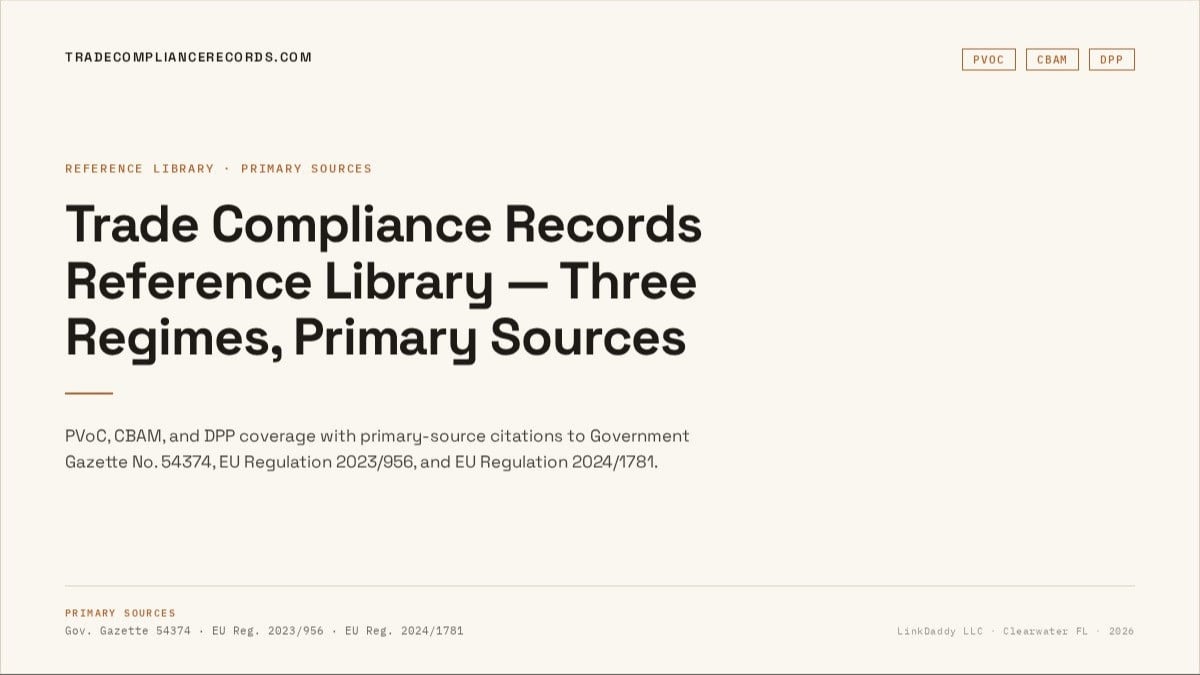
That's the position the Trade Compliance Records reference library is built for. It covers the three regulatory regimes generating the most search activity right now — South African PVoC, EU CBAM, EU Digital Product Passport — and it answers the underlying questions in plain language with citations to primary regulatory sources.
The PVoC pages address the practical reality of the 20 September 2026 deadline. The Gazette established the programme on 20 March 2026 with a six-month transition. For sea freight from China via the Cape of Good Hope route — the operational reality since the Bab el-Mandeb disruption — typical transit is 35-45 days. An importer loading after mid-August arrives after the mandatory date. The practical preparation window is therefore not six months; it is approximately fourteen weeks. The library walks through what that means for an importer who needs to identify product scope against the Phase 1 list, brief a Chinese supplier on the SANS standard, contract one of the four authorised inspection bodies, and integrate the Certificate of Conformity reference into the SAD500 customs declaration.
The CBAM pages address the question every non-EU manufacturer with EU buyers has had to confront since 1 January 2026. The CBAM Declarant — the EU importer — is the party with the legal reporting obligation. But the data has to come from somewhere, and that somewhere is the non-EU manufacturer. If the manufacturer cannot provide verified actual emissions data, EU default values apply. Those default values are set at the 90th percentile of EU production with a punitive mark-up. For a steel exporter, the difference between default and verified actual values can exceed EUR 1 million per year in CBAM certificate costs — which the EU buyer pays and increasingly recovers from the supplier through contract.
The DPP pages address the phased ESPR timeline honestly. Despite some early discussion suggesting a 19 July 2026 cliff, no product-specific ESPR delegated act is in force on that date. The first mandatory DPP category is batteries under EU Regulation 2023/1542, with February 2027 enforcement. Textiles, furniture, iron and steel, and electronics follow on a phased schedule through 2027 to 2030. The library treats this as sustained multi-year demand, not a single deadline, which is what it actually is.
The library is freely accessible. It exists because the people who actually do the work — compliance officers, brokers, forwarders — deserve primary-source-cited answers in plain language to the questions they actually search.
For the full library, visit tradecompliancerecords.com.
LinkDaddy LLC
City: Clearwater
Address: 509 N Prescott Avenue
Website: https://linkdaddy.com
Phone: +1-727-350-8520
Email: tony@linkdaddy.com


Comments
Post a Comment