Sussex Council Reorganisation: The Hidden Marketing Crisis Brewing for 2028
Key Takeaways
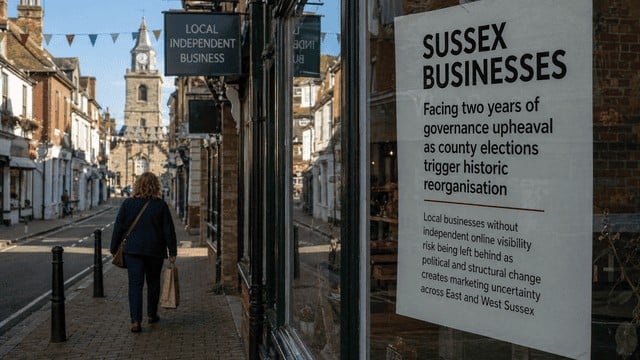
- Sussex businesses face a two-year period of structural uncertainty as local government reorganisation creates potential disruptions to council directories, business partnerships, and area-specific marketing profiles through 2028.
- The government has not yet decided on reorganisation proposals, with final structures to be determined after May 2026 elections and new authorities operational from April 2028.
- Contractors, professional services firms, and local service businesses are most vulnerable to marketing disruption during the transition period.
- Independent digital visibility strategies protect businesses from relying on council-controlled marketing platforms that may become obsolete.
- Building marketing resilience through multi-platform distribution creates authority that persists regardless of political or administrative changes.
Local businesses across East and West Sussex are entering an unprecedented period of governance uncertainty that extends well beyond typical political cycles. The implications reach directly into marketing strategies, business partnerships, and digital visibility—creating risks that many companies haven't yet recognised.
Sussex Businesses Facing Extended Governance Uncertainty Period
The structural upheaval facing Sussex represents more than routine political change. With county council elections scheduled for May 2026 occurring during an ongoing mandatory reorganisation process, local businesses must prepare for a landscape where fundamental administrative relationships may not survive in their current form.
West Sussex County Council remains Conservative-controlled, while East Sussex County Council operates under no overall control with a Conservative minority administration since 2023. Both councils face significant challenges from Reform UK, Liberal Democrats, and the Green Party in what has become a genuine four-way contest. The outcome matters less than the certainty: whoever wins will govern structures already scheduled for abolition within two years.
This administrative uncertainty creates specific marketing vulnerabilities that traditional business planning rarely addresses. Companies relying on council-run directories, local authority partnerships, or area-specific online profiles face potential disruption as boundaries, naming conventions, and authority structures undergo fundamental revision. Hybrandr™ distribution services represent one approach to building marketing resilience that operates independently of government structures.
Delayed Reorganisation Creates Marketing Challenges Through 2028
Summer 2026 Decision Following Post-Election Consultation
The government has not yet made decisions on reorganisation proposals submitted by Sussex councils in March 2026, announcing instead that further consultation will take place after the May elections. This delay means that businesses across Brighton, Hove, Worthing, Eastbourne, Hastings, Crawley, and the wider county areas face a minimum of two years where the identity, priorities, and spending decisions of their local authority remain genuinely unclear.
The consultation process scheduled for summer 2026 will determine not just administrative boundaries but also the practical frameworks through which local businesses engage with government services. Economic development programmes, business directory structures, and partnership networks all face potential restructuring based on decisions that haven't yet been made.
April 2028 Target for New Unitary Authorities
Elections to new shadow unitary authorities will take place in 2027, with the current county councils formally abolished and replaced from April 2028. A Sussex-wide elected mayor is expected to follow, holding strategic powers over transport, housing, skills, employment support, and economic development across the entire region.
The transition period extends beyond 2028, creating ongoing uncertainty for marketing strategies dependent on local government structures. This timeline creates a window where businesses relying on council-controlled platforms face continued risk.
Unresolved Proposals Prolong Structural Uncertainty
The government's decision to take additional time considering reorganisation options highlights the complexity of restructuring arrangements that have existed for decades. Public consultation responses will influence final arrangements, suggesting that outcomes may differ significantly from current expectations.
The extended decision-making process demonstrates that even anticipated reorganisation plans remain subject to revision. Businesses building marketing strategies around expected structures may find themselves preparing for arrangements that ultimately don't materialise or take different forms than originally proposed.
Marketing Vulnerabilities During Structural Transition
Council Directory Structures Face Potential Disruption
Local authority business directories represent a particular vulnerability during reorganisation. These platforms often form part of economic development strategies that new authorities may restructure or abandon entirely. Directory users frequently encounter outdated or incorrect information, and this risk increases significantly when administrative structures change.
Current directory listings may become obsolete as council names, contact details, and administrative processes change. Businesses relying heavily on these platforms for local visibility face potential gaps in their digital presence at precisely the moment when establishing independent authority becomes most critical.
Business Partnership Networks Risk Reorganisation Impact
Formal and informal partnership networks between businesses and local authorities face disruption as personnel, priorities, and organisational cultures change. Economic development contacts, procurement relationships, and business support referral pathways all sit within structures currently scheduled for dismantling.
New authorities will inevitably establish different approaches to business engagement, potentially prioritising different sectors or geographic areas. Companies that have built marketing strategies around existing relationship networks may find these connections diminished or discontinued under new arrangements.
Area-Specific Marketing Profiles May Require Revision
Geographic marketing positioning faces particular challenges where boundary changes affect catchment area definitions. Health, beauty, and wellness businesses that depend heavily on hyper-local search visibility may need to revise their location-based marketing as administrative areas are redrawn.
Search engine optimisation strategies built around specific district or council area targeting may become less effective if those areas cease to exist or change significantly in scope. The challenge extends beyond simple boundary changes to include shifts in how local areas are perceived and searched for by potential customers.
Business Sectors Potentially Affected by Change
Contractors and Approved Trader Schemes
Home services trades face particular exposure through council-run approved trader schemes that may not transfer directly to new authorities. Planning authority relationships, building control processes, and licensing arrangements all operate through frameworks that will undergo restructuring during the transition period.
Contractors who have invested time and resources in gaining approved status with current councils may need to re-establish credentials with new authorities operating different assessment criteria. This disruption occurs at a time when maintaining consistent market presence becomes most critical for business continuity.
Professional Services and Procurement Frameworks
Solicitors, accountants, consultants, and other professional services firms often maintain formal relationships with local authorities through procurement frameworks that will require renegotiation under new structures. Changes to business support referral pathways carry direct commercial implications for firms that have built client acquisition strategies around these relationships.
New public procurement reforms aim to allow local authorities to reserve lower-value contracts for local suppliers, creating opportunities for businesses with established local visibility. However, these opportunities favour companies that have built recognition independently of any single administrative arrangement.
Local Service Businesses and Catchment Areas
Restaurants, retail outlets, personal services, and other location-dependent businesses face challenges where administrative changes affect how customers search for and identify local services. The shift to larger unitary authorities may dilute the local identity that many businesses use as a competitive advantage.
Service businesses that have optimised their marketing around specific district or borough identities may find these geographic references less meaningful to customers as political and administrative boundaries change. The challenge requires rebuilding local authority through channels that transcend administrative structures.
Building Marketing Resilience Through Independence
Multi-Platform Distribution Strategy
Effective marketing resilience during structural transition requires distribution across platforms that operate independently of local government arrangements. Research shows that 87% of customers conduct online searches for services and products, making consistent visibility across multiple channels necessary for business continuity.
Multi-platform strategies reduce dependency on any single directory, partnership, or administrative relationship. By establishing presence across more than 300 established third-party platforms, businesses create distributed foundations that persist regardless of political or administrative changes affecting individual channels.
Authority Beyond Single Government Structures
Digital authority built through consistent content distribution and citation building creates marketing assets that belong to the business rather than depending on external administrative arrangements. Unlike council-linked directories subject to changes outside business control, independently established authority compounds over time and strengthens competitive positioning.
The transition to larger unitary authorities and regional mayoralties suggests that competition for visible positioning will intensify as regional economic policy consolidates. Businesses with established independent authority are better positioned to engage effectively with new structures while maintaining existing market presence.
Hybrandr™ Delivers Government-Independent Digital Foundation
The Hybrandr content distribution service creates and distributes articles, video, audio, infographic, and news announcement content across established third-party platforms, building consistent name, address, and phone citations that maintain search visibility regardless of local government structure. Unlike paid advertising that ceases when spending stops, or council-linked directories subject to administrative changes, this approach builds distributed digital authority that persists and compounds over time.
Businesses currently utilising this approach have recorded significant organic traffic increases and strong return on investment within ten months—results achieved independently of any single platform or political arrangement. The service operates as part of a broader systematic marketing framework designed specifically for Brighton and Sussex market characteristics, where consumer research behaviour is intensive and trust signals are scrutinised closely.
The political situation in Sussex illustrates a principle applicable to every local business: marketing foundations cannot be built on structures outside direct business control. As Sussex faces its most significant governance upheaval in fifty years, the businesses best positioned for continuity and growth are those that have already established visibility foundations that will remain effective regardless of how many councils exist, what they are called, or who runs them. The transition period ahead makes independent digital authority not just advantageous, but necessary for competitive survival.
For structured marketing systems designed specifically for the Brighton and Sussex market, Quantum Business Dynamics provides systematic business growth solutions that build resilience through independence from any single administrative or political arrangement.
Quantum Business Dynamics
City: Hove
Address: 126 Shirley St
Website: https://qbdynamics.co.uk
Comments
Post a Comment