Mobile vs Desktop Ad Creative Formats: Size & Adaptation Requirements
Key Takeaways
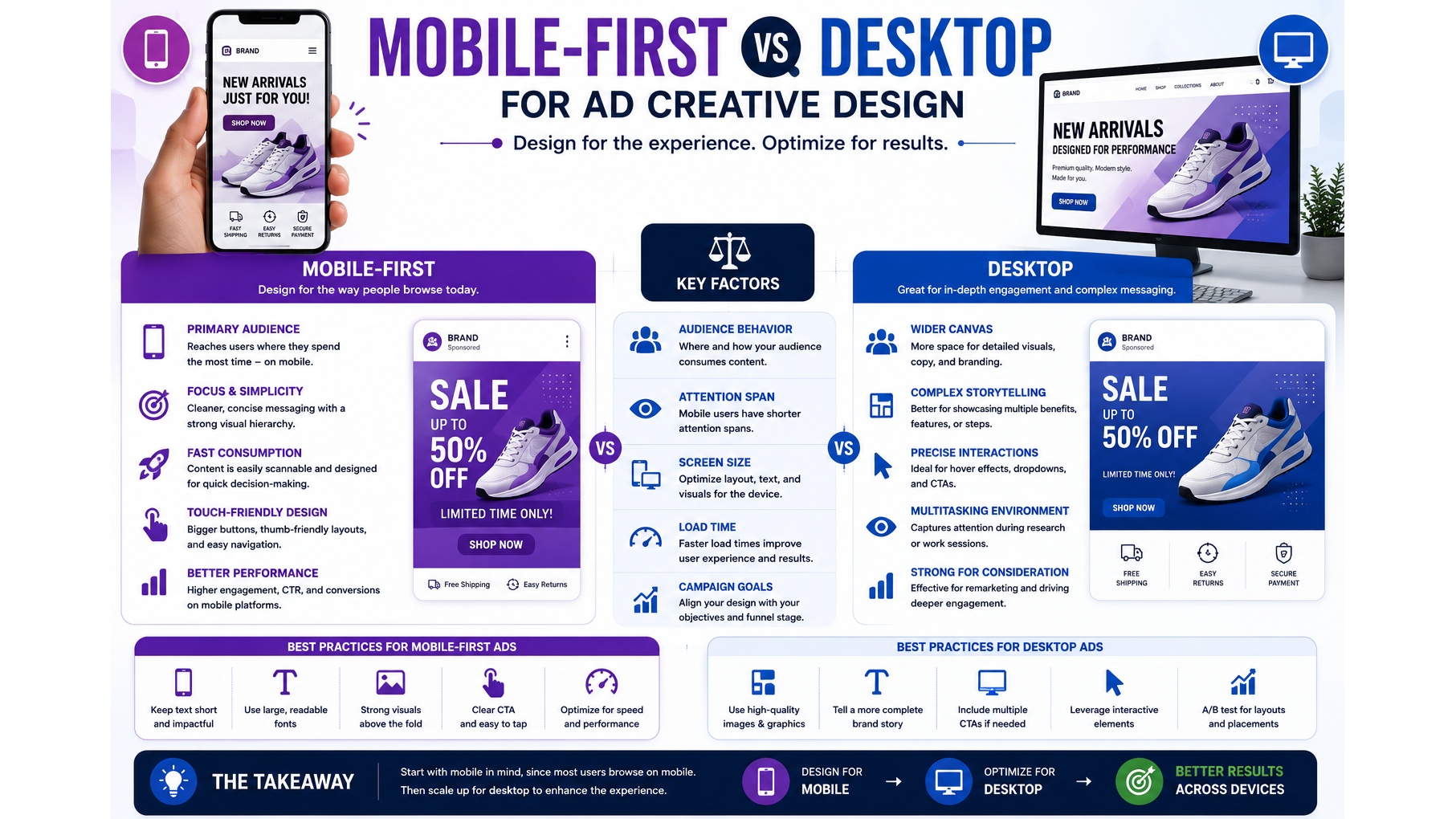
- Mobile and desktop ads require drastically different format specifications - mobile needs vertical or square formats (9:16, 1:1) while desktop favors horizontal layouts (8:1 for leaderboards, 16:9 for video content)
- File size optimization is critical for mobile performance - large creative files can slow loading times and increase bounce rates on mobile devices
- Poor cross-platform adaptation leads to decreased engagement, higher costs, and negative brand perception across advertising campaigns
- AI-powered solutions can automate resizing and reformatting while maintaining visual quality and brand consistency across all platforms
- Strategic creative adaptation can increase campaign efficiency and return on ad spend when properly implemented
The digital advertising landscape demands precision across multiple platforms, yet many marketers struggle with the technical complexities of format adaptation. Understanding the fundamental differences between mobile and desktop creative requirements isn't just about hitting the right pixel dimensions - it's about maximizing performance, engagement, and return on investment across every touchpoint in the customer journey.
Critical Size Differences Drive Platform Performance
The foundation of successful cross-platform advertising lies in recognizing that mobile and desktop environments operate under completely different visual paradigms. Mobile devices prioritize vertical and square aspect ratios that maximize screen real estate, while desktop platforms use horizontal formats that complement wider monitor displays. This fundamental difference extends beyond simple aesthetics - it directly impacts user engagement, click-through rates, and conversion performance.
Research consistently demonstrates that ads optimized for their intended platform see significantly higher engagement rates compared to poorly adapted creatives. When desktop-oriented horizontal banners are displayed on mobile devices, users experience visual disruption, reduced readability, and frustration that translates into lower campaign performance. The cost implications extend beyond immediate metrics, affecting long-term brand perception and customer acquisition efficiency.
Modern advertising success requires understanding that platform-specific optimization isn't optional - it's necessary for competitive performance. AdCreative.ai states it has analyzed over $35 billion in ad spend data to identify the specific format requirements that drive superior performance across mobile and desktop platforms.
Mobile Creative Formats and Standard Sizes
1. Primary Mobile Ad Dimensions
Mobile advertising operates within strict dimensional constraints that prioritize thumb-friendly interaction and portrait-oriented viewing. The **320x50 Mobile Leaderboard** serves as the foundational banner format, positioned typically at the top or bottom of mobile screens without disrupting content consumption. This compact format requires concise messaging and clear call-to-action buttons that remain legible on smaller screens.
The **300x250 Medium Rectangle** format bridges mobile and desktop compatibility while offering more creative space for compelling visuals and extended copy. This square format performs exceptionally well in content feeds and between article sections, providing advertisers with sufficient real estate for brand storytelling without overwhelming the user experience.
**320x100 Large Mobile Banner** formats provide expanded creative opportunities while maintaining mobile-optimized proportions. These banners allow for more detailed product showcases, multiple call-to-action elements, and improved brand visibility without sacrificing loading performance on mobile networks.
2. Social Media Platform Requirements
Social media platforms have revolutionized mobile advertising with platform-specific format requirements that prioritize native user experience. **Facebook and Instagram's 1080x1080 square format** dominates feed advertising, offering equal visual weight across desktop and mobile displays while maintaining consistent brand presentation.
The **1080x1350 portrait format** capitalizes on mobile-first consumption patterns, providing 25% more vertical space for creative storytelling. This format particularly excels in showcasing product details, lifestyle imagery, and sequential brand narratives that engage users through extended viewing time.
**Story advertisements utilizing 9:16 ratio** represent the pinnacle of mobile-first advertising design. These full-screen formats eliminate competition for visual attention, creating immersive brand experiences that drive higher engagement rates and stronger emotional connections with target audiences.
3. File Size and Loading Speed Considerations
Mobile creative performance directly correlates with file size optimization and loading speed efficiency. Large creative files create significant barriers to user engagement, particularly on slower mobile networks or older devices. Industry benchmarks indicate that creative files exceeding 150KB for static images experience measurable drops in engagement and completion rates.
Technical optimization extends beyond simple file compression to include format selection, color palette optimization, and progressive loading techniques. Mobile-optimized creatives use efficient file formats like WebP for images and H.264 for video content, ensuring rapid loading without sacrificing visual quality or brand integrity.
Desktop Creative Specifications and Layout Demands
1. Standard Desktop Banner Formats
Desktop advertising uses larger screen real estate through horizontally-oriented formats that complement natural reading patterns and mouse-based navigation. The **728x90 Leaderboard** format dominates header and footer placements, providing extensive horizontal space for detailed messaging, multiple product showcases, and complex call-to-action sequences.
**300x250 Medium Rectangle** banners maintain versatility across desktop placements while offering substantial creative canvas for detailed product imagery, testimonials, and brand messaging. This format's square proportions ensure consistent visual impact regardless of sidebar or content-integrated placement.
The **160x600 Wide Skyscraper** format capitalizes on vertical screen space, particularly effective for detailed product catalogs, step-by-step processes, and sequential brand storytelling. **300x600 Half-Page** banners provide premium positioning with extensive creative opportunities for immersive brand experiences, detailed product demonstrations, and value propositions.
2. Visual Complexity and Text Capacity for Larger Screen Real Estate
Desktop formats accommodate significantly more visual complexity and textual information compared to mobile constraints. Larger screen real estate enables detailed product photography, feature lists, customer testimonials, and multi-layered design elements that would overwhelm mobile interfaces.
Desktop creative strategies use increased text capacity for detailed value propositions, technical specifications, pricing information, and compelling calls-to-action that guide users through complex decision-making processes. This expanded canvas allows for sophisticated design hierarchies, multiple focal points, and brand storytelling that builds trust and drives conversions.
Adaptation Challenges and Design Principles
1. Responsive Design Requirements
Effective cross-platform creative adaptation requires sophisticated responsive design principles that automatically adjust layout, typography, and visual hierarchy based on display dimensions. Responsive creative design ensures optimal user experience across device types while maintaining brand consistency and message clarity.
Advanced responsive techniques include fluid grid systems, scalable vector graphics, and adaptive image optimization that preserves visual quality across varying screen resolutions. These approaches enable single creative assets to perform effectively across multiple platforms while reducing production complexity and maintaining design integrity.
2. Message Optimization Across Screen Sizes
Message adaptation extends beyond visual resizing to include content prioritization and information hierarchy optimization. Mobile formats require concise, action-oriented messaging that communicates value propositions within limited attention spans and smaller reading areas.
Desktop formats accommodate expanded messaging strategies that include detailed explanations, multiple benefits, social proof elements, and calls-to-action. Effective adaptation requires understanding how users consume information differently across platforms and adjusting message complexity accordingly.
3. Performance Impact of Poor Adaptation
Inadequate creative adaptation creates measurable negative impacts across key performance indicators. **Decreased engagement** manifests through lower click-through rates, reduced time spent viewing content, and diminished brand recall among target audiences exposed to poorly optimized creatives.
**Increased costs** result from reduced ad efficiency, requiring higher impression volumes to achieve target conversion numbers. Poor adaptation forces advertisers to compensate for reduced creative effectiveness through increased budget allocation, ultimately reducing return on advertising spend.
**Negative brand perception** develops when users encounter visually disrupted or functionally impaired advertising experiences. Poorly adapted creatives signal lack of attention to user experience, potentially damaging brand credibility and customer trust.
**Ad fatigue** accelerates when users repeatedly encounter the same poorly optimized creative across different platforms, leading to decreased engagement rates and increased cost per acquisition over campaign duration.
4. Cross-Platform Testing and Validation
Testing protocols ensure creative performance optimization across all target platforms and devices. Testing strategies include device-specific performance monitoring, load time analysis, engagement tracking, and conversion rate optimization across mobile and desktop environments.
Advanced testing methodologies use automated quality assurance tools, real-device testing networks, and performance analytics platforms that provide actionable insights for creative optimization. These approaches enable data-driven creative decisions that maximize performance across diverse platform requirements.
AI-Powered Solutions for Multi-Format Creation
1. Automated Resizing and Reformatting
**Intelligent layout adaptation** revolutionizes creative production through AI algorithms that understand design principles, brand guidelines, and platform requirements. Advanced AI systems automatically adjust element positioning, typography scaling, and visual hierarchy to maintain design integrity across format variations.
**Visual quality preservation** ensures that automated resizing maintains professional design standards while optimizing for platform-specific requirements. AI-powered tools analyze image composition, text readability, and brand element prominence to create platform-optimized variations without compromising visual impact.
**Brand consistency** across multiple formats becomes achievable through AI systems that understand brand guidelines, color palettes, typography standards, and visual style requirements. These systems ensure every creative variation maintains brand integrity while optimizing for platform-specific performance requirements.
2. Performance Prediction Technology
**Forecasting consumer trends** enables proactive creative optimization based on predictive analytics and historical performance data. AI systems analyze engagement patterns, seasonal trends, and audience behavior to recommend creative strategies that maximize performance potential.
**Predicting engagement and conversions** allows advertisers to optimize creative investments before campaign launch. Advanced prediction models analyze visual elements, messaging strategies, and format specifications to forecast performance outcomes with remarkable accuracy.
**Real-time campaign optimization** enables continuous creative improvement based on performance feedback and audience response data. AI systems automatically adjust creative elements, targeting parameters, and format distribution to maximize campaign effectiveness throughout campaign duration.
Scale Your Creative Production with AI Automation
The future of cross-platform advertising lies in intelligent automation that eliminates technical barriers while maximizing creative performance. AI-powered creative production enables marketers to focus on strategic messaging and brand storytelling while automated systems handle format adaptation, performance optimization, and platform-specific requirements.
Successful implementation of AI creative automation requires understanding both technical capabilities and strategic applications. Forward-thinking marketers use these technologies to scale creative production, improve campaign performance, and reduce time-to-market for advertising initiatives across multiple platforms and audience segments.
The competitive advantage gained through intelligent creative automation extends beyond immediate performance improvements to include long-term strategic benefits like reduced production costs, improved campaign agility, and improved ability to test and optimize creative strategies at scale.
Transform your advertising workflow with AdCreative.ai, the leading AI platform for generating high-performing ad creatives across all platforms and formats.
Ad Creative
City: Paris
Address: 40 Rue des Blancs Manteaux
Website: https://free-trial.adcreative.ai/2z57swznplw3


Comments
Post a Comment