Fashion As Protest: How T-Shirt Slogans Influenced Historic Political Movements
Key Takeaways
- Clothing has long functioned as a visible form of political expression across movements and decades.
- T-shirt slogans allow complex ideas to be communicated quickly and publicly.
- Protest fashion has evolved alongside social movements, from coordinated dress to mass-produced apparel.
- Modern political climates have intensified the use of direct, message-driven clothing
- Social media has expanded the reach and speed of protest fashion globally.
Clothing As Communication
Political messaging has not always relied on speeches, publications, or organized campaigns. In many cases, clothing has served as one of the most immediate and accessible forms of expression. T-shirts in particular have emerged as a widely used medium, transforming individuals into visible participants in broader political conversations.
From early campaign apparel to contemporary protest slogans, clothing has provided a way to communicate alignment, dissent, and identity in public spaces. The simplicity of a printed message allows individuals to convey complex ideas in a format that is both portable and highly visible.
Early Examples of Protest Fashion
Symbolism Before Slogans
Before printed T-shirts became widespread, political movements relied on color, fabric, and coordinated dress to signal unity and purpose. Historically, the suffragette movement in the early 20th century used white clothing to project discipline and legitimacy, while purple and gold accents symbolized justice and courage. These visual choices helped reshape public perception of the movement and reinforced a collective identity.
Similarly, during the French Revolution, clothing became a marker of political allegiance. Citizens adopted national colors to demonstrate support for revolutionary ideals, while opponents used contrasting attire to signal dissent. In both cases, fashion acted as a form of silent but powerful communication.
The Emergence of Political T-Shirts
The modern political T-shirt began to take shape in the mid-20th century, when campaign merchandise introduced printed slogans to a wider audience. This shift marked an important transition from symbolic dress to direct messaging. Much like the advent of the printing press, mass-market production of T-shirts provided an inexpensive and scalable way to distribute political ideas, allowing individuals to participate in messaging without formal affiliation to organizations.
As production methods improved, slogan-based apparel became a staple in protest movements, offering a standardized format for expressing political views.
Protest Fashion in Civil Rights and Identity Movements
Black Power and Cultural Expression
During the civil rights era, fashion became closely tied to identity and resistance. The “Black is Beautiful” movement emphasized natural hairstyles and traditional African-inspired clothing as a rejection of imposed cultural norms. These choices carried political meaning, reinforcing pride and self-definition in the face of systemic inequality.
Clothing in this context was not limited to slogans but extended to overall presentation. It demonstrated how fashion could communicate values, heritage, and resistance simultaneously.
LGBTQ+ Activism and Visual Messaging
The AIDS crisis of the 1980s saw the emergence of some of the most recognizable protest slogans in modern history. The phrase “Silence = Death,” displayed on T-shirts and posters, became a direct response to government inaction and public indifference. Its stark simplicity made it highly effective, conveying urgency without requiring explanation.
This period also marked a shift toward using apparel as both a unifying symbol and a tool for visibility. Wearing such messages in public spaces signaled solidarity and drew attention to issues that were often ignored.
Designer Influence and Mainstream Visibility
Fashion as a Political Platform
By the late 20th century, designers began incorporating political messaging into mainstream fashion. Slogan T-shirts appeared on runways and in public appearances, bridging the gap between activism and commercial fashion.
Designers such as Katharine Hamnett demonstrated how direct messaging could enter political spaces. Her use of bold, text-based designs such as "Choose Life" showed that clothing could carry clear and immediate statements, even in formal or high-profile settings.
Designer Connor Ives created the "Protect the Dolls" T-shirt to support transgender women facing escalating political attacks. Celebrities including Pedro Pascal and Troye Sivan wore these shirts as political statements, generating sales that directly funded LGBTQ+ Lifeline support services. This direct connection between fashion purchases and activist funding represents evolving approaches to cause-related marketing.
Expanding Reach Through Popular Culture
As fashion became more integrated with media and entertainment, protest messaging reached broader audiences. Public figures wearing slogan apparel - think anti-ICE pins on celebrity tuxes at recent award shows as a recent example - contributed to wider visibility, allowing messages to circulate beyond traditional activist circles.
This expansion highlighted the dual role of protest fashion: it remained a grassroots tool while also becoming part of mainstream cultural expression. Thus, creating the ability shock and spark debate internationally. Consider the furore around Alexandria Ocasio-Cortez' Tax The Rich dress worn at the 2021 Met Gala; taking the political message right to the heart of an exclusive, elitist event.
The Modern Political Climate and Protest Fashion
Direct Messaging in Contemporary Movements
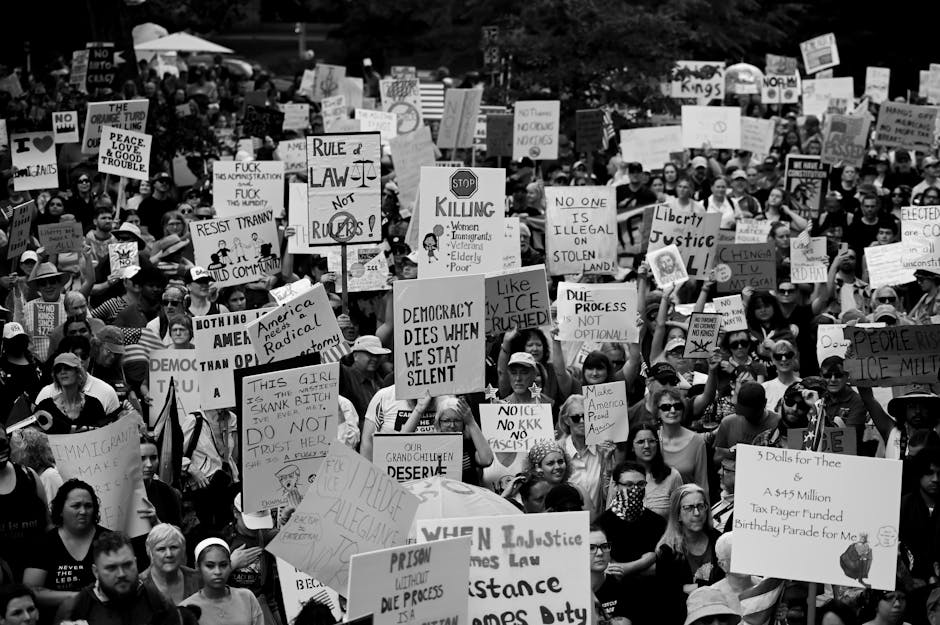
In recent years, protest fashion in the United States has shifted toward more direct and explicit messaging. Slogans addressing immigration policy, government authority, and constitutional rights have become more prominent, reflecting heightened political polarization.
Messages such as “Abolish ICE” or “No Kings” illustrate a departure from subtle symbolism toward clear, declarative statements. These slogans are designed to be immediately understood, reducing ambiguity and encouraging public engagement.
The current political environment has contributed to this shift. As debates around governance, civil liberties, and enforcement agencies intensify, individuals increasingly use clothing to express positions that might otherwise remain private.
Protest Fashion and Public Visibility
Clothing allows individuals to participate in political discourse without formal organization. Wearing a slogan T-shirt in public spaces creates visibility and contributes to a broader sense of collective presence.
This form of participation is particularly relevant in environments where traditional forms of protest may be limited or less accessible. Apparel serves as a continuous and mobile expression of viewpoint, extending beyond specific events or demonstrations.
The Role of Social Media in Amplifying Protest Fashion
Digital platforms have significantly increased the reach of protest fashion. Images of slogan T-shirts can circulate widely, allowing messages to move beyond local contexts and reach national or global audiences.
The "I Can't Breathe" slogan emerged from Eric Garner's final words during a fatal police encounter, becoming a rallying cry for the Black Lives Matter movement. Athletes, celebrities, and ordinary citizens wore T-shirts bearing this phrase, transforming individual tragedy into collective outrage. The slogan's power lay in its simplicity—three words that encapsulated systemic racism's deadly consequences.
Social media also accelerates the adoption of these specific slogans. A phrase that gains traction online can quickly appear on apparel, creating a feedback loop between digital discourse and physical expression. This dynamic has contributed to the rapid spread of protest messaging in recent years. At the same time, visibility through social platforms can influence public perception, shaping how movements are understood and represented.
Protest Fashion in the United States Today
A Reflection of Political Tension
In the current American context, protest fashion reflects ongoing debates around governance, immigration, and constitutional interpretation. Apparel has become a way to signal alignment with specific positions, particularly in environments where political identity plays a visible role.
One of the most visibly recognizable protest-wear in recent years has been the prominent red cape and white cap associated with Margaret Atwood's dystopian novel, The Handmaid's Tale. A stark visual immediately linking the women's rights movement with the fictitious, yet horrific, outcomes of removing bodily autonomy in Atwood's book. The iconic costume speaks louder than words. However, it is not practical for everyday wear. Which is why adopting the image on T-shirts or hooded tops has become popular.
The use of slogan T-shirts in this setting underscores the accessibility of protest fashion. Individuals do not require institutional support to participate; a single garment can communicate affiliation or dissent. It also creates a means of tribal identification and feelings of safety for those targeted by unjust laws.
The Rise of Message-Driven Apparel
Contemporary protest fashion often prioritizes clarity and immediacy. Rise and Revolt, who create American protest-wear, say that the greatest demand is for designs that focus on concise language, bold typography, and high contrast to ensure readability in both physical and digital spaces. This approach aligns with broader communication trends, where shorter, more direct messaging is more likely to capture attention. In this context, T-shirts function as both personal expression and public statement.
The Enduring Role of Fashion in Political Expression
Fashion has consistently adapted to the needs of political movements, evolving from symbolic dress to explicit messaging. While the formats and technologies have changed, the underlying function remains the same: to communicate ideas in a visible and accessible way. T-shirt slogans, in particular, have proven to be durable tools for this purpose. Their simplicity allows for rapid production and distribution, while their visibility ensures continued relevance in public discourse.
As political environments shift, protest fashion is likely to evolve alongside them. New slogans, materials, and methods of distribution will emerge, but the connection between clothing and expression will remain.
Rise And Revolt
City: Battle Creek
Address: 30 East Columbia Avenue
Website: https://www.riseandrevolt.net


Comments
Post a Comment