Email Automation vs Manual Campaigns: Time & Efficiency Comparison
Key Takeaways
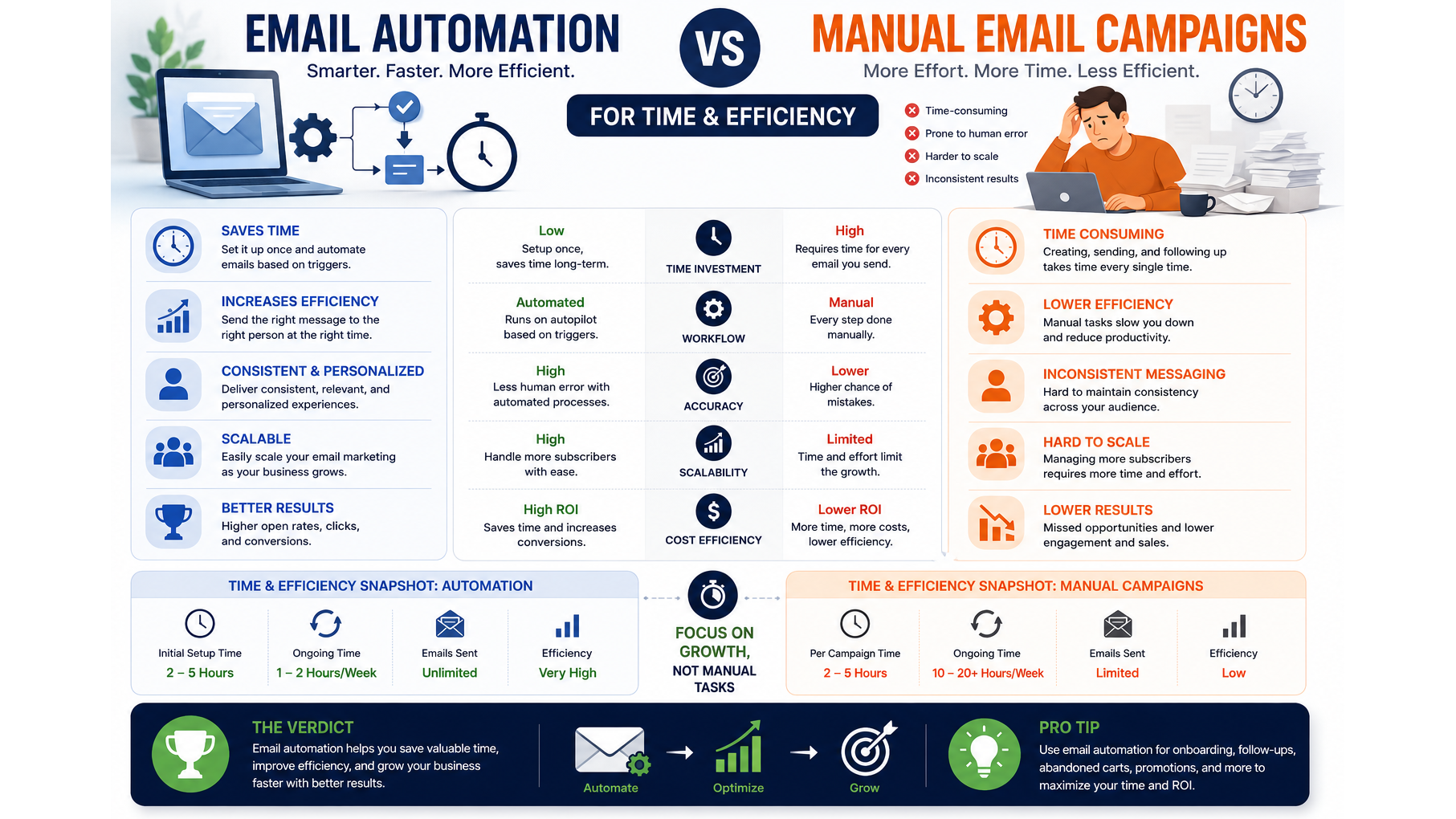
- Automated email campaigns generate 320% more revenue than manual email marketing efforts
- Email automation reduces campaign production time by up to 40%, saving businesses hundreds of hours annually
- Automated campaigns achieve 42% open rates compared to just 15-25% for manual campaigns
- Manual email management creates costly human errors and inconsistent messaging that hurt business growth
Email marketing remains one of the highest-performing digital channels, delivering $36-$42 for every dollar spent. However, the method businesses use to execute their email campaigns determines whether they'll tap into this potential or struggle with diminishing returns. The choice between automated and manual email campaigns represents a fundamental decision that impacts everything from operational efficiency to revenue generation.
Automated Emails Generate 320% More Revenue Than Manual Campaigns
The financial impact of email automation versus manual campaigns is striking. Research consistently shows that automated emails generate 320% more revenue than their manual counterparts. This dramatic difference stems from automation's ability to deliver personalized, timely messages that align with customer behavior and preferences.
While manual campaigns rely on broad messaging sent at predetermined times, automated systems respond to real-time customer actions. A customer browsing specific products receives targeted recommendations, while someone who abandons their cart gets a perfectly timed recovery email. GetResponse's automation platform exemplifies this approach by using AI-powered customer journey mapping to deliver the right message at the optimal moment.
The revenue difference becomes even more pronounced when considering the compound effect over time. Automated campaigns continuously optimize based on customer interactions, creating increasingly effective messaging that drives higher lifetime customer value. Manual campaigns, by contrast, remain static until the next manual revision cycle.
Time-Consuming Manual Campaign Challenges
Manual email marketing creates significant operational burdens that extend far beyond the initial time investment. These challenges compound as businesses grow, eventually becoming unsustainable for companies seeking to scale their marketing efforts effectively.
Labor-Intensive Campaign Management
Manual email campaigns demand constant human oversight at every stage. Marketing teams spend hours crafting individual messages, segmenting lists by hand, scheduling sends, and monitoring performance metrics. Each campaign requires dedicated staff time for creation, review, approval, and deployment. As email lists grow from hundreds to thousands of subscribers, this manual approach becomes increasingly unwieldy. Teams find themselves trapped in repetitive tasks that consume valuable time better spent on strategic marketing initiatives.
Inconsistent Messaging and Timing
Manual campaign management struggles with consistency across different customer touchpoints. Without automated rules governing message frequency and timing, customers might receive multiple emails in quick succession or experience long gaps between communications. Brand messaging varies depending on which team member creates each campaign, leading to mixed experiences that confuse customers and weaken brand identity. Timing becomes particularly problematic when campaigns must coordinate across multiple time zones or customer segments.
Human Error Risks
Manual processes inherently increase the likelihood of costly mistakes. Common errors include sending duplicate emails, mixing up recipient addresses, forgetting scheduled sends, or deploying campaigns with broken links. These mistakes damage sender reputation, frustrate customers, and can result in significant revenue losses. More serious errors, such as sending the wrong promotional offers or including incorrect pricing information, create customer service nightmares that require extensive resources to resolve.
Automation Delivers 80% Time Savings
Email marketing automation transforms how businesses approach customer communication by eliminating manual bottlenecks and streamlining campaign management. Companies implementing automation report saving up to 80% of the time previously spent managing email campaigns. This translates to hundreds of hours annually that can be redirected toward strategic growth initiatives.
40% Reduction in Campaign Production Time
Automation significantly accelerates campaign creation through template systems, pre-built customer journeys, and intelligent content generation. Marketing teams that previously spent days crafting individual campaigns can now set up sophisticated email sequences in hours. Automated systems handle list segmentation, content personalization, and scheduling simultaneously, eliminating the sequential workflow bottlenecks that slow manual processes. This efficiency gain allows businesses to launch more campaigns with existing resources while maintaining higher quality standards.
Hundreds of Hours Saved Annually
The time savings from email automation accumulate rapidly across an organization. Email automation saves an estimated 10-15 hours per week on repetitive sending tasks for businesses that previously managed campaigns manually. These reclaimed hours enable marketing teams to focus on strategy development, customer research, and campaign optimization rather than repetitive administrative tasks.
Performance Gaps Favor Automation
The performance differences between automated and manual email campaigns extend beyond convenience, revealing substantial gaps in customer engagement and conversion metrics that directly impact business outcomes.
42% Open Rates vs 15-25% Industry Average
Automated email campaigns consistently outperform manual efforts in open rates, achieving 42% compared to the 15-25% industry average for manual campaigns. This performance gap occurs because automated systems optimize send times based on individual subscriber behavior patterns. While manual campaigns use generic send times that may miss optimal engagement windows, automation delivers messages when each recipient is most likely to open and read them. The timing precision available through automation creates a significant competitive advantage in crowded inboxes.
180% Higher Conversion Rates
Conversion rate differences between automated and manual campaigns are even more dramatic, with automation driving 180% higher conversion rates than batch emails. Automated campaigns excel at conversion because they deliver contextually relevant messages triggered by specific customer actions. When someone downloads a lead magnet, automation immediately sends related offers. When customers browse specific product categories, they receive targeted recommendations. This behavioral targeting creates highly relevant experiences that manual campaigns cannot match without enormous manual effort.
GetResponse Automation Features
Modern email automation platforms offer sophisticated capabilities that make the transition from manual campaigns both practical and profitable for businesses of all sizes.
AI-Powered Customer Journey Automation
Advanced automation platforms use artificial intelligence to map customer journeys and optimize touchpoints automatically. These systems analyze subscriber behavior patterns, purchase history, and engagement data to create personalized communication paths for each customer. AI-powered automation adapts messaging frequency, content selection, and send timing based on individual preferences, creating highly effective campaigns that would be impossible to manage manually. Machine learning algorithms continuously refine these journeys, improving performance over time without human intervention.
Above-Average Inbox Placement Rates
Professional automation platforms maintain higher deliverability rates than manual email sending, ensuring messages reach intended recipients rather than spam folders. These platforms invest heavily in sender reputation management, authentication protocols, and ISP relationships that individual businesses cannot maintain independently. The result is improved inbox placement rates and better overall campaign performance, contributing to the superior ROI that automated campaigns deliver consistently.
Switch to Email Automation for 320% Revenue Growth
The evidence overwhelmingly supports email automation as the superior choice for businesses seeking sustainable growth through email marketing. The combination of dramatic time savings, improved performance metrics, and substantial revenue increases makes automation necessary for competitive success in today's marketplace.
Businesses continuing to rely on manual email campaigns face increasing disadvantages as competitors use automation to deliver superior customer experiences. The initial investment in automation technology pays for itself quickly through time savings alone, while the ongoing revenue benefits compound over time. Companies that make the switch report not only immediate operational improvements but also improved customer satisfaction and stronger long-term relationships.
The transition from manual to automated email marketing represents more than a technological upgrade—it's a fundamental shift toward data-driven, customer-centric marketing that scales with business growth. As customer expectations continue rising and competition intensifies, automation becomes not just advantageous but necessary for sustainable email marketing success.
GetResponse
City: Gdańsk
Address: Grunwaldzka 413 (NEON)
Website: https://try.getresponsetoday.com/y1bkt7wl0yve


Comments
Post a Comment