Why Medical Tourism Inquiry Volume Isn’t Converting at the Same Rate
Key Takeaways
- Patients begin forming preferences before they start researching providers in medical tourism
- Early preferences are shaped through passive exposure before patients are actively looking
- International patients spend three to nine months researching, during which those preferences solidify
- By the time a patient reaches out, the decision is often already made
- Repeated third-party visibility builds familiarity, which drives perceived safety and selection
- This pattern extends beyond medical tourism to other service industries where trust and perceived risk influence selection, particularly for providers targeting international clients
The medical tourism industry has recovered, with patient demand returning to pre-pandemic levels. However, a growing gap remains between inquiry volume and conversion rates. A structural shift is emerging in how international patients select providers, with referral influence and preference formation occurring before patients begin active research.
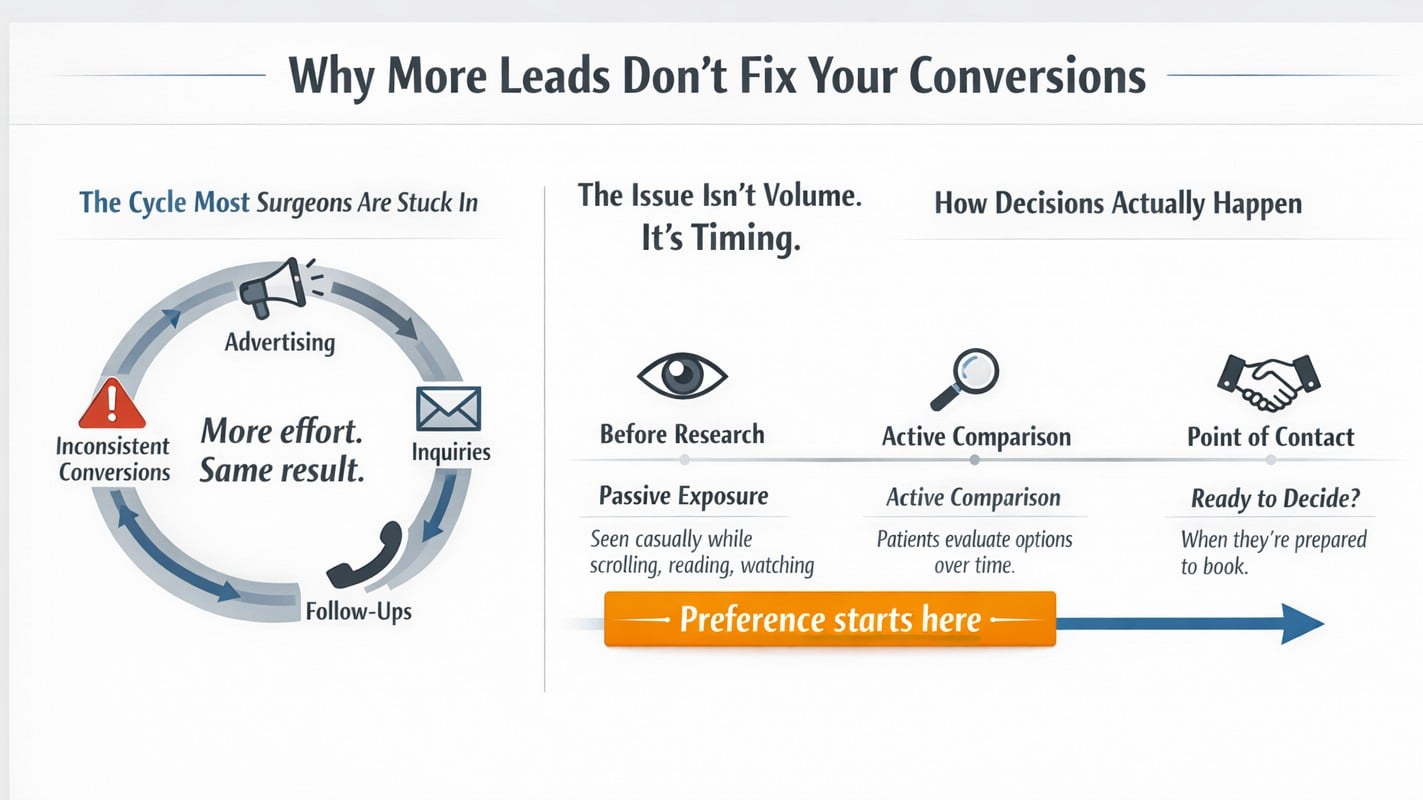
Most surgeons remain in the same cycle: more advertising, more inquiries, and more follow-ups, yet inconsistent conversion. The issue is not volume. It is timing. The decision does not occur at the point of contact. It occurs before patients begin researching, during passive exposure in environments they encounter daily.
This shift reflects broader changes in patient behavior, where trust is established through repeated exposure across independent information sources rather than direct marketing. While particularly visible in medical tourism, this pattern extends beyond it to other service industries where trust and perceived risk shape selection.
By the time a patient begins researching providers, some names already feel known, while others feel like risk. If that name does not appear during the passive phase, it is unlikely to make the shortlist once research begins.
Lead generation assumes the conversation begins when a patient makes contact. It does not. By the time a patient submits a form, the market has already been filtered and a sense of safety established. The contact form is not the beginning of the journey. It is the final step.
92% of people trust recommendations from people they know over advertising. In medical tourism, patients do not have direct referrals, so they rely on a substitute. They look for repeated exposure across trusted, independent sources. That repetition builds familiarity. Familiarity reduces perceived risk, and reduced risk drives selection. Not pricing pages or consultation calls.
This explains why referrals in medical tourism do not behave like traditional referrals. They are not passed from person to person. They are built through recognition, and that recognition happens before any direct interaction.
Patients then move into the research phase. During this extended period, they evaluate safety, expertise, and credibility. Familiarity becomes a substitute for safety. Patients are crossing borders and navigating unfamiliar systems in high-stakes decisions. They reduce that uncertainty by gravitating toward names they’ve seen repeatedly across credible environments. A surgeon who appears in multiple trusted contexts feels safer than one who appears only on their own website, regardless of credentials.
This is where most strategies fail. When a surgeon’s visibility is limited to self-controlled platforms, it triggers skepticism. Patients interpret that as a lack of independent validation. Third-party presence changes that perception. It removes the sense of being sold to and replaces it with perceived credibility.
This shift is why recognition velocity matters more than ad reach. It is not about how many people see a provider, but how often the provider’s name appears in environments patients already trust. When that presence compounds, selection becomes automatic. Patients shift from comparing options to validating a provider they already recognize.
At that point, price sensitivity drops, resistance decreases, and the sales cycle shortens. The surgeon is no longer competing for attention. They are being sought out by name.
92% Trust Recommendations Over Advertising
The trust gap in medical tourism creates a documented psychological barrier where patients feel vulnerable due to limited familiarity with destination countries' medical standards. When North American patients research international care options, they don't evaluate providers in isolation—they judge credibility based on where and how often a surgeon's name appears across independent, trusted sources.
This phenomenon explains why 92% of consumers trust recommendations from people they know over advertising. In medical tourism, third-party recognition acts as a proxy for these personal recommendations when direct connections are absent. Unlike other industries, healthcare marketing directly impacts patient trust through transparency, cultural sensitivity, and respect for diverse patient values. Patients rely heavily on "clear, accurate, and accessible information" from neutral sources to mitigate the perceived risks of traveling for healthcare.
The shift from lead generation to long-term reputation building represents a fundamental change in how international surgeons should approach North American patient acquisition. Further analysis of this pattern explores how recognition influences selection before comparison begins.
Patient Decision Journey Mapping
1. Passive Exposure (Before Research Begins)
Patients do not first encounter a surgeon’s name during research. They encounter it before they begin looking. These are passive moments: reading, scrolling, and consuming information in environments they already use daily.
Repeated exposure creates familiarity. Familiarity reduces uncertainty. By the time research begins, certain names already feel known while others feel unfamiliar.
2. The Three to Nine Month Research Window
International patients do not make impulse decisions about overseas surgery. The research phase spans three to nine months, during which patients evaluate safety, expertise, and credibility.
But this process does not start from zero. It builds on what already feels familiar.
3. Familiarity as a Safety Substitute
For patients traveling thousands of miles for medical care, familiarity becomes a substitute for safety. When a surgeon’s name appears repeatedly across credible environments, it feels lower risk than names seen only in self-controlled channels.
This is how uncertainty gets reduced before any direct interaction happens.
Research suggests that patient choice is often finalized during the research phase, not during the consultation phase. This dynamic shifts focus from inquiry volume to how recognition is established before price discussions begin.
4. Why Lead Forms Come Too Late
Traditional lead generation assumes that contact forms represent the beginning of the patient journey. In reality, lead forms often represent the end of a months-long evaluation process. By the time patients reach out, they've already determined which providers feel safe, credible, and professionally aligned with their expectations. The contact form is not the beginning of the journey. It is the final step.
Surgeons relying on traditional marketing practices that focus solely on generating inquiries miss the critical recognition-building phase where actual selection occurs. In many cases, selection occurs before any direct contact is made.
Repeated Visibility Across Trusted Sources vs Advertising Reach
Third-Party Credibility Signals
Determining how quickly a surgeon's name appears in trusted research spaces predicts conversion more accurately than total ad reach. Patients do not choose providers based on advertising frequency; they choose based on perceived authority and independent validation.
This presence creates familiarity that substitutes for safety in cross-border decisions.
Recognition Creates Automatic Selection
When the number of times a surgeon’s name appears in third party environments reaches critical mass, patient selection becomes automatic rather than competitive. Instead of comparing multiple options, patients research how to work with their pre-selected provider. This fundamental shift eliminates price competition and reduces the sales cycle to logistics coordination.
Many successful international surgeons are not competing for patients in the traditional sense. They become the recognized authority patients seek out by name. This shift changes medical tourism from a lead-driven process to one influenced by recognition and perceived credibility over time.
When familiarity is established before research begins, the decision process changes. Patients do not start by comparing options. They start with a name that already feels familiar and look for reasons to proceed. That is why some surgeons are consistently chosen while others remain invisible despite similar credentials or outcomes.
Source Note
These observations align with analysis from JCH Digital on how pre-research exposure influences provider selection among international patients.
JCH Digital
City: Quesnel
Address: Blair Street
Website: https://www.jchdigital.ca/


Comments
Post a Comment