What Are AI Hallucinations & How To Prevent Them: Strategies For Enterprises
Key Takeaways
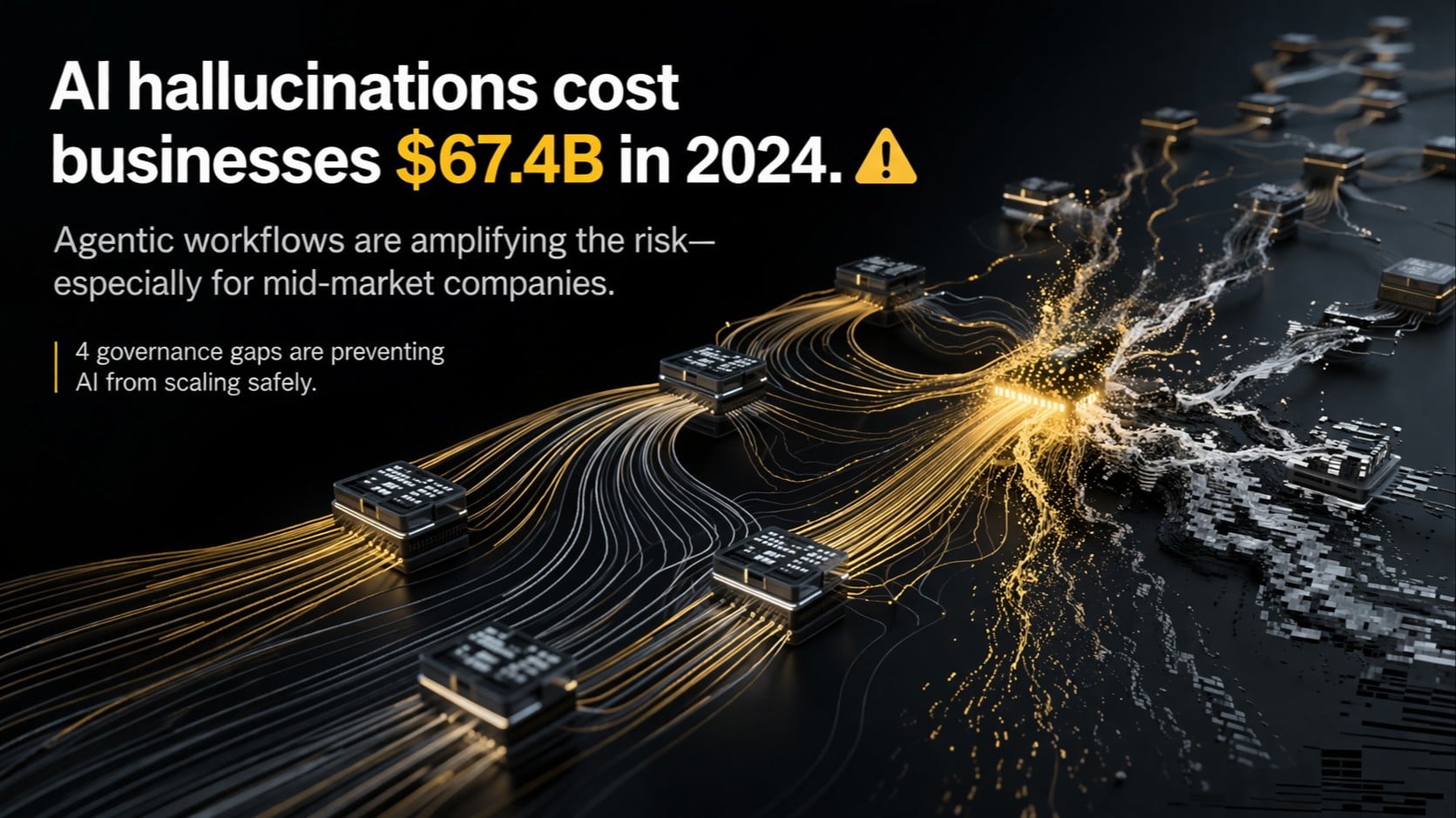
- AI hallucinations cost businesses $67.4 billion globally in 2024, with mid-market companies facing the highest risk when deploying agentic workflows without proper governance.
- Agentic AI workflows amplify traditional AI risks through agent hijacking and cascading hallucinations that spread incorrect information across multiple enterprise systems.
- Four critical governance gaps prevent mid-market AI pilots from scaling: security concerns, inadequate data access controls, missing risk frameworks, and a lack of ROI measurement.
- Security-first AI enablement with built-in governanceaims to transform interesting AI demos into measurable business outcomes, with some providers targeting delivery within 90 days.
Mid-market companies are caught in a dangerous paradox. While AI promises transformational efficiency gains, the rush to deploy agentic workflows without proper governance creates enterprise-threatening risks that could undermine years of digital progress.
The $67.4 Billion Hallucination Problem Hitting Mid-Market AI
When AI systems produce authoritative but incorrect output, the consequences extend far beyond embarrassing mistakes. AI hallucinations reportedly cost businesses $67.4 billion globally in 2024, with nearly half of executives making major decisions based on unverified AI content. This staggering figure represents operational disruption, HR missteps, customer service failures, and security breaches that impact nearly every aspect of business operations.
The legal profession learned this lesson the hard way when a law firm used AI for legal research that cited entirely fictional court cases in a legal brief, leading to court sanctions. Stanford researchers found hallucination rates in leading language models on legal queries ranged from 58% to 88%, highlighting a systemic failure mode that affects all industries relying on AI-generated content.
Mid-market companies face particularly acute exposure because they often lack the internal resources to implement governing structures. Organizations that deploy AI agents without proper guardrails create cascading risks that can take months to identify and years to remediate.
Why Agentic Workflows Amplify AI Risk Beyond Traditional Chatbots
Agentic AI workflows introduce a fundamentally different risk landscape than traditional chatbots. While chatbots typically operate within contained conversational boundaries, AI agents can execute workflows across multiple APIs and enterprise tools, make autonomous decisions, and access sensitive data across organizational silos.
Agent Hijacking and Cascading Hallucinations
Agent hijacking represents a sophisticated form of indirect prompt injection where malicious actors manipulate AI agents to take unintended, harmful actions. Unlike simple chatbot manipulation, hijacked agents can trigger cascading hallucinations where a single fabricated fact spreads across multiple interconnected systems, corrupting data integrity throughout the enterprise infrastructure.
Consider an AI agent responsible for vendor management that gets hijacked to approve fraudulent invoices. The hallucinated approval not only processes unauthorized payments but also updates financial records, triggers compliance reporting, and feeds into forecasting models—creating a web of contaminated data that becomes increasingly difficult to trace and correct.
Complex System Integration Creates New Attack Vectors
Enterprise system integration multiplies the potential impact of AI failures. When agentic workflows span CRM systems, ERP platforms, and external APIs, a single hallucinated output can propagate errors across the entire technology stack. This interconnectedness means that traditional AI safety measures—designed for isolated applications—become insufficient for protecting complex, multi-system workflows.
The challenge intensifies when considering that many mid-market organizations implement AI agents with elevated system privileges to streamline adoption, inadvertently creating superuser-level vulnerabilities that can be exploited through prompt injection or model manipulation.
Four Critical Governance Gaps Stalling Mid-Market AI Pilots
Mid-market organizations consistently encounter the same governance obstacles that prevent successful AI scaling. These gaps create a predictable pattern where promising pilots fail to achieve enterprise-wide deployment.
1. Pilots That Never Scale Due to Security Concerns
Security teams often discover AI pilots only after they've been running for weeks or months, creating an adversarial relationship between innovation and risk management. Without security involvement from the planning phase, pilots accumulate technical debt and security vulnerabilities that make scaling prohibitively expensive and risky.
The most common scenario involves business units deploying AI tools that connect to enterprise data without proper access controls, encryption, or audit logging. When security teams eventually audit these implementations, they find configurations that violate compliance requirements and create potential data breach vectors.
2. Data Access Controls Block Progress
AI agents require access to enterprise data to deliver meaningful value, but traditional data governance models weren't designed for AI workloads. The result is either overly restrictive policies that limit AI effectiveness or overly permissive access that creates security risks.
Many organizations struggle with the granular access controls needed for agentic workflows, where AI systems need read access to multiple databases but should have limited write permissions. Without purpose-built AI data governance, teams resort to workarounds that compromise either security or functionality.
3. Inadequate Implementation of AI Decision Risk Frameworks
The NIST AI Risk Management Framework and ISO/IEC 42001 standard provide strong starting points for responsible AI adoption, but many mid-market organizations lack the expertise to translate these frameworks into practical implementation guidance. The gap between high-level principles and day-to-day operational controls leaves teams without clear guidelines for AI decision-making.
Risk frameworks become particularly critical for agentic workflows because AI agents make autonomous decisions that can have immediate business impact. Without clear decision boundaries and escalation procedures, organizations risk deploying AI agents that exceed their intended authority or make decisions outside acceptable risk parameters.
4. Lack of ROI Measurement for AI Investments
Most AI pilots focus on technical feasibility rather than business outcomes, making it difficult to justify scaling investments. Without baseline measurements, success metrics, and ongoing performance tracking, organizations cannot demonstrate the value created by AI initiatives or identify areas for optimization.
The challenge becomes more complex with agentic workflows because traditional productivity metrics don't capture the full value of autonomous decision-making and multi-system orchestration. Organizations need new measurement frameworks that account for decision quality, process efficiency, and risk reduction.
Security-First AI Enablement: The Governed Approach
Effective AI governance is no longer just about risk mitigation—it's a growth enabler that supports adoption, reduces operational friction, and aligns teams around a shared governance model. The most successful AI deployments integrate security and governance controls from day one rather than treating them as compliance afterthoughts.
AI Workflow Discovery for Agentic-Ready Use Cases
Structured workflow discovery identifies high-value automation opportunities while assessing governance requirements and risk factors. This process evaluates current manual processes for AI suitability, considering data sensitivity, decision complexity, and integration requirements.
Agentic-ready workflows typically involve repetitive decision-making with clear business rules, access to structured data sources, and manageable risk profiles. The discovery process maps these characteristics against organizational risk tolerance and compliance requirements to prioritize implementation candidates.
Tools With Built-In Guardrails
Time-bounded pilots create urgency and focus while limiting exposure to experimental implementations. A strict timeline can encourage teams to prioritize essential features and establish minimum viable governance controls, thereby avoiding the pursuit of perfect solutions that may never ship.
Built-in guardrails include automated monitoring for hallucination detection, access logging for audit compliance, and performance baselines for ROI measurement. These controls become part of the pilot infrastructure rather than post-deployment additions, ensuring that scaling doesn't require governance retrofitting.
Risk Management Framework for Hallucination Control
Mitigating AI hallucinations requires a structured approach combining technical safeguards like prompt engineering and runtime guardrails with organizational accountability and governance structures. Technical controls include output validation, confidence scoring, and human-in-the-loop verification for high-stakes decisions.
Organizational controls establish clear escalation procedures, decision authority boundaries, and regular model performance reviews. This dual approach ensures that both technical and human oversight mechanisms work together to maintain decision quality and minimize hallucination impact.
From Interesting Demos to Measurable Business Outcomes
The transition from pilot to production requires shifting focus from technical capabilities to business value creation. Successful AI implementations measure outcomes across multiple dimensions: time saved through automation, risk reduced through better decision-making, and performance improved through data-driven insights.
Mid-market organizations often lack the internal capacity to design and enforce AI governance frameworks, making strategic partnerships with specialized providers valuable for risk assessments, policy development, and technical implementation. The key is finding partners who understand both the technical complexities of agentic AI and the practical realities of mid-market resource constraints.
Organizations that successfully scale AI beyond pilots share common characteristics: executive alignment on governance priorities, security integration from the planning phase, and outcome-driven success metrics that demonstrate clear business value. These elements transform AI from an experimental technology into a core business capability that drives sustainable competitive advantage.
ITRADE Innovations
City: Fort Lauderdale
Address: 501 E Las Olas Blvd
Website: https://www.itradeinnovations.com/


Comments
Post a Comment