Organic Seed Garlic: Why Triple Certification Changes Your Harvest
Key Takeaways
- Triple certification (CCOF + USDA Organic + Real Organic Project) means three separate annual inspections instead of one, and zero synthetic inputs across every farmable acre.
- The Real Organic Project rejects hydroponic operations and adds soil-based requirements on top of USDA Organic, which matters for garlic because the flavor compounds need actual soil biology to develop.
- Volcanic soil naturally carries trace minerals that synthetic fertilizer can't replicate, and cover crops are what convert raw geology into garlic-ready nutrition.
- Hardneck varieties suit cold zones (3-6) and store 4 to 7 months; softneck varieties suit warm zones (7-9) and store 8 to 12 months. Pick by zone first, flavor preference second.
- Pre-orders for premium organic seed garlic open March 1st, and the most popular cultivars sell out by early summer, so locking in your variety matters more than most growers plan for.
Picking organic seed garlic shouldn't feel like reading a chemistry exam. But once you start comparing certifications and varieties and clove grades, the choices stack up fast and most folks just end up clicking "buy" on whatever looks decent and hoping for the best.
That's how you end up disappointed two summers from now.
We put together a buyers guide to fix that, because honestly we made every one of those mistakes ourselves the first few years. The new organic seed garlic buyers guide walks through the four decisions that actually move the needle: certification level, variety match, clove size, and planting timing. Skip any of them and the harvest will tell on you.
Here's what most beginners don't realize. Seed garlic isn't a generic input you can swap out for grocery-store cloves. The genetics and the soil it grew in and the certification path all carry forward into your harvest. A clove that came out of mineral-rich volcanic ground produces noticeably different bulbs than one grown in tired conventional soil somewhere. Two years from now, when you're saving your best bulbs to replant, that difference compounds.
This guide breaks down what triple certification actually means and why volcanic soil changes garlic quality and how to pick the right variety for your zone and when to lock in your pre-order before the popular cultivars sell out. None of it is theoretical. It's pulled from six years of growing on our farm in McArthur, California.
Triple Certification Means Three Inspections, Not One
Most "organic" seed garlic carries one certification. USDA Organic. That seal means no synthetic pesticides, no synthetic fertilizers, and a three-year transition window before any new ground can be marketed organic. It's real, and it matters. But it's also the floor.
Triple certification raises the bar in two specific ways: tighter oversight and stricter soil-based requirements. Both matter for seed quality.
CCOF: USDA-Accredited and Detail-Heavy
California Certified Organic Farmers (CCOF) was founded in 1973 and currently certifies over 4,400 organic operations across 46 states and 3 countries. CCOF is USDA-accredited, which means farms certified through CCOF are meeting federal organic standards. The difference is the depth of oversight.
CCOF inspectors do thorough annual reviews of farming practices, input usage, and record-keeping. They want detailed documentation of all field activities, from soil prep through harvest. That creates an audit trail. It also creates accountability. A CCOF inspector showing up isn't a formality. They're checking inputs against records, walking the fields, and asking pointed questions about anything that doesn't add up on paper.
For growers buying from a CCOF-certified operation, that oversight carries weight. You're not just trusting a label. You're trusting a third party that's been at the farm reviewing the work, year after year.
USDA Organic: The Federal Floor
The USDA Organic seal indicates that products have been produced through approved methods that integrate cultural, biological, and mechanical practices fostering resource cycling, ecological balance, and biodiversity conservation. That language comes straight from the federal standard. What it means in practice: synthetic pesticides are prohibited, synthetic herbicides are prohibited, synthetic fertilizers are prohibited, and any new ground entering organic production has to wait three years before crops grown there can carry the seal.
USDA Organic provides nationwide market access and consumer recognition that drives premium pricing for organic produce. It's also the most common organic certification by far. For most growers, it's the baseline they're comparing against when they shop seed.
Real Organic Project: The Add-On That Filters Out Hydroponics
The Real Organic Project (ROP) functions as an add-on label to USDA Organic certification. Farms can't get ROP without first being USDA-certified. ROP exists because a lot of farmers felt the USDA Organic seal was getting diluted by allowing large-scale hydroponic systems and concentrated animal feeding operations under the same umbrella as small soil-based farms.
The split matters. ROP requires that crops be grown in soil. Not water, not gravel beds, but actual dirt with active soil biology in it. For garlic specifically, that's not a marketing distinction. It's a quality distinction. Hydroponically grown alliums don't develop the same flavor compounds or storage characteristics as soil-grown garlic, because the biological pathways that produce allicin and the sulfur compounds garlic's known for need real soil microbes to fire properly.
A triple-certified operation carries USDA Organic at the federal level, CCOF at the regional level, and ROP as the soil-based add-on. That's three inspections per year, three sets of records, and zero synthetic inputs across all the farmable ground. The difference between calling something organic and proving it three different ways.
You can buy seed garlic certified by all three. You can also buy seed garlic with just the USDA seal. The price gap's smaller than you'd expect, and the quality gap on planting stock is bigger than most growers realize.
Volcanic Soil Does Things Synthetic Fertilizer Can't
Basaltic Farms sits at 3,100 feet on a volcanic flood plain. The soil there carries trace minerals from ancient lava flows that traveled roughly 100 miles south from Lava Beds National Park. Iron, magnesium, potassium, boron, zinc, molybdenum, and a whole bunch more.
You can't buy that in a bag.
What synthetic fertilizer can't replicate is the way those minerals interact with soil biology. Microbes and fungi and root networks turn raw minerals into food the plant can actually absorb. Mustard cover crops release sulfur compounds that intensify the flavor compounds garlic's known for. Legume cover crops fix nitrogen. Buckwheat scavenges phosphorus that's bound up in the soil. Each cover crop in the rotation pulls a different lever.
The 3,100-foot elevation provides the cold winters that garlic needs too. Garlic needs at least 40 days of freezing or near-freezing weather to form proper bulbs, which is called vernalization. At lower elevations, especially in southern climates, growers struggle to get enough cold exposure. The result is small bulbs or single-clove "rounds" instead of the segmented heads buyers expect. Vernalization isn't optional. It's the trigger that tells the plant to break a single clove into a multi-clove bulb.
Volcanic soil structure also helps with drainage. Garlic hates wet feet. Heavy clay or compacted ground holds water around the bulbs and invites white rot, which is the most serious garlic disease there is. Once white rot enters a field it can persist in the soil for 20 years or more. Volcanic soil drains better than most clay-heavy ground, which reduces that risk.
Working with a garlic farm that pays attention to soil structure changes what you're buying. The seed cloves coming out of well-drained, mineral-rich ground tend to be larger and harder and store better than what comes out of conventional sandy or clay soil.
For growers looking at premium certified organic garlic, that mineral profile is part of what they're paying for. The first generation grown from volcanic-soil seed often shows better flavor and harder bulbs than what most beginners get from grocery-store cloves. By year two or three of saving and replanting, the compounding difference becomes obvious to anyone who's tasted both.
Hardneck or Softneck? Climate Decides for You
The single biggest variety question is hardneck vs. softneck. Get this wrong and the harvest disappoints no matter what else you do right.
Hardneck garlic seed varieties like Music, Chesnok Red, and German Extra Hardy need cold winters. They produce edible scapes in spring, which is a whole second harvest most beginners don't know about. Storage runs 4 to 7 months under typical conditions, and flavors are bolder and more complex.
If you're in USDA hardiness zones 3 through 6, hardnecks are the right call. They evolved in cold climates and they need that vernalization to form proper bulbs. Plant them in zone 8 or 9 without enough winter cold and you'll get small heads or solo bulbs instead of segmented cloves.
Softneck garlic seed varieties like Inchelium Red and Italian Late tolerate warmer winters. They store 8 to 12 months, flavors are milder, and softnecks also braid, which matters if you're planning to hang harvests for kitchen use through the off-season.
Softnecks suit zones 7 through 9. They can be grown in zone 6 too, but the flavor's noticeably better when they get more heat than less. For southern growers, softnecks are usually the easier choice and the more reliable bet.
Heat-Tolerant Varieties Exist
Heat-tolerant cultivars get less attention than they should. These varieties have been specifically selected for performance in warm climates where traditional hardneck varieties fail to form bulbs properly. Mediterranean varieties often perform well in heat-prone regions because they evolved in areas with hot, dry summers and mild winters, which means they require less vernalization while still producing good flavor.
For growers in zones 9 and 10, heat-tolerant varieties aren't a backup option. They're the main option. Trying to force a Russian hardneck in central Texas usually ends in disappointment because the plant doesn't get the cold signal it needs and the bulb doesn't segment.
Storage: The Hidden Variety Decision
Softneck garlic can maintain quality for 8 to 12 months under proper conditions. That means cool storage temperatures, moderate humidity, and adequate airflow. For growers eating their own harvest year-round, softnecks bridge the gap between one season and the next. You harvest in July and you're still pulling solid bulbs from the basket the following May.
Hardneck varieties typically store for 4 to 7 months. Some Porcelain types push toward 6 or 7. Some Rocambole types tap out at 4. The complex flavors justify shorter storage life for many growers, but it's a trade-off worth knowing about before you plant.
Storage temperatures between 32 and 38 degrees Fahrenheit work for maximum long-term hold. For home use, 55 to 65 degrees Fahrenheit is more practical and still gives most of the storage life. Humidity should sit between 60 and 70 percent. Plastic bags are a hard no. Mesh bags, paper sacks, or open baskets keep airflow moving and prevent the moisture buildup that triggers mold. And don't refrigerate. Cold storage below 50 degrees triggers premature sprouting in most varieties.
Clove Size Is the Quiet Variable
Most growers don't think about clove size when ordering. They should.
Larger cloves usually produce larger bulbs. That's not a marketing claim. It's how alliums work. The clove is essentially a starter pack of stored energy and genetic material, so bigger clove means more starter energy and a larger resulting bulb.
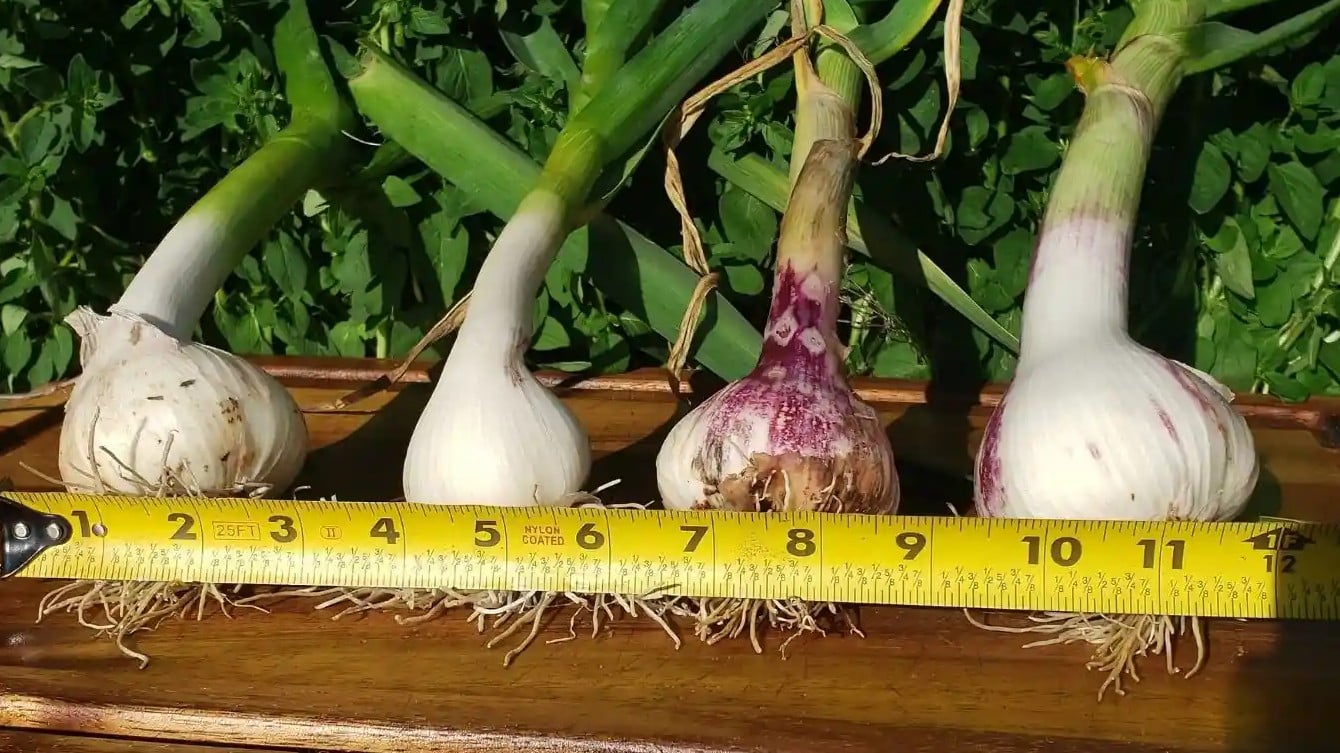
We grade our planting stock as Jumbo (three inches and up), Culinary (two to three inches), and Small (one to two inches). If you're chasing maximum yield, plant the Jumbo-grade cloves and save the smaller ones for the kitchen. Or plant them in a separate row and treat them as next year's seed bulbs once they size up over a season of growth.
There's a quality angle too. Small cloves often come from stressed parent plants, and stressed parents pass weaker disease resistance to their offspring cloves. Jumbo-grade cloves come from healthy, vigorous parent plants. The genetics carry forward, and so does the resilience.
For first-time growers, plant the largest grade you can afford. The harvest will pay you back faster than splitting the difference. Year two, save your best bulbs for replanting and you've started building your own seed stock from genetics that already proved themselves on your specific soil.
Regenerative Farming Builds Soil You Can't Buy
Regenerative agriculture practices work alongside volcanic soil to maximize garlic quality. The combination matters more than any single practice. Volcanic minerals in soil sitting under bare ground all winter erode and leach. The same minerals in soil planted with a diverse cover crop mix get cycled, captured, and made plant-available. The cover crops are what convert raw geology into garlic nutrition.
Diverse cover crop mixes work because each species pulls a different lever. Legumes fix atmospheric nitrogen. Mustards release isothiocyanates that suppress soil-borne pathogens. Buckwheat scavenges phosphorus. Grasses build biomass and protect against erosion through winter. Planting a single-species cover crop misses the point. The biological diversity is what builds long-term soil health.
Composting closes the loop. Garlic harvest leaves, scapes that didn't make it to market, broken bulbs, and stems all go into the pile, and that material returns to the field as compost. Composted material isn't just fertilizer. It's a biological inoculant that carries fungal networks, beneficial bacteria, and protozoa into the field. Synthetic fertilizer doesn't do any of that. It feeds the plant directly without feeding the soil.
Minimal tillage protects what you've built. Reduced soil disturbance lets fungal hyphae establish long-term relationships with garlic roots, which improves nutrient uptake and drought resistance. Heavy tillage breaks fungal networks every time the plow goes through, and if you repeat that cycle every season the soil never builds the long-term biological complexity that drives organic production.
For growers wanting deeper context on soil prep and rotation strategy, our library of organic farming methods walks through cover crop selection, composting basics, and tillage tradeoffs in more detail.
Pre-Order Strategy: March 1 Isn't Optional
Pre-orders for fall planting stock open March 1st each year. Popular cultivars often sell out by early summer, and growers who wait until August or September usually find that their first three variety choices? They're gone.
Music sells out first most years. Chesnok Red follows close behind. Inchelium Red and Italian Late hold longer but still tighten by July. The pattern doesn't change much year to year.
Early ordering gives you more than variety access. It locks in pricing before any season-end inflation. It guarantees quantities for larger plantings. And it gives you time to properly prepare your planting site, because three months of lead time vs. three weeks makes a real difference in how prepared you actually are when planting day arrives.
Storage between order arrival and planting matters too. Once organic seed garlic arrives at your door, keep it cool (55 to 65 degrees Fahrenheit) and moderately humid (60 to 70 percent) until planting. Skip plastic bags. Mesh works better, and cardboard boxes with vent holes work fine.
Bulk buyers, restaurants, and small-scale commercial growers can reach the farm directly to talk through pricing and variety blends. Working with us as a bulk organic garlic supplier means you're getting volume pricing plus a real grower on the phone who can answer questions about which varieties suit your specific climate and use case.
For first-time growers, ordering enough to cover a substantial home garden plus a little extra to save back for next year's seed gets you started right. Year two, you're partly self-sufficient. Year three, you're growing your own seed stock from bulbs that already proved themselves on your specific ground.
The Bottom Line
Organic seed garlic isn't a commodity input. The certification path and the soil it grew in and the variety match for your climate all change what you'll harvest a season later. Triple certification raises the floor. Volcanic soil raises the ceiling. Variety match decides whether you get bulbs or rounds. Clove size decides yield. Pre-order timing decides which cultivars are still on the table.
Skip any of these and the harvest tells on you. Get them right and you're growing better garlic than most commercial operations sell at the grocery store, with seed stock that improves year after year as you save your best bulbs for replanting.
The full seed garlic buyers guide covers planting depth, regional timing, curing technique, and storage in detail. It's free to read and built from the lessons we've learned the hard way, so hopefully you can skip a few of the mistakes we made along the way.
Basaltic Farms
City: McArthur
Address: 641200 Beck Elliot Lane
Website: https://basalticfarms.com/


Comments
Post a Comment