New 2026 Report Reveals Homeowner Searches Before Hiring Foundation Repair
Key Takeaways
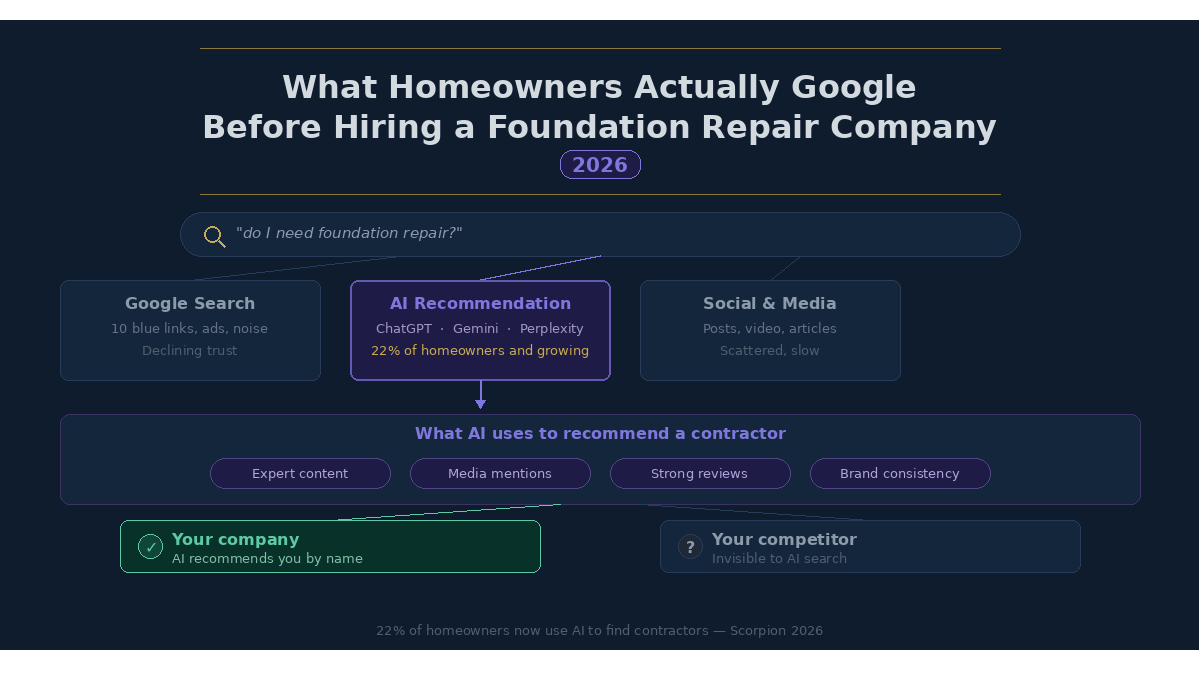
- AI platforms like ChatGPT, Perplexity, and Google AI are increasingly influencing homeowner research patterns, changing how foundation repair contractors are discovered
- Foundation repair ad costs have reached $15-40 per click in many markets, with some competitive areas seeing even higher rates
- Homeowners conduct extensive educational research about foundation problems before contacting any contractor
- Building authority through multi-platform content distribution creates sustainable visibility across emerging research channels
- AI platforms are fundamentally changing how foundation repair leads are generated and qualified
The foundation repair industry faces a fundamental shift in how homeowners discover and evaluate contractors. Traditional Google Ads are becoming less effective as research patterns evolve toward AI-powered platforms that provide direct answers without clicking through to contractor websites.
Most Foundation Research Bypasses Your Ads
Foundation repair contractors are experiencing a dramatic decline in ad effectiveness as homeowners increasingly bypass traditional search results. The shift represents a fundamental change in research behavior that directly impacts lead generation strategies. While contractors continue investing heavily in Google Ads, the majority of potential customers are gathering information through channels their ads cannot reach.
This research migration creates a significant visibility gap for contractors who rely exclusively on paid advertising. Homeowners are making informed decisions about foundation problems using platforms that operate independently of traditional search advertising models. The result is a growing disconnect between where contractors are investing their marketing dollars and where their customers are actually conducting research.
AI Platforms Are Becoming Homeowners' First Choice for Foundation Advice
1. ChatGPT and Perplexity Provide Direct Answers Without Clicking Ads
AI platforms fundamentally change how homeowners approach foundation repair research by delivering detailed answers within the platform itself. When homeowners ask about foundation cracks, settlement issues, or waterproofing solutions, these platforms provide detailed explanations without requiring clicks to external websites. This eliminates the traditional pathway from search query to contractor website that Google Ads depend upon.
The conversational nature of AI platforms encourages deeper research sessions where homeowners ask follow-up questions about repair methods, costs, and timelines. These extended research sessions happen entirely within the AI platform, creating educated prospects who may never encounter traditional advertising. Companies like Carvium AI are helping contractors establish visibility across these emerging platforms where traditional advertising cannot reach.
2. Google AI Overviews Keep Homeowners on Google's Results Page
Google's AI Overview feature provides detailed answers directly on the search results page, reducing the need for homeowners to click through to individual contractor websites. These AI-generated summaries compile information from multiple sources to answer questions about foundation problems, repair processes, and cost expectations. Homeowners can gather substantial information without ever leaving Google's results page.
This development significantly impacts paid advertising effectiveness since homeowners can satisfy their research needs without clicking ads. The AI overviews often provide more detailed information than individual contractor landing pages, making paid clicks less attractive to information-seeking homeowners. Contractors find their expensive ad clicks generating fewer qualified leads as prospects arrive already educated about their options.
3. Homeowners Get Educational Content Before They Know They Need Contractors
AI platforms excel at educational content delivery, helping homeowners understand foundation problems before they recognize the need for professional intervention. Homeowners might start by asking about minor foundation cracks and receive detailed information about underlying causes, potential progression, and various solution approaches. This educational process builds knowledge that influences their eventual contractor selection criteria.
The timing of this education creates challenges for contractors who depend on urgent, high-intent searches. By the time homeowners reach traditional search queries, they often have preformed opinions about repair methods, cost expectations, and contractor qualifications. This educated prospect requires a different approach than the traditionally uninformed lead generated through emergency-focused advertising.
Foundation Repair Keywords Cost More Each Year With No Long-Term Value
Competitive Bidding Drives Costs Above $100 Per Lead
Foundation repair keywords represent some of the most expensive clicks in the contractor advertising space, with costs ranging from $15-40 per click in many markets, though some competitive areas and related urgent services can see significantly higher rates. The high customer lifetime value of foundation projects attracts intense competition from both local contractors and national franchise operations. This competition creates bidding wars that drive costs well above sustainable levels for many businesses.
The lead generation math becomes increasingly challenging as click costs rise without corresponding increases in conversion rates. Contractors find themselves paying premium prices for clicks that may not convert, while competitors with larger budgets can sustain higher cost-per-acquisition models. The result is a market where advertising costs consume an unsustainable percentage of project margins.
Paid Ads Stop Working the Moment You Stop Paying
Google Ads provide no lasting value beyond the active campaign period, creating a dependency that becomes increasingly expensive to maintain. When contractors pause campaigns due to budget constraints or seasonal considerations, lead flow immediately stops. This creates a feast-or-famine cycle where business growth requires continuous advertising investment without building any long-term assets.
The lack of compounding value from paid advertising contrasts sharply with content-based approaches that build authority over time. Contractors who rely exclusively on paid advertising find themselves trapped in an escalating cost cycle where pausing campaigns means losing market presence entirely. This dependency prevents the development of sustainable lead generation systems that continue working without ongoing investment.
How Homeowners Actually Research Foundation Problems Today
1. They Ask AI Platforms About Foundation Crack Causes
Homeowners begin their research by asking AI platforms specific questions about foundation problems they observe. Questions range from "Why do basement walls develop horizontal cracks?" to "What causes foundation settlement in clay soil?" These platforms provide detailed explanations about soil conditions, water damage, structural factors, and environmental influences that contribute to foundation problems.
This initial research phase educates homeowners about the complexity of foundation issues while introducing terminology and concepts they'll use in subsequent research. The AI platforms often suggest follow-up questions that lead deeper into technical discussions about repair methods, materials, and prevention strategies. This educational foundation influences how homeowners evaluate contractor expertise and proposals.
2. They Watch YouTube Videos for Visual Problem Assessment
Video content plays a vital role in homeowner education as foundation problems often require visual context for proper understanding. Homeowners search for videos showing foundation crack patterns, water intrusion signs, and structural settlement indicators that match their observations. These videos help homeowners assess problem severity and understand the urgency of professional intervention.
YouTube's recommendation algorithm introduces homeowners to related content about repair methods, contractor selection criteria, and cost considerations. This video-based research often spans multiple sessions as homeowners build understanding of their situation. The visual nature of this content makes complex foundation concepts accessible to non-technical homeowners.
3. They Read Educational Articles About Repair Methods
Long-form educational content helps homeowners understand the various approaches to foundation repair and their appropriate applications. Articles explaining pier systems, underpinning methods, drainage solutions, and waterproofing approaches provide the technical knowledge homeowners use to evaluate contractor recommendations. This research helps homeowners ask informed questions and recognize expertise during contractor consultations.
The depth of available educational content means homeowners can research specific repair methods relevant to their situation. Articles comparing steel piers versus concrete piers, explaining basement waterproofing systems, or detailing crawl space encapsulation provide the background knowledge that influences contractor selection decisions. Well-informed homeowners are more likely to choose contractors who demonstrate superior technical knowledge.
4. They Check Multiple Platforms Before Calling Any Contractor
Modern homeowners conduct research across multiple platforms before making contact with foundation repair contractors. This multi-platform approach includes checking review sites, social media presence, Better Business Bureau ratings, and company websites. The thorough research process means homeowners arrive at contractor consultations with established expectations and evaluation criteria.
This thorough research approach extends the sales cycle but produces more qualified leads when homeowners finally make contact. Contractors benefit from prospects who understand their foundation problems and have realistic expectations about repair processes and costs. However, this informed prospect also has higher standards for contractor expertise and professionalism.
Building Authority Through Educational Content Distribution
Create Content That AI Platforms Reference and Cite
AI platforms develop recommendations based on the authoritative content they can access and reference. Contractors who create detailed, technically accurate content about foundation repair increase their likelihood of being referenced in AI responses. This content must demonstrate expertise through detailed explanations, case studies, and technical specifications that AI platforms can cite as reliable sources.
The key to AI citation lies in creating content that answers specific questions homeowners ask while maintaining technical accuracy and depth. Content covering regional soil conditions, local building codes, climate-specific foundation challenges, and detailed repair methodologies provides the depth AI platforms seek when formulating responses. Regular publication of expert-level content builds recognition as an authoritative source.
Focus on Multi-Platform Presence Across Key Channels
Effective authority building requires consistent content distribution across multiple platforms where homeowners conduct research. This includes professional content on LinkedIn, educational videos on YouTube, detailed articles on company websites, and responsive social media engagement. Each platform serves different aspects of the homeowner research process and requires platform-specific content optimization.
Multi-platform presence also increases the likelihood of being discovered through various research pathways. Homeowners who find contractors through multiple channels during their research process demonstrate higher trust levels and conversion rates. Consistent messaging across platforms reinforces expertise while accommodating different homeowner research preferences and behaviors.
Diagnose Your Current AI Visibility Before Your Competitors Dominate These Platforms
Foundation repair contractors need immediate assessment of their visibility across AI platforms to understand their competitive position. Most contractors discover they have little to no presence in AI platform responses when homeowners ask about local foundation repair services. This invisibility represents missed opportunities as competitors who establish early presence gain significant advantages in AI platform algorithms.
The rapid evolution of AI search patterns means contractors must act quickly to establish authority before competitors dominate these channels. Early adopters who begin building AI platform presence now will benefit from algorithm recognition and citation patterns that become increasingly difficult to disrupt over time. Waiting to address AI visibility allows competitors to establish dominant positions in emerging search channels.
Regular auditing of AI platform responses for foundation repair queries in your service area reveals which competitors are gaining visibility while identifying content gaps that represent opportunities. Contractors who understand their current AI visibility can develop targeted strategies to improve their presence across platforms where their customers are increasingly conducting research.
Carvium AI
City: Dublin
Address: 77 Camden Street Lower
Website: https://carvium.ai


Comments
Post a Comment