How To Increase Organic Traffic Using Content: Strategies From Baltimore Pros
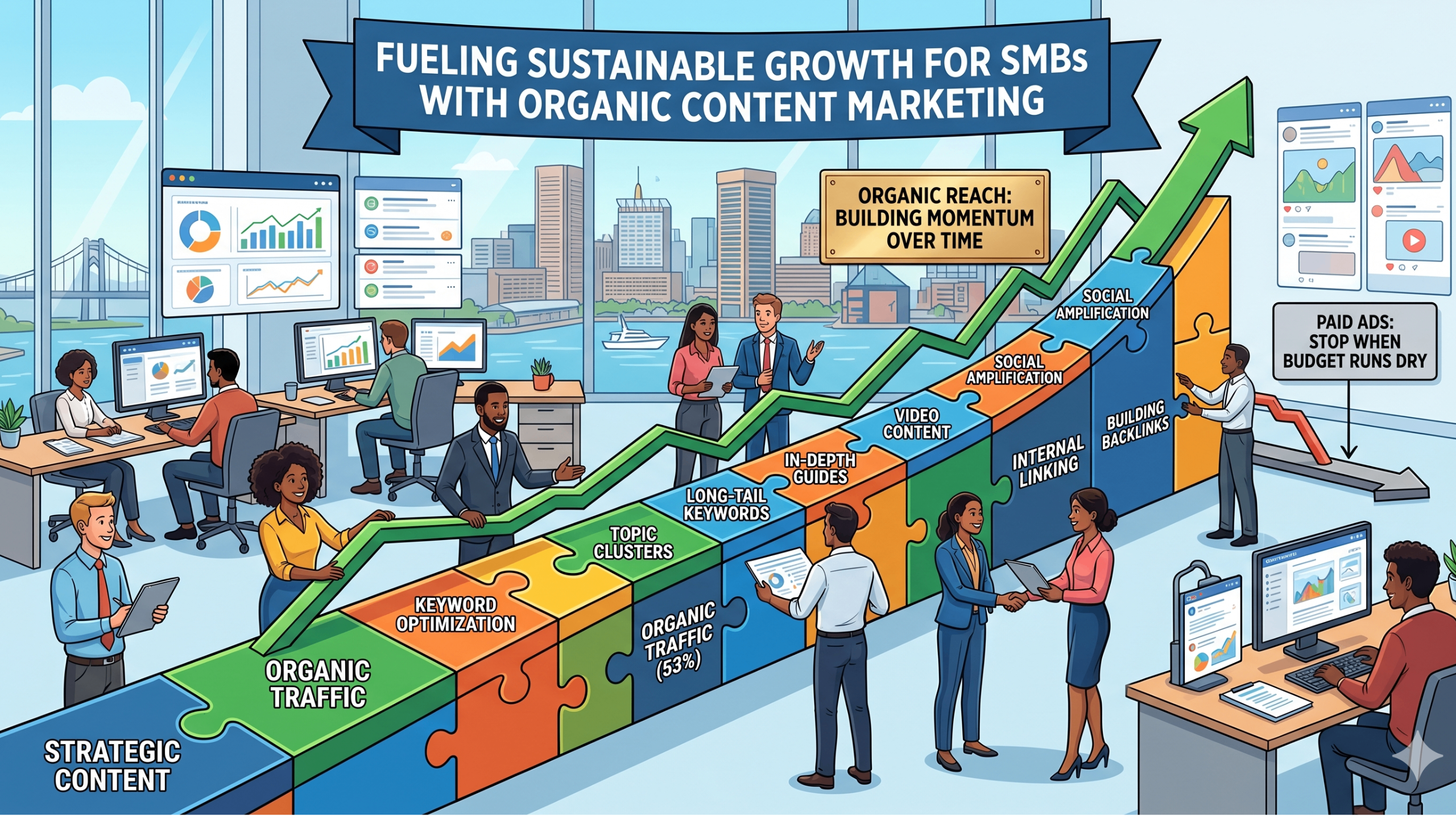
Organic search results account for 53% of all website traffic, representing the largest single source of visitors for most businesses. This statistic reveals a massive opportunity for small and medium-sized businesses willing to invest in strategic content marketing. Unlike paid advertising that stops generating results the moment budgets run dry, organic traffic builds momentum over time, creating a sustainable foundation for business growth.
Most SMBs struggle with limited marketing budgets and fierce competition from larger companies with deeper pockets. Content marketing levels the playing field by allowing smaller businesses to compete on expertise, value, and relevance, and not advertising spend.
Baltimore-based marketing experts from Digital Marketing Pro Shop explain that the businesses capturing this organic traffic share several common characteristics: they create content that directly answers customers' questions, they optimize strategically for search engines, and they measure performance consistently to refine their approach. These fundamentals transform content from an expense into a revenue driver.
Build Brand Authority With Strategic Content Creation
1. Create Keyword-Optimized Content That Ranks
Creating valuable, useful, and relevant content optimized with strategic keywords forms the foundation of successful organic traffic growth. Google's algorithms reward content that genuinely helps users solve problems, but that content must also be discoverable through search. This balance between user value and search optimization separates content that ranks from content that disappears.
Effective keyword optimization starts with understanding search intent rather than simply targeting high-volume terms. A local plumbing company benefits more from ranking for "emergency toilet repair near me" than "plumbing services," even though the latter has higher search volume. The former indicates immediate purchase intent, while the latter represents general research.
SMBs should focus on keywords with moderate competition and clear commercial intent. Tools like Google Keyword Planner reveal search volumes and competition levels, but the real insight comes from analyzing what content currently ranks for target terms. Study the top-ranking articles, identify gaps in their coverage, and create more detailed resources that better serve searcher needs.
2. Develop Topic Clusters
Topic clusters represent a strategic approach to content organization that dramatically improves search visibility. Instead of creating isolated blog posts on random subjects, successful SMBs build interconnected content hubs around core business themes. A marketing agency might create a cluster around "email marketing" with supporting articles on subject lines, automation, segmentation, and analytics.
This approach signals topical authority to search engines while providing visitors with detailed resources that keep them engaged longer. When users spend more time on a website and visit multiple pages, it sends positive engagement signals that boost overall search rankings. Each piece of content within a cluster should link to related articles, creating a web of internal connections that helps search engines understand content relationships.
3. Target Long-Tail Keywords for Niche Traffic
Long-tail keywords capture highly specific search queries that indicate strong purchase intent. While "marketing software" attracts broad traffic with low conversion rates, "email marketing automation for small retail businesses" targets users with specific needs and higher likelihood to purchase. SMBs excel at capturing long-tail traffic because they can address niche concerns that larger competitors overlook.
These longer, more specific phrases typically face less competition while attracting more qualified visitors. A customer searching for "how to reduce cart abandonment for online jewelry stores" has already identified their industry and specific problem. Content targeting this query can provide detailed, actionable solutions that position the business as an expert resource.
The cumulative effect of ranking for dozens of long-tail keywords often exceeds the impact of ranking for a single competitive head term. Long-tail strategy allows SMBs to build organic traffic gradually while establishing authority in specific niches before expanding to broader topics.
Proven Content Formats That Drive Discovery
In-Depth Guides and Research Articles
Detailed guides and research-based articles naturally attract valuable backlinks, which serve as strong ranking signals that grow domain authority over time. When other websites reference detailed resources, they're essentially vouching for the content's quality and reliability. This external validation carries significant weight with search engines.
The most effective guides combine original research, expert insights, and actionable advice. Instead of rehashing common knowledge, they provide unique perspectives or data that make them worth linking to and sharing. SMBs can conduct simple surveys, analyze industry trends, or compile best practices from their client work to create original, valuable resources.
Video Content and Visual Assets
Video content addresses multiple search optimization opportunities while serving diverse user preferences. YouTube ranks as the second-largest search engine globally, representing a massive organic traffic opportunity for businesses willing to create video content. Additionally, embedding videos on web pages increases average session duration, which positively impacts search rankings.
Visual content performs exceptionally well because it can explain complex concepts quickly while maintaining viewer engagement. Tutorial videos, behind-the-scenes content, and customer testimonials provide value while building brand familiarity. Many companies have experienced significant increases in organic website traffic through coordinated content marketing that includes video optimization and social media promotion.
SMBs should focus on creating videos that answer frequently asked questions or demonstrate their expertise. Screen recordings showing software tutorials, brief explanations of industry concepts, or quick tips provide immediate value while establishing credibility. These videos can then be embedded in related blog posts, creating multimedia resources that satisfy different learning styles.
Maximize Reach With Smart Content Distribution
1. Master Internal Linking for SEO Boost
Strategic internal linking within content helps search engines find new pages, distribute authority across websites, and improve user navigation. When implemented correctly, internal links send positive engagement signals to search engines while keeping visitors engaged with multiple pieces of content. This dual benefit makes internal linking one of the most effective SEO tactics available to SMBs.
Effective internal linking requires planning and intention. Rather than randomly linking to other pages, successful businesses link to related content that genuinely improves the reader's understanding or provides logical next steps. A blog post about email marketing automation should link to articles about segmentation strategies, campaign analytics, and integration setup.
The key lies in using descriptive anchor text that tells both users and search engines what to expect from the linked page. Instead of "click here" or "read more," use phrases like "email segmentation best practices" or "conversion rate optimization strategies." This approach helps search engines understand content relationships while providing clear navigation for users.
2. Use Social Media for Content Amplification
Social media platforms serve as content amplifiers that extend organic reach beyond search engines. While social media links typically don't pass direct SEO value, they drive traffic, increase brand visibility, and create opportunities for natural link acquisition. Content that performs well on social platforms often attracts attention from bloggers, journalists, and industry influencers who may link to it from their own websites.
Each social platform rewards different content types and posting strategies. LinkedIn favors professional insights and industry commentary, while Instagram responds to visual storytelling and behind-the-scenes content. SMBs should focus on platforms where their target audience is most active rather than trying to maintain presence everywhere.
The most effective social media amplification happens when businesses adapt their content for each platform rather than posting identical messages across all channels. A detailed blog post about marketing trends can become a LinkedIn article, an Instagram carousel, a Twitter thread, and a Facebook discussion starter, each optimized for its specific platform and audience.
3. Build Backlinks Through High-Quality Content
High-quality content naturally attracts backlinks from other websites seeking to reference authoritative sources. These external links represent votes of confidence that significantly impact search rankings and domain authority. Rather than pursuing aggressive link-building tactics, SMBs achieve better results by creating content so valuable that other websites want to link to it organically.
Linkable content typically provides unique insights, original research, detailed guides, or useful tools. Industry surveys, case studies with specific results, and detailed how-to guides consistently attract natural links. The key lies in creating resources that solve real problems or provide information that's difficult to find elsewhere.
Building relationships within industry communities also facilitates natural link acquisition. When businesses participate in industry forums, contribute to discussions, and share expertise generously, they become recognized authorities that others naturally reference. This approach builds backlinks while establishing valuable professional relationships that can lead to additional opportunities.
Start Your Content Marketing Strategy Today for Measurable Growth
Content marketing offers SMBs a proven path to sustainable organic traffic growth, but success requires strategic implementation and consistent execution. The businesses achieving the strongest results focus on creating genuinely valuable content, optimizing strategically for search visibility, and measuring performance systematically to guide continuous improvement.
Starting with a focused approach yields better results than attempting to implement every strategy simultaneously. Begin by identifying your target audience's most pressing questions, create detailed content that addresses those needs, and optimize for relevant keywords with clear commercial intent. Build from this foundation by developing topic clusters, implementing smart distribution strategies, and tracking results consistently.
The compound effect of consistent, strategic content marketing creates sustainable competitive advantages that paid advertising cannot replicate. While results require patience and persistence, businesses that commit to strategic content marketing typically see measurable improvements within 3-6 months and significant growth within 12 months. The key lies in treating content marketing as a long-term investment rather than a short-term tactic.
Digital Marketing Pro Shop LLC
City: Baltimore
Address: Baltimore
Website: https://digitalmarketingproshop.com/
Phone: +1 301 968 6099
Email: contact@digitalmarketingproshop.com


Comments
Post a Comment