Surge Protection | North Richland Hills Electrician Reveals Internal Sources
Key Takeaways
- 80% of damaging power surges originate inside your home from appliances cycling on and off, not from external lightning strikes
- Texas adopted the 2023 National Electrical Code on September 1, 2023, making whole house surge protection mandatory for new installations and panel upgrades
- Internal surges create "electronic rust" that shortens appliance lifespan by 30-50% through cumulative damage over time
- Professional installation costs $200-$700 total, but beware of contractors charging over $800 without major panel work
- Texas homes face higher surge risk due to ERCOT grid instability and the state's #1 ranking for lightning activity nationwide
Most homeowners think power surges come from dramatic lightning strikes during storms. The reality is far different—and more concerning for your expensive appliances and electronics.
80% of Damaging Power Surges Start Inside Your Home
The biggest threat to your electronics isn't the lightning you can see—it's the invisible electrical activity happening inside your own walls every day. Up to 80% of all damaging power surges originate from inside your home, caused by common appliances cycling on and off throughout the day.
Every time your air conditioning compressor kicks on, your refrigerator starts its cooling cycle, or your pool pump begins running, it creates what electrical engineers call "inductive kickback." When these motor-driven appliances shut off, the magnetic fields they create collapse suddenly, sending voltage spikes back through your home's wiring system.
These internal surges typically range from 200 to 600 volts—not dramatic enough to cause immediate, obvious damage like a lightning strike would. Instead, they create cumulative wear that experts call "electronic rust." This phenomenon can shorten the lifespan of sensitive electronics by 30-50%, gradually wearing down the microscopic components that control everything from your smart thermostat to your dishwasher's control board.
That three-year-old refrigerator control board that suddenly failed? The HVAC system that needed unexpected repairs? Many of these "random" failures aren't random at all—they're the result of months or years of electrical stress that whole house surge protection could have prevented.
Texas Code Now Requires Whole House Surge Protection
2023 NEC Adoption Makes It Mandatory
Texas officially adopted the 2023 National Electrical Code on September 1, 2023, fundamentally changing surge protection from an optional upgrade to a legal requirement. Section 230.67 of the NEC now mandates the installation of a Type 1 or Type 2 Surge Protective Device (SPD) for all new dwelling unit service entrances and electrical panel replacements.
This isn't a suggestion—it's electrical code. If you're pulling a permit for electrical work involving your main panel, surge protection must be included in the installation. The code change reflects the electrical industry's recognition that modern homes contain far more sensitive electronics than previous generations of houses, making surge protection a safety necessity rather than a luxury.
North Richland Hills Permit Requirements
The City of North Richland Hills has adopted the 2023 edition of the National Electrical Code, meaning all electrical installations must conform to these updated standards. When homeowners apply for electrical permits—whether for panel upgrades, service increases, or new construction—the plans must include compliant surge protection.
Local electrical inspectors now verify that surge protection devices are properly installed and meet NEC specifications. This ensures that North Richland Hills homes receive consistent protection standards, regardless of which electrical contractor performs the work.
What Happens During Electrical Inspections
Electrical inspectors check several key aspects of surge protection installations during code compliance inspections. They verify that the surge protective device is appropriately rated for the home's electrical service, properly connected to both legs of the electrical supply, and installed according to manufacturer specifications.
Installations that don't meet code requirements will fail inspection, resulting in permit re-filing fees, project delays, and potential complications with homeowners insurance claims if electrical problems occur later. The inspection process protects homeowners by ensuring surge protection systems function as intended.
Why Texas Homes Face Higher Surge Risk
ERCOT Grid Instability Creates Voltage Swings
The Electric Reliability Council of Texas operates independently from neighboring state grids, creating unique challenges for power stability. ERCOT's grid has experienced significant stress in recent years, with electricity demand exceeding dispatchable generation capacity for over 1,000 hours in 2023 alone.
When the grid operators implement rolling blackouts or restore power after outages, thousands of appliances across entire neighborhoods attempt to restart simultaneously. This creates massive voltage swings and "restoration surges" that can be more dangerous to home electronics than the original outage. ERCOT projects an 80% likelihood of rolling blackouts if severe weather events like Winter Storm Uri occur again, indicating ongoing grid fragility.
Industrial facilities switching large electrical loads on and off also create "dirty power" conditions—voltage fluctuations and harmonic distortion that travel through the transmission network to residential areas. Texas has approved over 205 gigawatts of new industrial load requests, mostly from data centers and cryptocurrency operations, which will likely increase these power quality issues.
Texas Leads the Nation in Total Lightning Activity
Texas consistently ranks as the #1 state for lightning activity nationwide, with the Dallas-Fort Worth area holding the highest lightning strike density among all major metropolitan areas. In 2024, Texas recorded 4,369 homeowners' insurance lightning loss claims, with an average cost per claim of $38,558—significantly higher than the national average of approximately $17,000.
The higher claim costs in Texas reflect the severity of electrical damage when surge events occur. Unlike Florida, which experiences more frequent but often less destructive lightning activity, Texas lightning events tend to cause catastrophic damage to multiple systems simultaneously—wiping out HVAC equipment, pool systems, and networks of smart appliances in single incidents.
Internal Surge Sources Your Appliances Create
HVAC Compressor Cycling
Your air conditioning system's compressor is the largest single source of internal surges in most Texas homes. Modern variable-speed compressors and electronically commutated motors create particularly complex electrical signatures when they start and stop. The startup current can be 5-8 times the running current, and the magnetic field collapse when the compressor cycles off generates voltage spikes that propagate throughout your home's electrical system.
Heat pumps compound this issue because they cycle more frequently than traditional AC systems, especially during mild weather when they're constantly adjusting output. Each cycling event creates another opportunity for surge generation, making heat pump homes particularly vulnerable to cumulative electronic damage.
Major Appliance Motor Startup
Refrigerators, washing machines, dryers, and dishwashers all contain motors that create surge events during normal operation. Modern appliances with variable-speed motors and electronic controls actually generate more complex electrical disturbances than older, simpler appliances with basic mechanical controls.
A case study from a local coffee shop revealed that their espresso machine's frequent breakdowns were traced to internal surges caused by the HVAC system cycling on the same electrical circuit. The subtle but persistent voltage spikes gradually degraded the machine's control electronics, causing seemingly random failures that appeared unrelated to any external electrical events.
Pool Pumps and Garage Door Openers
Pool equipment represents a significant source of internal surges, particularly variable-speed pool pumps that cycle on and off based on filtration schedules and spa operation. These pumps often operate on dedicated 240-volt circuits but share the same electrical panel with household circuits, allowing surge propagation throughout the home.
Garage door openers, while smaller loads, cycle frequently and often share circuits with other devices. The combination of motor startup current and the mechanical load variations as the door moves create electrical disturbances that can affect sensitive electronics on the same or nearby circuits.
The Cumulative 'Electronic Rust' Effect
Unlike lightning strikes that cause immediate, obvious damage, internal surges create progressive wear on electronic components. Each small voltage spike—even those well below destructive levels—slightly degrades the microscopic insulation layers inside integrated circuits and microprocessors.
Over months and years, this cumulative damage manifests as premature appliance failures, erratic operation of smart devices, and shortened lifespan of electronics that appear to "wear out" faster than expected. Modern appliances contain far more sensitive electronics than their predecessors, making them increasingly vulnerable to this electronic rust phenomenon.
What Whole House Surge Protectors Actually Protect
Direct Lightning Strikes vs Near-Field Events
Whole house surge protectors cannot stop direct lightning strikes to your home—no residential device can handle millions of volts and tens of thousands of amps. However, they're highly effective against near-field events, which are far more common and still extremely damaging.
When lightning strikes utility poles, transformers, or the ground near your home, it creates electromagnetic pulses that induce voltage surges in nearby power lines. These induced surges—typically ranging from 1,000 to 10,000 volts—travel through the electrical grid directly into homes. Whole house surge protectors can effectively clamp these events, bringing dangerous voltages down to safer levels before they reach your appliances.
The protectors also defend against utility switching surges, which occur when power companies switch large capacitor banks or transformer taps to manage grid voltage. These switching events can send transient voltage spikes throughout the distribution network without any weather involvement.
Why Layered Protection Still Requires Surge Strips
Whole house surge protection works as the first line of defense, bringing dangerous voltage spikes down to approximately 600 volts—safe for major appliances like water heaters and HVAC systems, but still potentially harmful to sensitive electronics like computers and smart TVs.
Quality point-of-use surge strips provide the second layer of protection, further reducing voltage to around 330 volts—safe for delicate electronics. This layered approach ensures complete protection: the whole house unit handles large external surges and prevents internal surge propagation, while individual surge strips protect specific sensitive devices from residual voltage.
Both layers working together provide far more effective protection than either approach alone. The whole house protector prevents surge propagation throughout your electrical system, while surge strips handle the final voltage clamping for your most valuable electronics.
Installation Costs and What You're Actually Buying
Equipment Costs: $50-$350
Quality whole house surge protectors from established manufacturers like Siemens, Square D, and Eaton typically cost between $50 and $350, depending on surge capacity and features. Units rated for 40,000-50,000 joules provide adequate protection for most homes, while higher-capacity units rated for 80,000+ joules offer additional protection in high-lightning areas.
The price difference between basic and premium units often reflects surge capacity, indicator lights, and warranty coverage. Units with diagnostic capabilities and audible alarms cost more but provide better monitoring of protection status over time.
Professional Installation: $150-$350
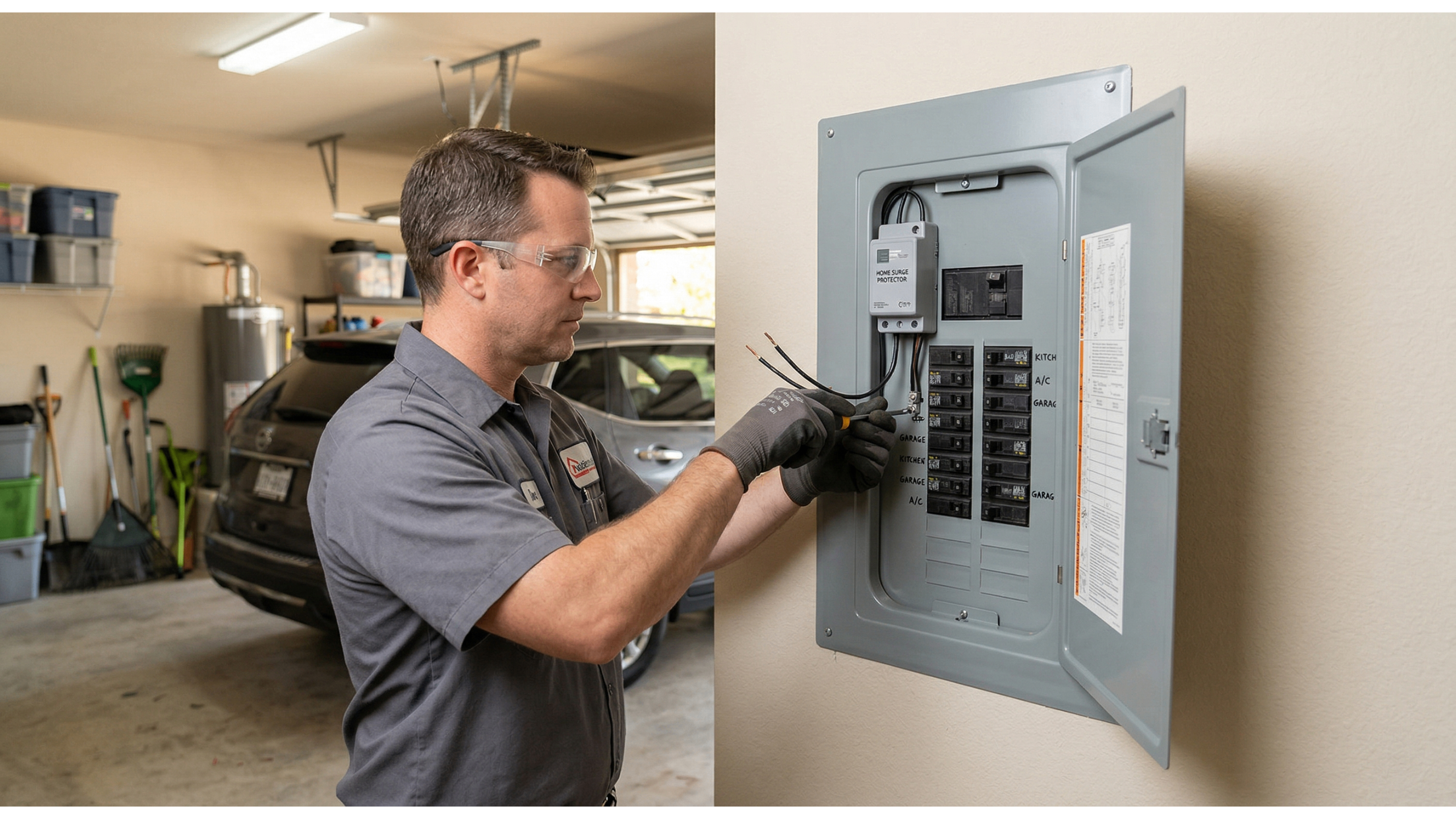
Professional installation by a licensed electrician typically costs $150-$350, depending on panel accessibility and local labor rates. The installation process involves connecting the surge protector to both legs of your electrical service with appropriate breaker sizing and ensuring proper grounding connections.
Installation time usually ranges from 30 to 60 minutes for straightforward installations where the electrical panel has available space and good access. More complex installations requiring panel modifications or addressing grounding issues may require additional time and cost.
Permit Fees Where Required
Permit requirements vary by municipality, but most North Texas cities don't require separate permits for adding surge protection to existing electrical panels. However, if the surge protector installation is part of larger electrical work requiring permits, it's included under the main permit.
When permits are required, fees typically range from $50 to $150, depending on local jurisdiction requirements. Some cities waive permit fees for certain electrical safety upgrades, recognizing the public benefit of improved electrical protection.
Red Flags in Pricing Over $800
Quotes exceeding $800 for basic surge protector installation should raise concerns unless significant additional electrical work is involved. Some contractors inflate pricing by bundling unnecessary services or using premium units with features that don't provide proportional value.
Be particularly wary of companies emphasizing "connected equipment warranties" rather than technical specifications. These warranties, often touted at $25,000 to $75,000 in coverage, are extremely difficult to claim successfully and primarily serve as marketing tools rather than meaningful protection.
Protect Your North Richland Hills Home Before the Next Storm
With Texas's adopted electrical code requirements and the increasing frequency of both grid instability and severe weather events, whole house surge protection has evolved from optional upgrade to necessary home infrastructure. The combination of internal surge generation from modern appliances and external threats from lightning and grid switching creates a challenging environment for unprotected electronics.
Professional installation ensures code compliance and optimal protection for your investment in modern appliances and smart home technology. The relatively modest cost of surge protection installation provides insurance against thousands of dollars in potential appliance replacement and repair costs, while also meeting current electrical safety standards.
For North Richland Hills homeowners concerned about protecting their electrical investments, Epic Electrical provides professional whole house surge protector installation and electrical panel services throughout the DFW area.
Epic Electrical
City: North Richland Hills
Address: 7304 Hialeah Cir W
Website: https://epicelectrical.com/


Comments
Post a Comment