EV Charger Install? North Richland Hills Electrician Reveals Panel Upgrades
⚡ Key Takeaways
- Most North Richland Hills EV installations require panel assessment — Level 2 chargers demand 48 amps continuous load, which under NEC's 80% rule needs a 60-amp breaker and #6 wire in a dedicated circuit.
- Smart load management like Emporia's PowerSmart can sidestep expensive panel upgrades — by monitoring home electrical demand in real-time and throttling charger output to prevent overloads.
- Texas heat creates unique wiring requirements — attic temperatures exceeding 140°F demand THHN wire in conduit rather than standard Romex to maintain ampacity ratings.
- Federal tax credits expire June 30, 2026 — eligible homeowners can claim 30% of installation costs up to $1,000, making timing critical for budget-conscious installations.
Installing an EV charger in North Richland Hills sounds straightforward until the electrician mentions your electrical panel. Suddenly, what seemed like a simple plug-and-play upgrade becomes a discussion about amp ratings, load calculations, and potentially thousands in panel upgrades.
The reality is that most Level 2 EV charger installations trigger legitimate questions about electrical capacity. A 48-amp charger doesn't just need an outlet — it demands a dedicated 60-amp circuit that many older homes can't support without modifications. But before assuming a costly panel upgrade is inevitable, homeowners need to understand both the requirements and the alternatives.
Why Most North Richland Hills EV Installs Trigger Panel Questions
The electrical demands of Level 2 EV charging catch many North Richland Hills homeowners off guard. Unlike plugging in a phone charger, a Level 2 unit pulls serious power — typically 40 to 48 amps continuously for hours at a time. This isn't a brief spike like a microwave starting up; it's sustained electrical demand that your home's panel must handle safely night after night.
Many homes built before 2000 in the North Richland Hills area came with 100-amp or 125-amp electrical service. These panels were sized for the electrical needs of their era — before multiple large-screen TVs, gaming systems, and now electric vehicles became standard household loads. Adding a major new electrical demand often pushes these systems beyond their comfort zone.
The question isn't whether your lights will dim when the charger kicks on. The real concern is whether your electrical system can handle the additional load safely and reliably for the next 15-20 years. Understanding the full electrical impact of home EV charging in Texas helps homeowners make informed decisions about their installation approach.
Level 2 Chargers Demand Serious Electrical Capacity
Level 2 charging operates at 240 volts and typically draws between 32 and 48 amps. For perspective, this is comparable to running an electric dryer continuously for 4-6 hours every night. The difference is that unlike a dryer, which cycles on and off, an EV charger maintains steady power draw until the battery reaches its set charge level.
The 80% Load Rule Creates Panel Pressure
The National Electrical Code requires continuous loads — anything running for three hours or more — to operate at no more than 80% of a circuit's rated capacity. This means a 48-amp EV charger requires a minimum 60-amp breaker and appropriately sized conductors. The math is straightforward: 48 amps ÷ 0.8 = 60 amps minimum breaker size.
This 80% rule exists for safety, preventing circuits from operating at full capacity for extended periods. Heat buildup in electrical connections operating near maximum capacity can lead to premature failure or worse. For EV charging, which happens regularly and predictably, this safety margin becomes critical.
When 100-Amp Service Sometimes Falls Short
A 100-amp main panel theoretically provides 24,000 watts of capacity (100 amps × 240 volts). However, the practical reality is more complex. The main breaker, HVAC systems, water heater, and other major appliances already consume significant portions of this capacity. Adding a 60-amp EV charger circuit can push the total demand beyond safe operating limits.
The load calculation involves more than simple addition. Air conditioning systems, which are necessary in North Texas, can draw 30-50 amps during peak summer operation. When combined with normal household loads and EV charging, many 100-amp panels approach or exceed their safe capacity during high-demand periods.
Texas Heat Makes Wire Sizing Critical
North Texas attic temperatures regularly exceed 140°F during summer months, creating challenges for electrical wiring. Standard NM-B cable (Romex) has thermal limitations that reduce its current-carrying capacity when surrounded by hot insulation. Professional installations use #6 THHN wire in conduit, rated for 90°C operation, to maintain full ampacity in these extreme conditions.
This isn't just about meeting code requirements — it's about ensuring the circuit will perform reliably for decades. Wire that's undersized for the thermal environment may work initially but develop problems over time as insulation degrades or connections loosen due to thermal cycling.
Emporia's PowerSmart Load Management Sidesteps Many Upgrades
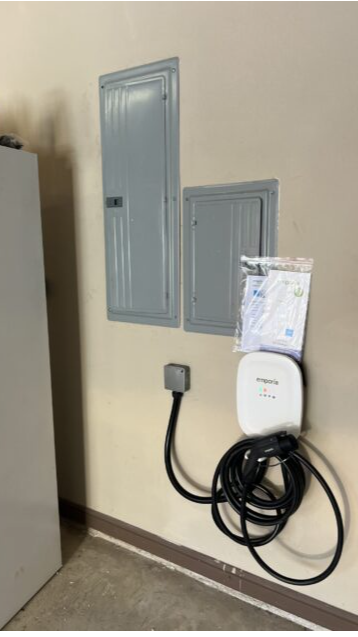
Smart load management represents a significant advancement in home electrical management. Rather than simply adding another large load to an already-stressed panel, these systems actively monitor and control electrical demand to prevent overloads. Emporia's PowerSmart technology has emerged as a particularly effective solution for homes where traditional panel upgrades would be costly or impractical.
How Vue Energy Monitor Tracks Real-Time Home Consumption
The Emporia Vue Energy Monitor installs directly in the main electrical panel and measures power consumption across all circuits with real-time monitoring precision. This isn't simple on/off monitoring — it's continuous measurement of actual power draw with millisecond precision. The system tracks everything from HVAC cycling to oven preheating, creating a real-time picture of home electrical demand.
This data feeds directly to the Emporia Pro EV charger via Wi-Fi connection. The charger constantly adjusts its output amperage based on total home load, ensuring the combined demand never exceeds the panel's safe capacity. When the air conditioning kicks on during a hot Texas evening, the charger automatically reduces its output. When household demand drops overnight, the charger increases to full capacity.
NEC-Approved Alternative to Traditional Panel Upgrades
The National Electrical Code explicitly permits energy management systems under Articles 625.42(B) and 750.30. These provisions allow total connected loads to exceed service capacity as long as an approved energy management system ensures actual demand stays within safe limits. This isn't a workaround or code interpretation — it's a recognized and approved method for managing electrical loads.
For many North Richland Hills homes with 100-amp or 125-amp service, this approach can eliminate the need for a costly service upgrade. The PowerSmart system effectively creates dynamic load management, allowing homes to support Level 2 EV charging without the expense and complexity of panel replacement.
Panel Upgrade Costs vs. Load Management Solutions
The financial impact of different approaches varies significantly. Traditional panel upgrades involve not just the panel itself, but often service entrance modifications, permits, inspections, and potential utility coordination. Smart load management systems offer a different cost structure with their own benefits and limitations.
200-Amp Service Upgrade Pricing in DFW
Upgrading to 200-amp service in the Dallas-Fort Worth area typically costs between $2,800 and $3,800, including materials, labor, and permits. This price assumes standard installation conditions — accessible panel location, adequate clearances, and no complications with the utility connection. Factors that can increase costs include panel relocations, service entrance upgrades, or requirements for trenching new utility connections.
The upgrade process usually takes 1-2 days and requires temporary power disconnection while the new service is installed. Most installations also require utility coordination to disconnect and reconnect service at the meter, which can add scheduling complexity but typically doesn't increase the total cost significantly.
Federal Tax Credits Expire June 30, 2026
The federal Alternative Fuel Vehicle Refueling Property Credit (30C) provides significant savings for eligible installations. Homeowners in qualifying low-income or non-urban census tracts can claim 30% of combined hardware and installation costs, up to $1,000 maximum credit. This credit applies to both the charging equipment and professional installation labor.
The June 30, 2026 expiration date makes timing significant for homeowners considering EV charger installation. After this date, federal tax incentives for residential charging equipment are scheduled to disappear entirely. For a typical installation costing $2,000-$3,000, this represents $600-$1,000 in lost savings for qualifying homeowners.
When Upgrades Remain Unavoidable
Smart load management isn't a universal solution. Homes with service entrance conductors rated below 100 amps require physical upgrades regardless of management technology. Similarly, homes with recalled panel brands like Federal Pacific or Zinsco need replacement for safety reasons before adding any significant new loads.
Wi-Fi dependency also creates limitations. If the home's internet connection fails, Emporia's PowerSmart system may reduce charging speed until connectivity is restored. While this prevents safety issues, it can significantly reduce charging speed during outages.
North Richland Hills Code Requirements Shape Installation
Local electrical codes and inspection requirements significantly impact EV charger installation approaches. North Richland Hills follows Texas state electrical codes with some local modifications that affect both permitting and installation methods.
Permit Requirements for New 240V Circuits
Installing a dedicated 240-volt circuit for EV charging requires an electrical permit in North Richland Hills, as it does in most Dallas-Fort Worth municipalities. The permit process ensures installations meet current electrical codes and safety standards. Permit fees typically range from $50 to $175, depending on the specific municipality and complexity of the installation.
The permitting process also requires a licensed electrician to sign off on the installation and coordinate required inspections. While this adds some complexity and cost, it ensures the installation meets all safety requirements and won't create issues for homeowner's insurance or future home sales.
Evolving GFCI Requirements for EV Charger Installations
NEC 2020 requires GFCI protection for 240-volt receptacles installed in garages, but this creates complications for EV charger installations. Both major charger brands include built-in ground-fault protection, which can conflict with external GFCI protection and cause nuisance tripping.
Professional installations typically hardwire the charger rather than using a plug-in connection. Hardwired installations are classified as "fixed equipment" rather than receptacle connections, allowing the use of standard 60-amp breakers without GFCI protection. This approach saves money on the breaker cost while improving reliability and maintaining code compliance.
Attic Temperature Derating Factors
Texas summer conditions require special attention to conductor ampacity corrections. When ambient temperatures exceed 86°F — a common occurrence in North Texas attics — electrical conductors must be derated according to NEC ampacity correction tables. This often means using larger conductors than the basic code minimum to ensure safe operation.
Professional installations account for these thermal conditions by using properly sized THHN conductors in conduit systems. This approach ensures the circuit maintains full capacity even when attic temperatures reach 140°F or higher during peak summer conditions.
Epic Electrical Delivers Code-Compliant EV Charging Solutions
The complexity of EV charger installation — from load calculations to local code compliance — requires experienced professional installation. Smart load management systems offer genuine alternatives to costly panel upgrades, but only when properly configured and installed. Similarly, traditional panel upgrades must be correctly sized and executed to provide reliable long-term service.
Professional installation ensures compliance with local codes, proper permit acquisition, and appropriate safety measures for North Texas conditions. The investment in quality installation pays dividends in reliability, safety, and peace of mind for years of EV charging.
Epic Electrical provides EV charging solutions throughout North Richland Hills, from smart load management installations to complete electrical panel upgrades, ensuring safe and code-compliant charging for every home.
Epic Electrical
City: North Richland Hills
Address: 7304 Hialeah Cir W
Website: https://epicelectrical.com/


Comments
Post a Comment